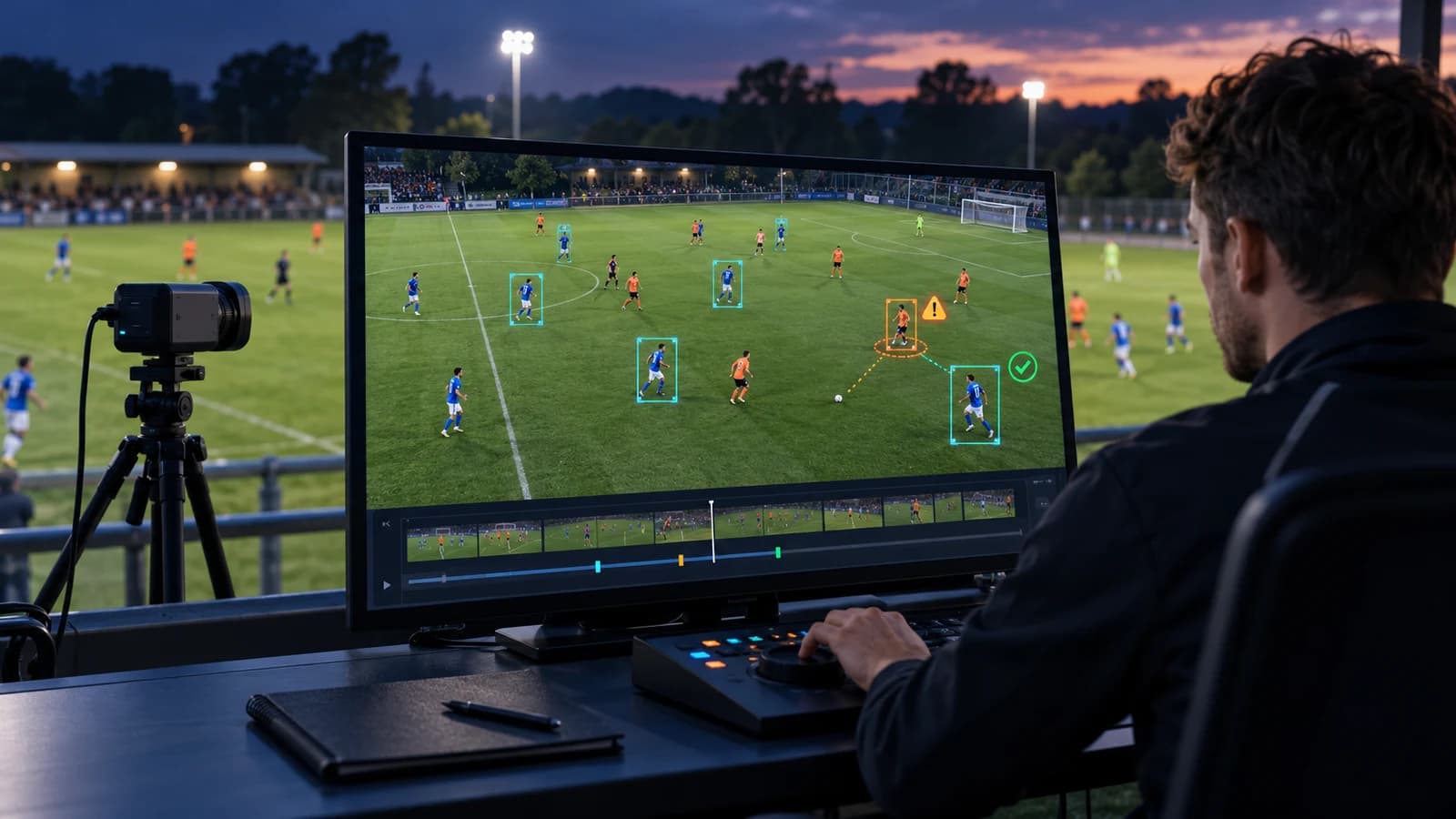
A professional club is not one customer for computer vision data. It is three. The coaching staff want to know why a defensive structure failed. Recruitment want to know whether a player in another league is worth the fee. The medical department want to know who is about to get injured. They look at the same footage and need different labels, different precision and different amounts of human review.
The examples below are from football, where the public research runs deepest, but the three-customer split holds in any club sport. Most tracking projects inside clubs stall because that distinction is skipped. A dataset built for tactical analysis gets handed to the medical team, who need joint angles it was never labelled for. This guide sets out what each department actually needs, and what published research says the data can and cannot support.
Key Takeaways
- Tactical models need unbroken identity more than they need precision. One dropped player ID corrupts the whole frame, not one player's row.
- Recruitment metrics from broadcast footage are possible but modest in effect. Scanning frequency, one of the best studied, showed only a small association with pass completion in Premier League players.
- Markerless pose estimation is reliable for sagittal joint angles and clearly unreliable for knee valgus, which is exactly the measure injury screening tends to want.
- Match the review depth to the decision. A transfer fee and a training-load tweak do not deserve the same QA.
Who actually consumes the data
| Department | The question | What the data must support | Cost of an error |
|---|---|---|---|
| Coaching and analysis | Why did that phase break down? | Continuous positions for all players, synchronised with events | A wrong conclusion about shape, repeated in team meetings |
| Recruitment | Is this player worth the fee? | Comparable metrics from other leagues' broadcast footage | A multi-million transfer built on a noisy metric |
| Medical and performance | Who is at risk, and is technique degrading? | Joint angles over time, in planes the method can actually measure | False reassurance, or flagging players who are fine |
The rest of this guide takes them one at a time.
Coaching: tactical models need unbroken identity
Pitch control models and spacing metrics are not tolerant of gaps. They need every player's position in every frame, because the model computes a property of the whole frame rather than of one player. If a player's identity is dropped during a goalmouth scramble, the model does not lose one row. It computes control of that area of the pitch as though a player were not there.
Pitch control is a model of which team would reach the ball first at each point on the pitch, built from every player's position at that moment. That is why identity persistence matters more to tactical work than pixel-perfect boxes. A box that is a few pixels loose changes almost nothing. A box attached to the wrong player after a collision changes who was where, which changes the conclusion.
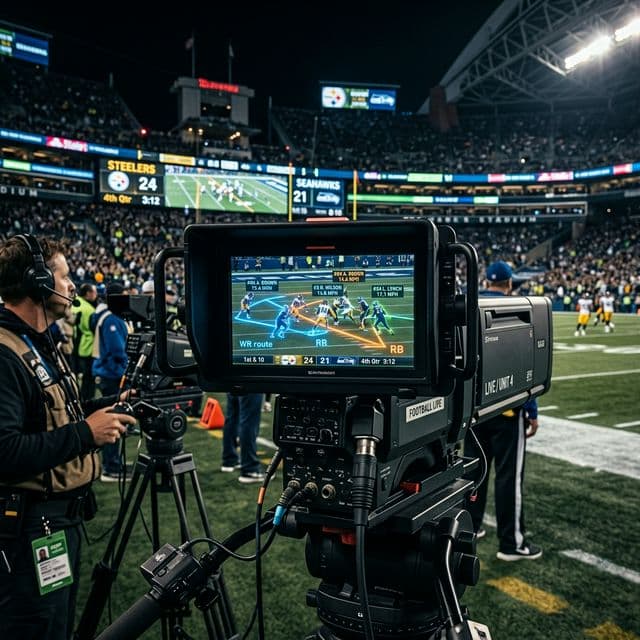
In the Premier League that work is done centrally: Genius Sports' technology "automatically captures real-time positional data on every Premier League player and the ball" (Genius Sports, October 2022). That page publishes no frame rate, camera count or skeletal detail, and the specifications quoted in secondary coverage are not confirmed there. Clubs below that tier, and any club analysing opponents in competitions without an official tracking feed, are working from broadcast video instead, where the camera pans and cuts and identity has to be reconstructed rather than received.
That reconstruction is its own discipline. Our guide to broadcast player tracking, court registration and re-ID covers how positions and identities are recovered from a moving camera, and why a benchmark baseline scores far below what a full-match analysis would need. For what the resulting tactical layer looks like in football specifically, see our guide to computer vision football and event AI.
Recruitment: what broadcast footage can honestly support
Broadcast footage can support some recruitment metrics, but the best-evidenced ones were not measured from broadcast, and the published effects are modest. Single numbers should not carry a transfer decision.
Scanning is the useful test case, because it is one of the most carefully studied behaviours in football and it cannot be read from positional data alone. A scan is defined as a player's active head movement where the face is temporarily directed away from the ball, to gather information before engaging with it. One study followed 27 professional players at an English Premier League club across 21 home matches and 9,574 individual ball possessions. More scanning was positively associated with pass completion, but the authors describe the effect as modest. Roughly 86% of players showed improved pass completion at higher scanning frequency, but the modelled effect was small (Jordet et al., Frontiers in Psychology, 2020).
How that data was produced matters more than the effect size. Eight trained coders marked the scans by hand, working from three dedicated 4K cameras and an automated close-up feed that kept the target player centred in frame. It was not a broadcast feed. Reading the same behaviour automatically, from broadcast, is two unvalidated steps beyond what the study demonstrates.
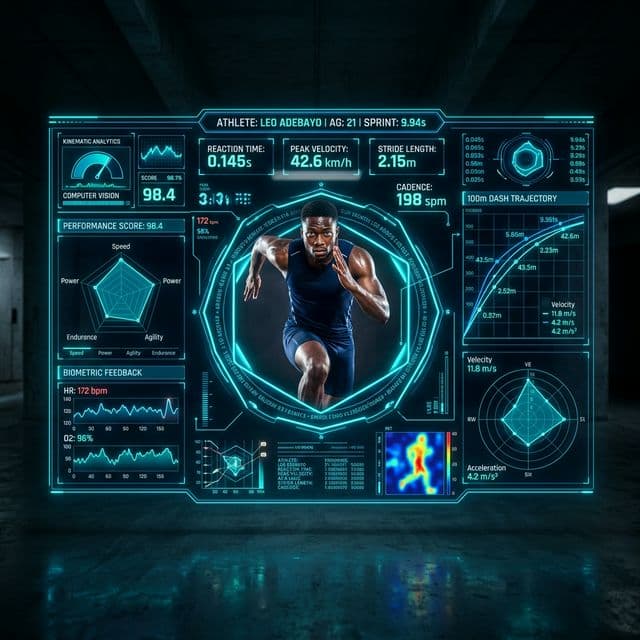 Metrics drawn from broadcast video need labels for head orientation, not just player position.
Two practical consequences follow. First, a metric like scanning needs head and body orientation labelled, which is a different and more expensive annotation task than tracking positions. Second, an effect that size is a supporting input to a recruitment decision, not a deciding one. Any vendor presenting a single broadcast-derived metric as a verdict is overselling what the research supports.
For what is realistic from ordinary footage at the amateur and academy end, see our guide to AI scouting from a phone camera.
Medical: what markerless pose estimation can measure
Markerless motion capture is now good enough for some joint measurements and clearly not good enough for others, and the difference matters most exactly where injury screening wants to look.
A 2026 systematic review in Sensors compared 3D markerless systems against marker-based reference systems across 11 studies. It concludes that several markerless systems can approximate marker-based measurements with acceptable accuracy for selected lower-limb joint angles and movement tasks. Root mean square errors generally fell between 2.5 and 9.6 degrees, and mean absolute errors were typically under 5 degrees for hip and knee. Sagittal plane motion, meaning flexion and extension at hip, knee and ankle, showed the strongest agreement. The review also reports reduced validity for coronal and transverse plane motion and for more complex or single-leg tasks, and singles out knee valgus as carrying substantial systematic error and variability (Chougule et al., Sensors, 2026).
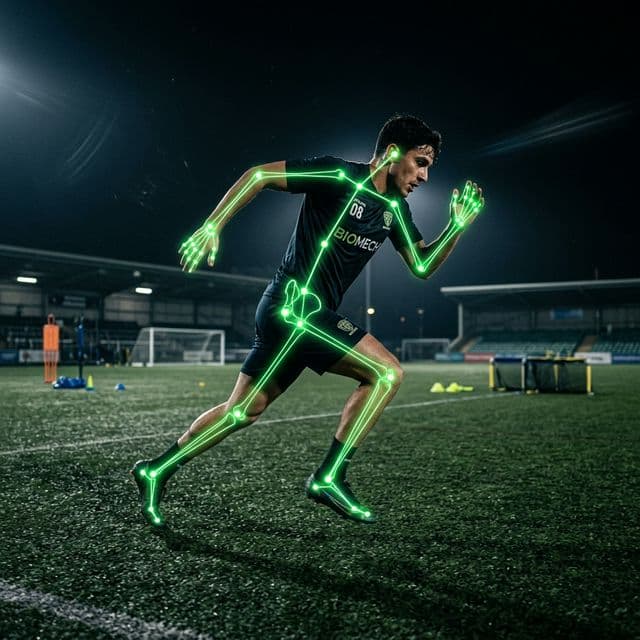 Dense keypoint labelling supports sagittal joint angles well; out-of-plane measures such as knee valgus are far less reliable.
Read that against what medical departments usually ask for. Knee valgus, the inward collapse of the knee, is a coronal-plane measurement, and the coronal plane is exactly where the review reports substantial systematic error. A more defensible use is tracking sagittal measures over time in the same camera setup, so a player is compared with their own earlier readings, though that is our inference rather than the review's finding: it tests agreement with marker-based systems, not reliability across repeat sessions. Building an injury risk score on markerless valgus from a training-ground camera is not supported by the evidence.
Where this touches annotation: keypoint tolerance has to be set per joint and per plane, and the guidelines need a rule for occluded joints. Our guide to computer vision in sports training covers the technique and load side, and skeletal keypoints versus bounding boxes covers choosing the label geometry in the first place.
Where human review belongs
Review depth should follow the cost of the decision, not be applied evenly.
- Tactical work needs identity audits above all: does a player ID survive contact, substitutions and camera cuts? An ID-persistence audit catches swaps that a frame-by-frame spot check will not.
- Recruitment needs cross-league consistency. The same definitions applied to a different broadcast style, with different camera work, or the comparison is meaningless.
- Medical needs per-joint tolerances and an explicit rule for what annotators do when a joint is hidden, because a guessed joint looks identical to a measured one downstream.
Our guide to measuring annotation quality sets out the metrics these audits use, including inter-annotator agreement and first-pass acceptance.
Frequently asked questions
What tracking data do clubs get automatically?
In leagues with an official tracking partner, positional data on every player and the ball is produced league-wide. Outside those competitions, and for opponent analysis in other leagues, clubs work from broadcast footage and have to derive positions themselves.
Can you get reliable physical metrics from TV footage?
Some, with care. Distances and speeds require the footage to be registered to the pitch, and derived behavioural metrics such as scanning need extra labels like head orientation. Published effect sizes for such metrics tend to be modest, so they belong alongside scouting judgement rather than replacing it.
Is markerless motion capture accurate enough for injury screening?
For sagittal joint angles, the evidence is reasonable, with mean absolute errors often under 5 degrees for hip and knee, and up to 5.4 degrees at the ankle. For knee valgus, which injury screening often targets, a 2026 systematic review reports substantial systematic error, so it is not a sound basis for a risk score on its own.
Why does one dropped player ID matter so much?
Because tactical models compute properties of the whole frame. Pitch control, spacing and defensive line metrics all assume every player is accounted for, so a missing or misattributed identity changes the output for the entire area, not one player's statistics.
Match the data to the decision it has to support
A club does not need one dataset. It needs labels that fit three different questions, with review depth matched to what each decision costs if it is wrong. The failures that waste budget are usually a mismatch: tactical data pressed into medical use, or a broadcast-derived metric asked to justify a fee it cannot support on its own.
If you need tracking with identity that survives contact and camera cuts, orientation labels for behavioural metrics, or per-joint keypoint tolerances for biomechanics, see Train Matricx pricing and the free pilot. We annotate a pilot clip on your own footage so the quality is measurable before any volume is agreed.

Client results

“Train Matricx didn't just provide labeling — they became an extension of our team. With 6K+ football matches annotated and counting at 98% accuracy, they are our premier data partner.”

Billy Brush
Founder & CEO, Dark Horse AI
Don't take our word for it. Test the labels.
Send us the footage your current vendor gets wrong — the occluded players, the motion blur, the edge cases. We annotate it and return a QA report you can check frame by frame.
- Your hardest clip, annotated in 48 hours
- Full QA report with per-frame accuracy
- No commitment, no contract, no card