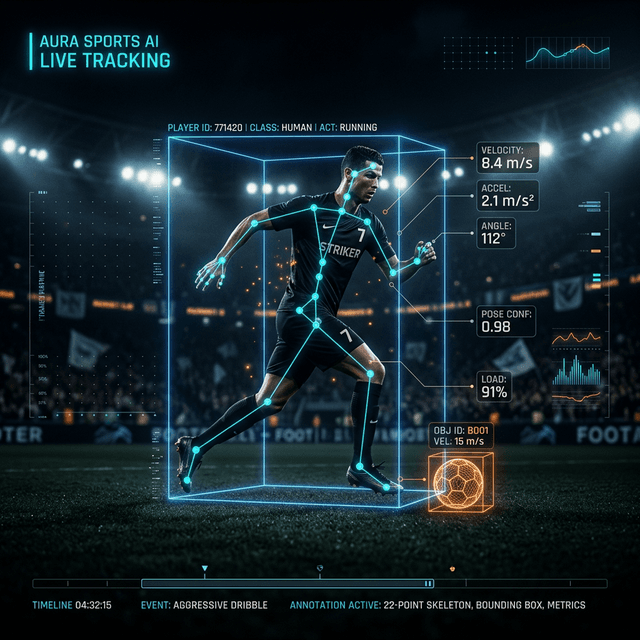
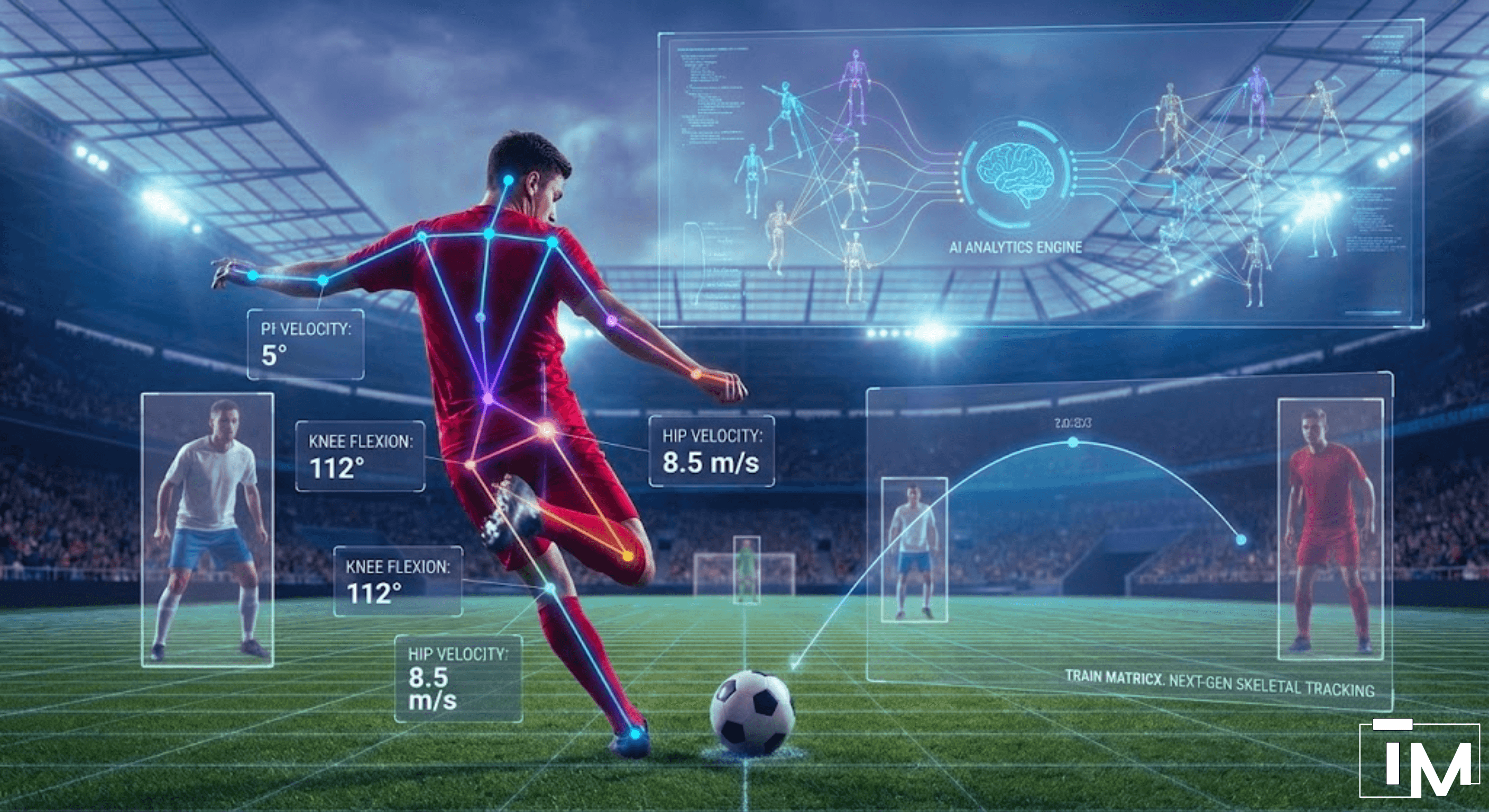
Introduction: The Evolution of Sports Computer Vision
In the rapidly accelerating field of sports analytics, the race to build the most accurate computer vision (CV) models is largely determined by one factor: the quality and granularity of Ground Truth training data. As AI moves from simple player detection to complex biomechanical analysis and automated broadcast generation, Data Scientists and CTOs are faced with a critical architectural decision: Should you rely on the speed of Bounding Boxes, or invest in the precision of Skeletal Tracking?
At Train Matricx, we annotate millions of frames of sports footage annually. We've seen firsthand how the choice of annotation taxonomy can either streamline a product roadmap or cause severe technical debt. In this guide, we break down the technical tradeoffs, computational costs, and ideal use cases for both methodologies in 2026.
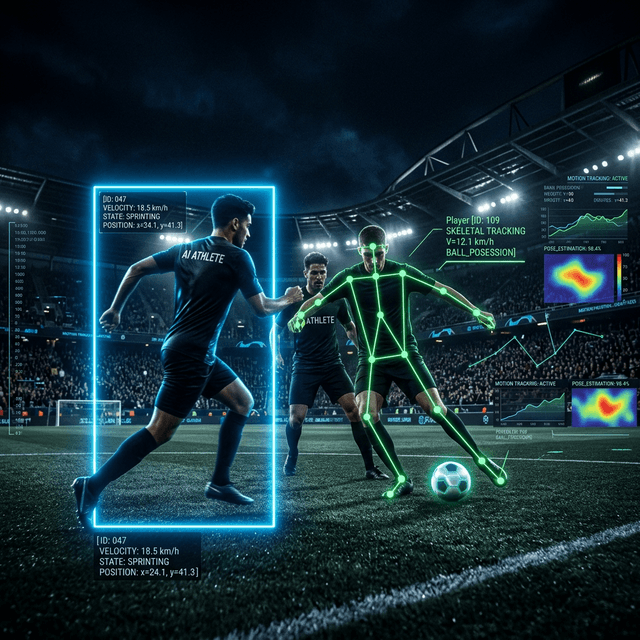 High-end visualization comparing standard bounding box tracking to continuous skeletal nodal tracking.
1. Bounding Boxes: The Foundation of Object Detection
Bounding boxes (2D or 3D cuboids) are the undisputed workhorses of modern computer vision. By defining the spatial extent of an object - specifically the x, y coordinates of the top-left corner alongside the width and height (w, h) - algorithms like YOLOv8 and Faster R-CNN can achieve real-time inference with relatively low computational overhead.
Technical Advantages
- Annotation Velocity: Drawing a bounding box takes a trained annotator fractions of a second. This enables the rapid ingestion of massive datasets - often millions of frames - required to train baseline detection models.
- Low Inference Latency: Models trained on bounding boxes process video feeds exponentially faster. If your edge device needs to run inference at 60 FPS in a live stadium environment, bounding boxes are often the only viable solution.
- Robustness to Resolution: Bounding boxes remain highly effective even in low-resolution or heavily compressed broadcast feeds where extracting fine details (like a player's hand position) is impossible.
The Problem of Occlusion
In sports like football or basketball, players constantly cross paths, block the camera's view, and cluster together. This creates massive issues for simple bounding box algorithms. When two players overlap, bounding boxes merge, leading to ID switching and target loss.
While advanced DeepSORT algorithms and transformer-based tracking models attempt to maintain ID persistence through occlusion, they are fundamentally limited by the lack of structural information provided by a basic rectangular coordinate system.
2. Skeletal Tracking: Biomechanical Precision
Skeletal tracking, also known as pose estimation, moves beyond simple localization. Instead of drawing a box around a player, annotators place precise keypoints (nodes) on the human body's anatomical joints - shoulders, elbows, wrists, hips, knees, and ankles. These nodes are then connected to form a wireframe skeleton.
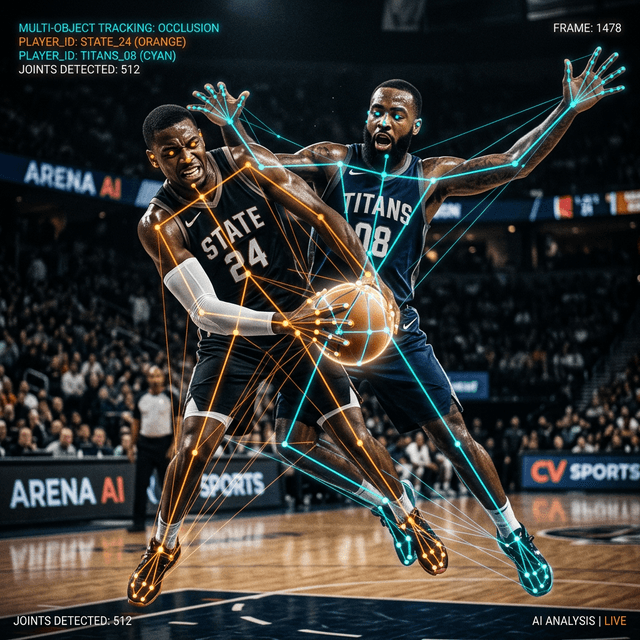 Dense keypoint annotation mapping a complex, multi-player mid-air collision in basketball.
The Complexity of Multi-Object Pose Estimation
Training a Multi-Person Pose Estimation (MPPE) model natively requires significantly more complex Ground Truth data. At Train Matricx, a standard skeletal annotation for a single player might involve 17 to 33 distinct keypoints per frame.
The immediate benefit of this granularity is structural awareness. A CV model trained on high-quality skeletal data doesn't just know where a player is; it knows what that player is doing.
Technical Advantages
- Solving the Occlusion Problem: Because skeletal tracking maps individual limbs, the model can infer the position of a hidden limb based on the visible joints and human anatomical constraints. If a player's torso is blocked by a defender, the algorithm can still track their visible legs and head, maintaining ID persistence through severe occlusion.
- Action Recognition: Bounding boxes only tell you a player is in the penalty box. Skeletal tracking tells you the player is extending their left leg at a 45-degree angle to intercept a pass. This level of semantic understanding is required for automated highlight generation, foul detection, and advanced tactical analytics.
- Biomechanical Analysis: For companies building injury prevention software or swing/form analysis tools (like in golf or baseball), skeletal tracking is non-negotiable. It provides the discrete spatial data required to calculate joint angles, velocity, and rotational force.
3. The Hybrid Approach: Combining Macros and Micros
In 2026, the most sophisticated sports AI platforms are eschewing the binary choice and instead adopting a hybrid annotation strategy.
Stage 1: The Macro Pipeline (Bounding Boxes) The initial layer of the neural network uses aggressively trained, highly optimized bounding box models to run rapid inferences across the entire ultra-wide pitch camera feed. This computationally cheap layer crops the video feed into smaller "regions of interest" containing the players.
Stage 2: The Micro Pipeline (Skeletal Tracking) Once the players are localized by the macro pipeline, a heavier, secondary pose-estimation network is applied only to those cropped regions. This conserves immense GPU resources while still extracting the granular biomechanical data needed for advanced analytics.
However, training a hybrid model requires a dual-annotated dataset - video frames that feature both pixel-perfect bounding boxes and strictly enforced skeletal keypoints. Quality assurance becomes paramount; if the bounding box data drifts, the secondary skeletal tracking model receives faulty inputs.
Public datasets can seed the first version of such a model. Our guide to public sports computer vision datasets covers which ones include athlete keypoints, and what their licences allow.
Conclusion: Partnering for Precision
The decision between bounding boxes and skeletal tracking dictates the capabilities of your final product. Simple tracking apps can survive on bounding boxes, but if you are building the next generation of automated broadcast analytics or biomechanical performance software, you must conquer skeletal tracking.
Generating thousands of hours of 33-point skeletal Ground Truth data is a logistical nightmare. It requires annotators with deep domain expertise, strict adherence to anatomical structures, and a multi-layered QA process to catch coordinate drift before it poisons the dataset.
At Train Matricx, we specialize in the high-fidelity annotation that standard outsourcing firms cannot handle. Whether you need 5 million rapid bounding boxes or 50,000 frames of densely occluded, 33-point skeletal mappings for your new basketball algorithm, our managed teams deliver the quality your models require.
Book a Free Proof of Concept Call Today and let us analyze your sports video data pipeline.

Client results

“Train Matricx didn't just provide labeling — they became an extension of our team. With 6K+ football matches annotated and counting at 98% accuracy, they are our premier data partner.”

Billy Brush
Founder & CEO, Dark Horse AI
Don't take our word for it. Test the labels.
Send us the footage your current vendor gets wrong — the occluded players, the motion blur, the edge cases. We annotate it and return a QA report you can check frame by frame.
- Your hardest clip, annotated in 48 hours
- Full QA report with per-frame accuracy
- No commitment, no contract, no card