Introduction
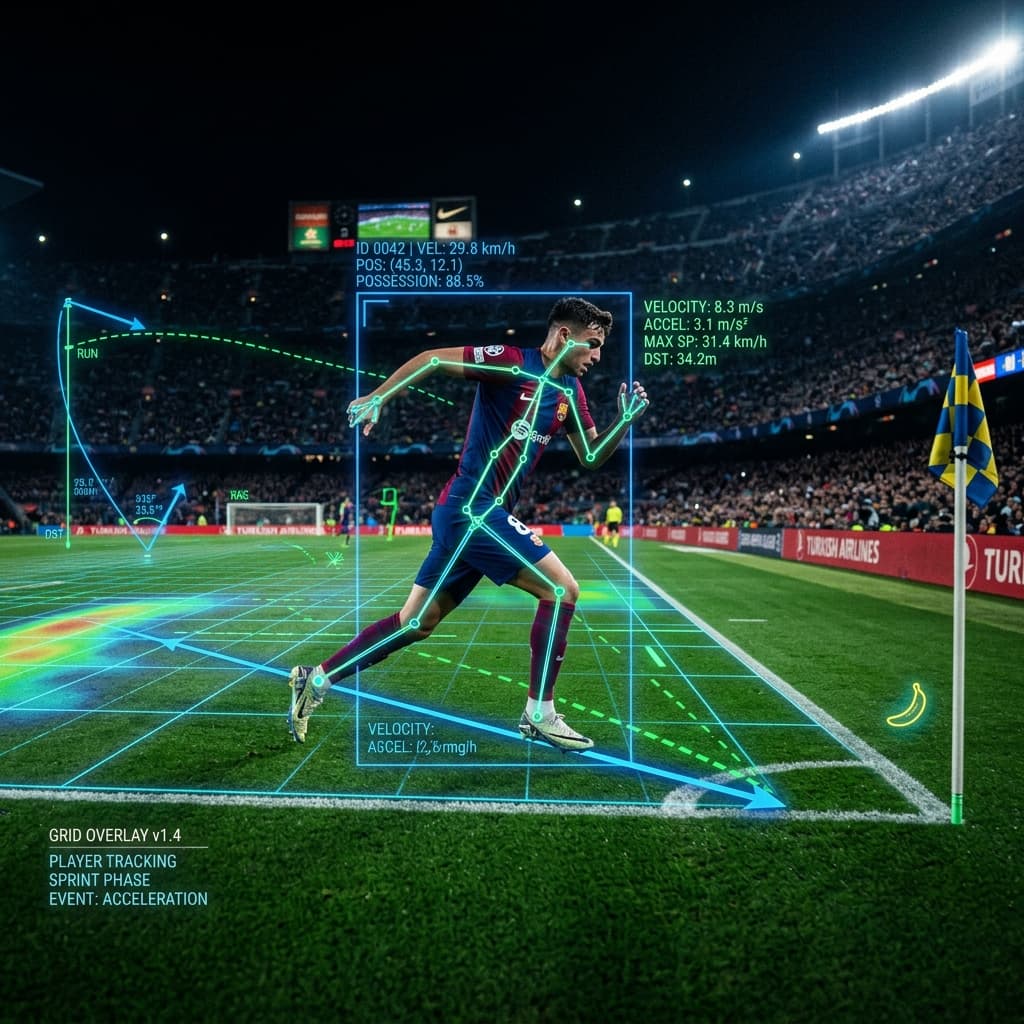
Computer vision football systems turn match footage into structured tactical data. They detect players, track the ball, follow movement, map body posture, classify events and create insights for coaches, clubs, broadcasters and AI product teams. What each department inside a club needs from that output, and what the published evidence supports, is covered in what each club role needs from the data. In football, this matters because the game is fluid. The most important actions often happen away from the ball. Defensive shape, pressing triggers, player orientation, offside structure, passing lanes and recovery runs all influence performance.
Traditional football analysis often depends on manual video review and event tagging. Computer vision extends that process by converting video into scalable data. A model can learn to recognize players, track identities across frames, detect passes, classify tackles, measure spacing and connect player movement to tactical outcomes.
However, football is also difficult for AI. Players overlap. Jerseys are similar. The camera pans quickly. The ball can disappear behind legs. A single possession may involve multiple micro-events before the visible shot or goal. This means football computer vision requires precise training data, not generic labels.
Train Matricx provides managed annotation and sports AI training data through Train Matricx. The company already covers football-specific tracking in Mastering Football AI Tracking: Implementing 22-Point Skeletal Data & Complex Event Recognition. This blog expands the topic for the query "computer vision football" and explains the full data pipeline behind football AI tracking and tactical event recognition.
What computer vision means in football
Computer vision in football means using AI models to extract structured information from video. The model may identify players, referees, ball, pitch lines, goals and other objects. It may track each player's position across the match. It may estimate body posture. It may recognize events such as passes, shots, tackles, fouls, offsides and interceptions.
The output can support several use cases. Clubs may use it for tactical analysis, scouting, player development and opponent reports. Sports tech companies may use it for automated camera systems, tracking products, coaching apps or performance dashboards. Broadcasters may use it for AR graphics, speed overlays, player trails and automated highlights. AI labs may use football as a test case for multi-object tracking, pose estimation and action recognition.
The common requirement is clean ground truth data. Football AI models do not learn the game from raw video alone. They learn from labeled examples that show what objects are present, how those objects move and what events occur.
Player detection: the foundation layer
The first layer of football computer vision is player detection. A model must locate every player in the frame, even when players are far from the camera, partially hidden or visually similar to teammates.
Bounding boxes are often used for this task. A box around each player helps the model learn where athletes appear in different camera conditions. However, bounding boxes have limits. A box says where the player is, but not how they are positioned, which direction they are facing or whether they are preparing to pass, shoot, sprint or defend.
Detection data should include additional context where possible. Team labels, jersey numbers, player roles, occlusion status and camera angle labels can make the dataset more useful. For football, the model must learn to distinguish players from referees, coaches, substitutes and spectators near the pitch.
Train Matricx explains the difference between simple detection data and richer pose data in Skeletal Tracking vs. Bounding Boxes in Sports AI. Football projects often need both. Bounding boxes help with object location. Skeletal tracking helps with movement interpretation.
Player tracking and identity persistence
Player tracking connects detections across time. This is one of the most important parts of football AI because football analysis depends on movement patterns. A team cannot measure pressing intensity, defensive line height, compactness, overloads or transition speed unless player identities remain stable.
Identity persistence is hard in football. A winger may sprint behind a fullback and disappear from the camera for several frames. Two midfielders may cross paths while wearing similar kits. A player may move out of frame and return later. Broadcast footage may cut from a wide camera to a close-up, then back to the tactical view.
If the model switches identities, the dataset becomes unreliable. A heat map may assign movement to the wrong player. A sprint metric may be inflated or split. Tactical shape may become distorted. Event attribution may attach a pass or tackle to the wrong athlete.
Training data should include clear rules for player ID continuation, occlusion handling and re-identification. Annotation teams should review sequences, not isolated frames. A frame may look correct on its own while the tracking identity is wrong across the play.
Ball tracking in football
The ball is the center of football events but one of the hardest objects to track. It is small, fast and often hidden by players. During a pass, the ball may blur across frames. During a crowded penalty-box sequence, it may be visible only briefly. During long passes, the camera may move while the ball changes height and direction.
Football ball tracking data may include bounding boxes, center-point keypoints, possession labels and contact events. The exact moment of contact matters for passes, shots, deflections and clearances. A model that learns approximate ball position may be acceptable for some analytics, but not for high-precision tactical or broadcast use cases.
Ball tracking becomes more powerful when linked to player tracking and event logs. The model should know who touched the ball, when the touch happened, what action occurred and what result followed. This converts movement data into football intelligence.
Skeletal tracking and player intent
Football AI becomes more useful when it can interpret body mechanics. A bounding box can detect a player, but a skeleton can show posture, balance, orientation and movement pattern.
Skeletal tracking maps key body points across frames. In football, this may include head, shoulders, elbows, wrists, hips, knees, ankles and feet. With this data, models can learn body orientation, stride pattern, kicking mechanics, defensive stance and acceleration cues.
This matters for player intent. A midfielder opening their hips before receiving the ball may signal a forward pass. A defender's body angle may indicate whether they are forcing the attacker inside or outside. A striker's shoulder position may indicate a timed run behind the defensive line.
Skeletal tracking also supports biomechanics and injury risk workflows. Clubs can analyze running mechanics, landing patterns, asymmetry, deceleration and fatigue signals. These use cases require consistent keypoint labels. Inconsistent keypoint placement creates unstable biomechanics data.
Train Matricx's football article, Mastering Football AI Tracking, is a useful resource for this section because it focuses directly on 22-point skeletal data and complex event recognition.
Event logging: teaching the model football language
Football is not a sequence of random movements. It is a rule-based and tactical game. Event logging connects video to football language.
Common football event labels include pass, shot, cross, dribble, tackle, interception, clearance, foul, save, block, corner, throw-in, offside, pressure and possession recovery. Advanced labels may include through-ball, progressive pass, cutback, switch, pressing trigger, counter-press, overlap, underlap and defensive line break.
A good event taxonomy should define start and end points. For a pass, does the event start when the leg begins the kicking motion or when the foot contacts the ball? Does it end when the receiving player touches the ball or when the ball reaches the intended zone? These rules affect model training.
Event logging should also connect involved player IDs. A pass event should include passer, receiver, defensive pressure and outcome. A tackle should include tackler, ball carrier, contact timing, result and foul status. An offside event should connect attacker, last defender, ball release frame and receiving movement.
This level of structure requires football knowledge. A general video labeler may identify a kick. A football annotator can classify the play in a way that supports analytics.
If you are deciding who should produce that event data, our guide to football data tagging services compares data providers, in-house tagging, AI tools and tagging services.
Tactical AI: from labels to decisions
Tactical AI is the layer where computer vision football data becomes useful for decision-making. It transforms tracking and event data into patterns.
For clubs, tactical AI can support pressing analysis, chance creation, build-up structure, defensive compactness, transition behavior and opponent weaknesses. For scouting teams, it can quantify player tendencies, off-ball movement, body orientation and decision patterns. For coaching teams, it can compare training sessions to match performance.
For sports tech companies, tactical AI can become a product feature. A platform may generate automated reports, tag match clips, recommend training focus areas or help analysts search for specific patterns. For broadcasters, tactical AI can create visual explanations of pressing traps, passing lanes, runs and defensive shape.
These applications depend on accurate low-level data. If player IDs drift, event labels conflict or skeletal points are inconsistent, tactical outputs become unreliable. The model's decision layer is only as strong as the annotation layer below it.
Computer vision in sports training
The query "computer vision in sports training" connects directly to football practice environments. Training footage has different challenges from broadcast footage. It may use fixed cameras, drones, tactical cameras or phone recordings. There may be fewer visual overlays, but lighting, camera height and player identification can still vary.
Football clubs can use computer vision in training to track drill execution, workload, positioning, finishing mechanics, pressing intensity and tactical shape. Youth academies can use it to monitor development over time. Coaches can review whether players maintain spacing, receive with correct orientation or execute positional principles.
Training data for this use case needs session context. The model should know the drill type, field zone, involved players, event intent and expected pattern. This is different from labeling a match where the tactical context emerges from competition.
A managed data annotation partner can help convert training footage into labeled examples that match the club's internal methodology.
Data requirements for football AI teams
A football computer vision dataset may include:
- Player bounding boxes
- Ball position labels
- Referee and object labels
- Team and jersey metadata
- Persistent player IDs
- Occlusion status
- 17-point, 22-point or 33-point skeletal keypoints
- Event labels
- Tactical phase labels
- Camera angle and timestamp metadata
- Delivery in JSON, CSV, XML, COCO, YOLO or custom format
The exact data structure should be chosen based on the model objective. A player detection model does not need the same labels as a tactical event recognition model. A broadcast AR model does not need the same format as a club scouting dashboard.
Train Matricx's service model is relevant here because it emphasizes custom schemas and managed delivery through Train Matricx.
Conclusion
Computer vision football systems depend on accurate player tracking, ball tracking, skeletal data, event logging and tactical context. The value is not only in detecting objects. It is in understanding the game across time. This requires sports-specific training data, clear taxonomies and QA that checks both visual accuracy and football logic.
Train Matricx supports this pipeline by providing managed sports data annotation for football AI and related sports computer vision workflows. For additional context, read Mastering Football AI Tracking, Skeletal Tracking vs. Bounding Boxes in Sports AI and The Human Element.
FAQ
What is computer vision football? Computer vision football is the use of AI to understand football video. It can detect players, track the ball, follow movement, classify events and create tactical data from match or training footage.
How does football AI tracking work? Football AI tracking detects players in each frame and links the same identity across time. This enables heat maps, sprint metrics, tactical shape analysis, possession tracking and event attribution.
Why is computer vision in football difficult? Football includes constant movement, overlapping players, similar kits, camera panning, small ball visibility and complex tactical events. These conditions require sport-specific annotation and QA.
What data does a football computer vision model need? A football model may need player boxes, ball labels, player IDs, skeletal keypoints, event tags, team metadata, occlusion labels, camera metadata and custom output formats.
How does Train Matricx help football AI teams? Train Matricx provides managed football data annotation, player tracking, event logging, skeletal tracking and custom sports computer vision training datasets through Train Matricx.

Client results

“Train Matricx didn't just provide labeling — they became an extension of our team. With 6K+ football matches annotated and counting at 98% accuracy, they are our premier data partner.”

Billy Brush
Founder & CEO, Dark Horse AI
Don't take our word for it. Test the labels.
Send us the footage your current vendor gets wrong — the occluded players, the motion blur, the edge cases. We annotate it and return a QA report you can check frame by frame.
- Your hardest clip, annotated in 48 hours
- Full QA report with per-frame accuracy
- No commitment, no contract, no card