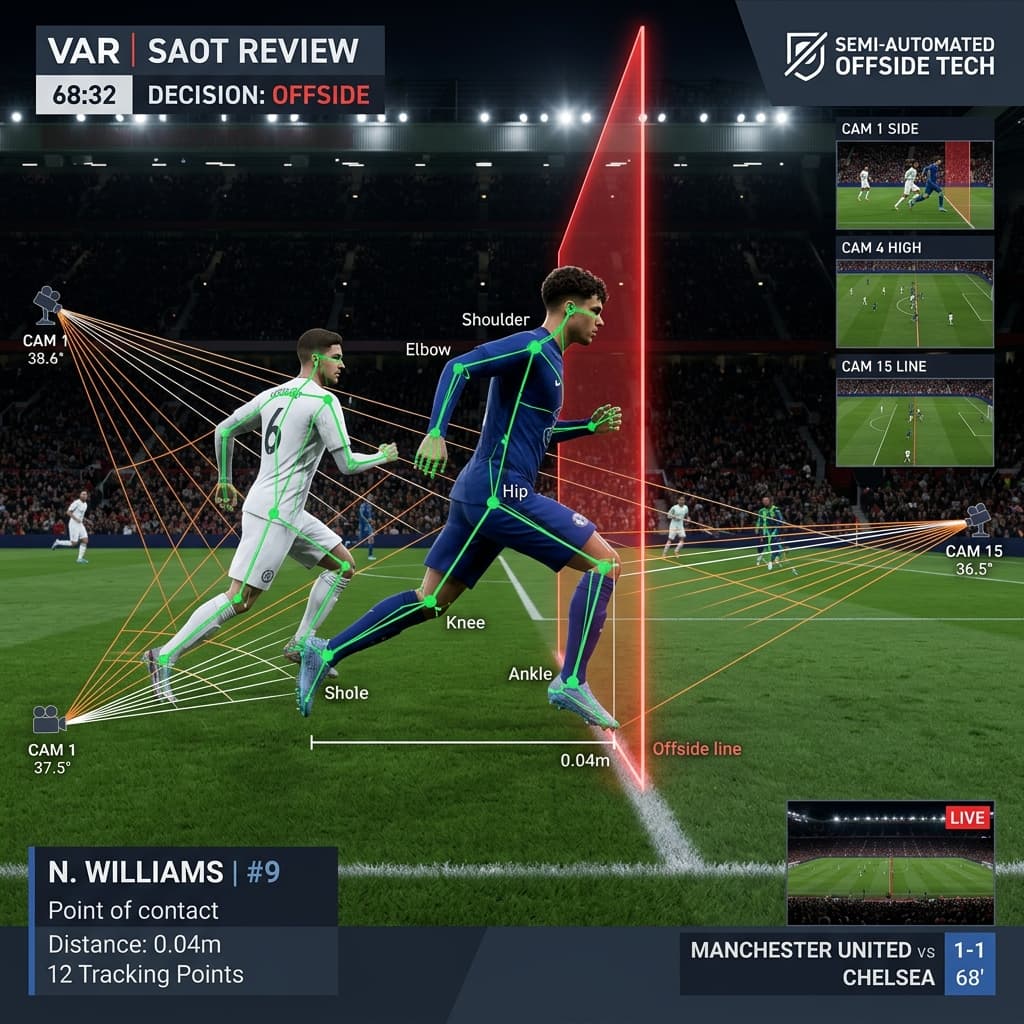
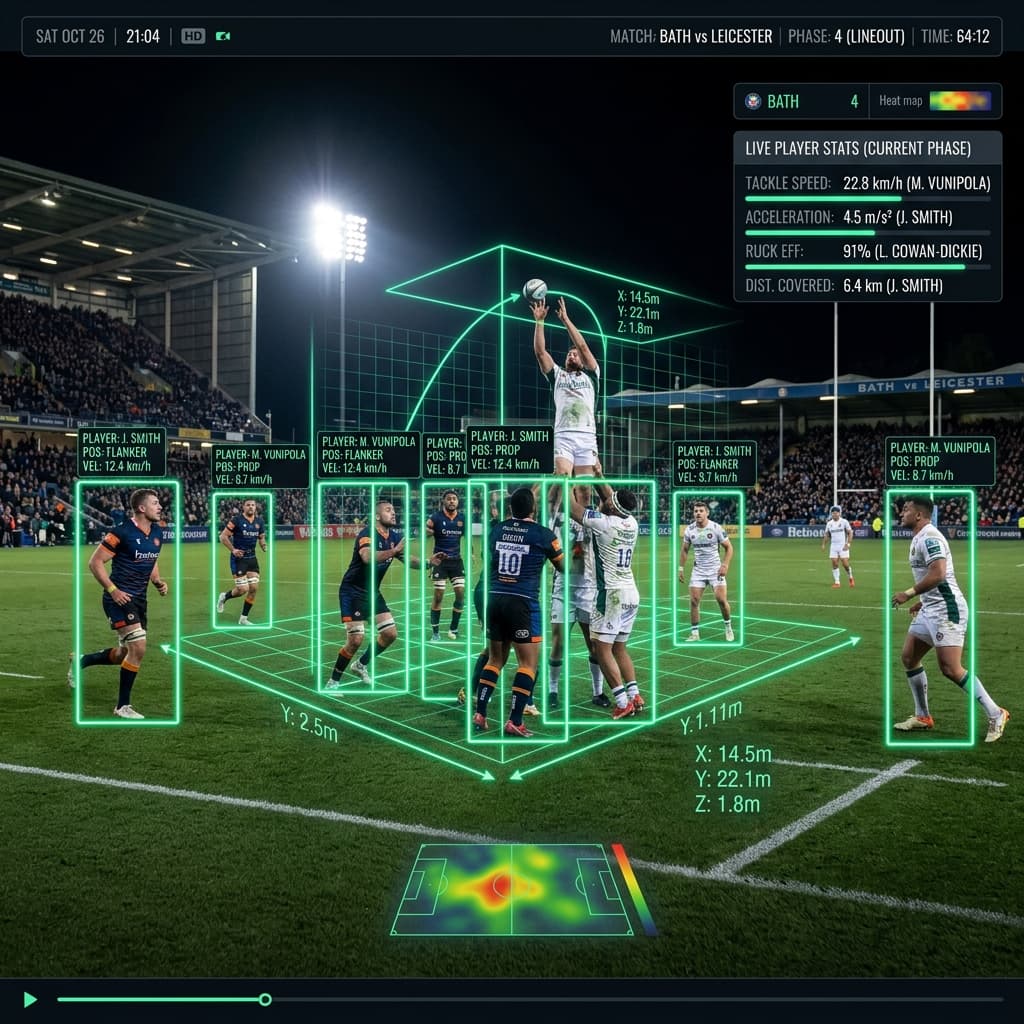
Scouting used to require a person in a stand with a notebook, or at best a club's own camera rig at its own facility. A growing wave of platforms now let an athlete record a drill on their own phone, anywhere, and get AI-driven feedback on technique, agility and power within minutes. No facility, no scout travel, no dedicated camera rig.
This is a genuine shift in how talent identification works, and it depends on solving a computer vision problem that's meaningfully different from tracking a professional match in a calibrated stadium.
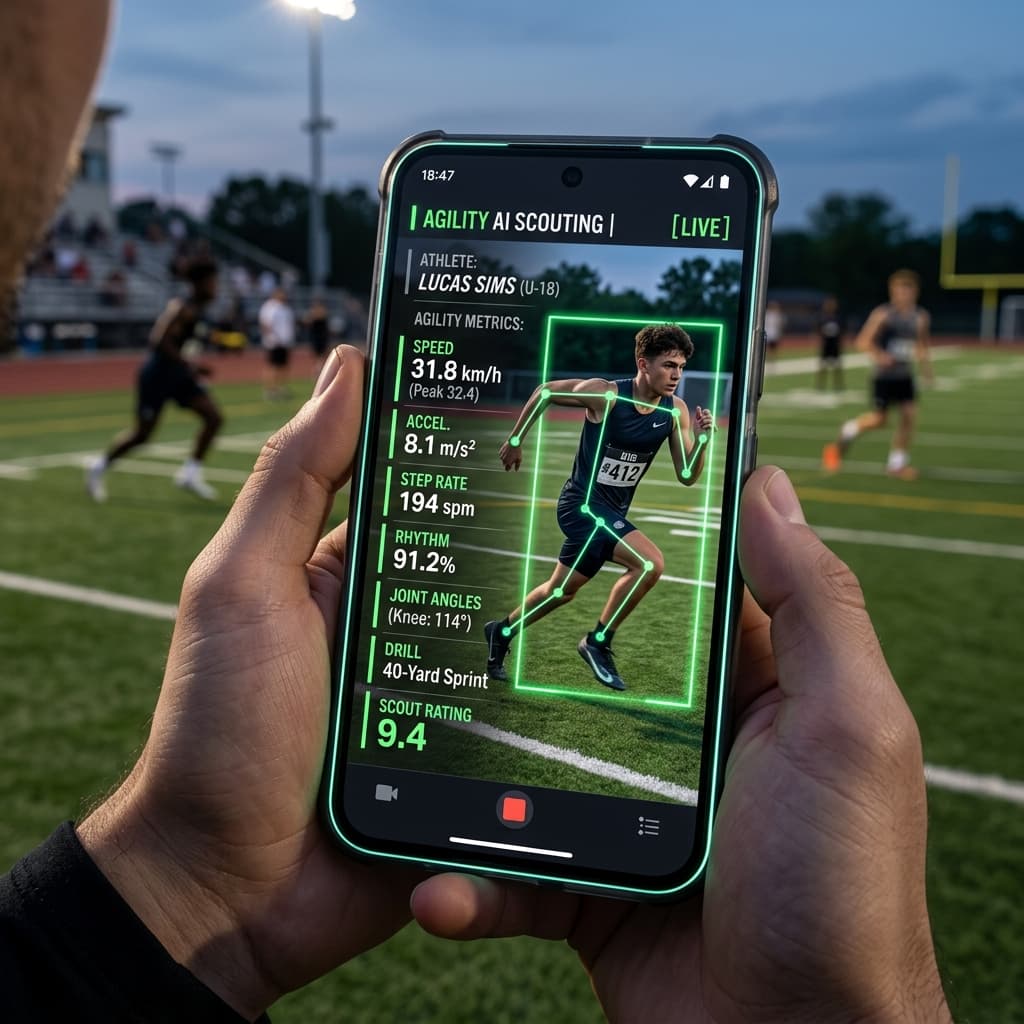 High-end technical visualization of remote AI scouting: an athlete performing a physical drill tracked on a mobile phone interface with pose keypoints and agility metrics.
What is remote computer vision scouting?
Remote computer vision scouting is the use of AI to analyse athlete performance, technique and physical attributes from self-recorded video, typically captured on a phone camera in an uncontrolled environment, without dedicated tracking cameras, calibrated multi-camera rigs or an in-person scout.
It's the same underlying computer vision discipline used in professional tracking systems, detection, pose estimation, event recognition, applied to a much harder input: single-camera, variable-quality, uncontrolled footage instead of a fixed multi-camera professional setup.
Why this is a harder computer vision problem than professional tracking
Single camera, no triangulation. Professional tracking systems use multiple calibrated cameras specifically so that positional and biomechanical measurements can be triangulated for accuracy, the same principle behind tennis line-calling and football's offside technology. A phone-recorded drill video has exactly one camera angle, with no second view to cross-reference or correct for perspective distortion. For what a club's own departments need from scouting data, and how strong the published evidence is, see what each club role needs from the data.
No camera calibration. A stadium tracking system knows exactly where every camera is positioned relative to the playing surface. A self-recorded video could be filmed from any distance, any height, any angle, often handheld, with no calibration data at all. Any measurement that depends on real-world scale, speed, jump height, stride length, has to be inferred without the reference points a calibrated system would normally rely on.
Wildly variable footage quality. Lighting, frame rate, resolution and stability differ from one submission to the next. A drill filmed in a school gym under fluorescent lighting on an older phone looks nothing like one filmed outdoors on a recent flagship phone in daylight. A model built for this use case has to perform reliably across that entire range, not just the clean conditions a professional broadcast camera guarantees.
Inconsistent framing and athlete positioning. Professional tracking cameras are fixed in position relative to a known playing surface. A self-recorded video might have the athlete entering and leaving frame, standing at inconsistent distances from the camera, or being filmed by someone who isn't a trained operator, introducing camera shake and framing errors a professional setup wouldn't have.
No guarantee of a single clean take. A facility-based assessment can be repeated until a clean recording is captured. A remote submission is often a single attempt at a drill, with whatever conditions existed at the time, which means the underlying model has to extract reliable signal from footage that would often be considered unusable input for a professional tracking system.
The four things remote scouting platforms actually measure
| Measurement | What it captures | Why it's harder from a single phone camera |
|---|---|---|
| Technique | Body mechanics during a specific skill or drill | Requires accurate pose estimation without multi-angle correction for perspective distortion |
| Agility | Change of direction speed, footwork patterns | Requires distance and speed inference without camera calibration or known reference points |
| Power | Explosiveness, jump height, acceleration | Requires scale inference from a single, often uncalibrated, camera view |
| Consistency | Repeatability of mechanics across multiple attempts | Requires comparing pose data across separate, independently filmed clips that may differ in framing |
Each of these is achievable with enough representative training data and the right model design, but each is also meaningfully harder than the equivalent measurement in a controlled, multi-camera professional environment.
How reference-point estimation works without calibration
The core technical challenge in remote scouting is recovering real-world measurements, distance, speed, height, from a single uncalibrated camera. This is typically solved through a combination of known reference objects and learned body-proportion models.
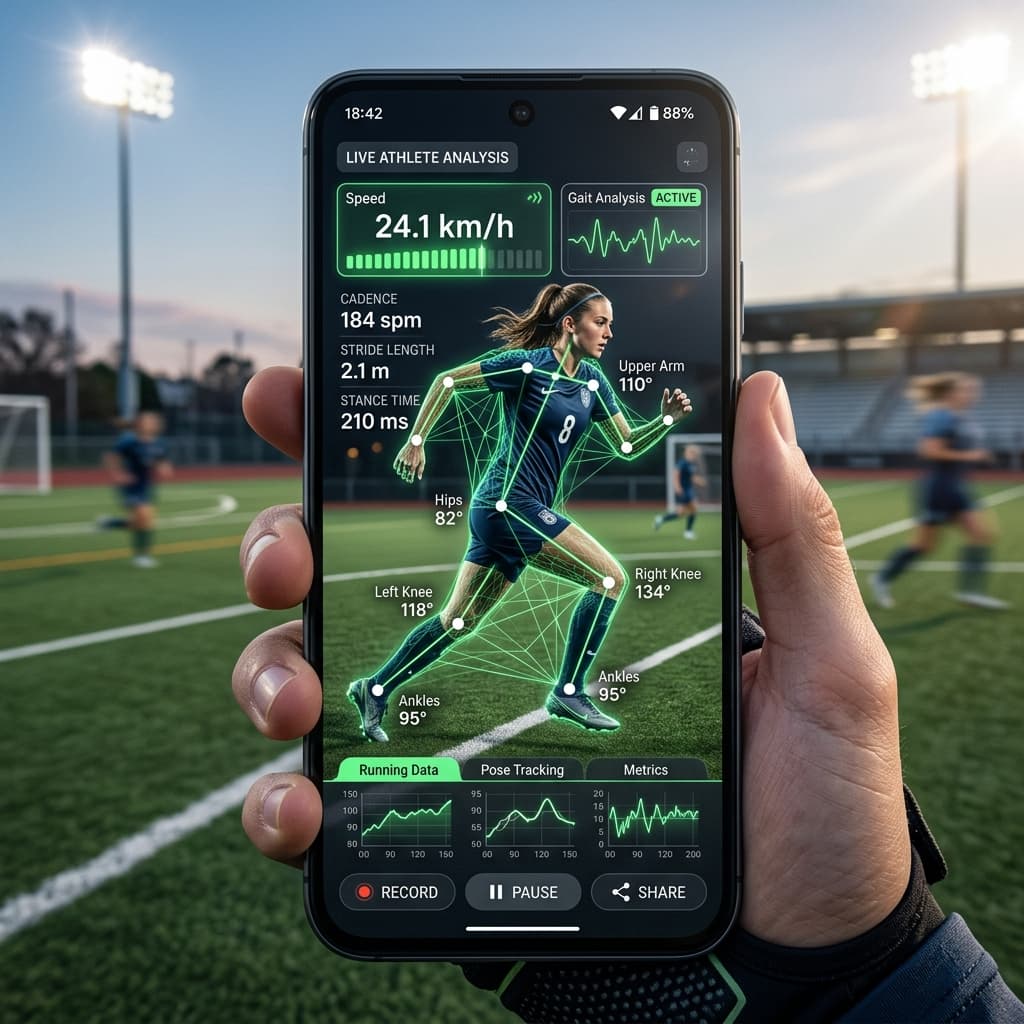 Smartphone-based athletic gait analysis demonstrating real-time joint angle calculations, stride length, and cadence tracking from a single camera angle.
Known object references. Some platforms ask athletes to place a reference object of known size in frame, a cone, a marked distance on a court, or even the dimensions of standard sports equipment, which gives the model a scale anchor it otherwise wouldn't have.
Body proportion estimation. Where no reference object is available, models can use learned relationships between body segment lengths, the kind of biomechanical priors used in pose estimation generally, to estimate scale from the athlete's own body, though this introduces more uncertainty than a true calibrated measurement.
Cross-clip consistency checks. Asking an athlete to perform a drill more than once and checking for measurement consistency across clips can flag unreliable footage before it produces a misleading assessment, an important quality control step given the highly variable nature of the input.
Annotated training data for this kind of model needs to deliberately represent the full range of these uncontrolled conditions, varied phone quality, varied lighting, varied framing, varied camera distance, rather than the relatively clean, consistent footage a professional tracking system would use to train on.
Why this matters: the democratization angle
The commercial significance of remote scouting isn't really the technology itself, it's what it makes possible. Talent identification has historically been bottlenecked by geography and cost: a scout can only physically attend so many events, and a facility-based assessment requires an athlete to already have access to that facility.
Remote computer vision scouting removes both constraints. An athlete training in a location with no professional scouting infrastructure nearby can submit footage and be assessed using the same underlying technology a professional academy might use, just adapted to work without the controlled environment. This is part of a broader trend of advanced sports analytics moving down-market, from exclusively elite, well-funded organisations to a much wider range of clubs, academies and individual athletes.
Where the accuracy trade-offs actually matter
Remote scouting platforms are not claiming to match the precision of a calibrated, multi-camera professional tracking system, and shouldn't be evaluated as if they do. The realistic value proposition is directional and comparative: identifying athletes worth a closer look, flagging technique patterns worth coaching attention, screening a large pool of submissions down to a smaller set worth deeper, in-person evaluation.
Understanding this distinction matters for how the underlying training data should be built. A model intended for sub-centimetre precision measurement needs training data and validation standards appropriate to that claim. A model intended for directional screening across a large volume of submissions has a different, still rigorous, but differently calibrated accuracy bar.
What training data remote scouting models need
Footage diversity as the primary requirement. Unlike professional tracking systems where footage conditions are relatively consistent, remote scouting models need training data that deliberately spans phone camera qualities, lighting conditions, framing styles and recording angles, because the deployment environment is inherently uncontrolled.
Pose and biomechanical annotation across varied body types and skill levels. Professional tracking datasets often skew toward elite athletes, since that's who professional cameras are pointed at. Remote scouting datasets need representation across a much wider range of ages, skill levels and body types, since the whole point of the use case is reaching athletes outside traditional pipelines.
Reference-point and scale-estimation labels. Where training data includes known reference objects or calibration markers, these need to be explicitly annotated so models can learn the relationship between visual cues and real-world scale.
Quality and reliability flags. Training data should include explicit labels for footage quality issues, motion blur, partial framing, inconsistent distance, so models can learn not just to make a measurement, but to flag when a given submission's quality is too poor to support a reliable one.
Frequently asked questions
What is remote computer vision scouting? Remote computer vision scouting uses AI to analyse athlete technique, agility and power from self-recorded video, typically captured on a phone camera without dedicated tracking infrastructure or an in-person scout. It applies the same underlying computer vision techniques used in professional sports tracking to much less controlled, single-camera footage.
How accurate is AI scouting from a phone video compared to professional tracking systems? Less precise than calibrated, multi-camera professional tracking systems, which is expected given the lack of camera calibration and triangulation. Remote scouting platforms are generally most useful for directional screening and flagging athletes or technique patterns worth closer evaluation, rather than producing measurement-grade precision.
How do these platforms measure speed and distance without calibrated cameras? Through a combination of known reference objects placed in frame, learned body-proportion estimation models, and cross-clip consistency checks, since a single uncalibrated phone camera has no inherent scale reference the way a professional multi-camera tracking system does.
Why is remote scouting considered part of the "democratization of analytics" trend? Because it removes the geographic and cost barriers that have historically limited talent identification to athletes near professional scouting infrastructure or well-funded academies. Advanced analysis tools that were previously exclusive to top-tier organisations are increasingly accessible to a much broader range of clubs and individual athletes.
What training data does a remote scouting AI model need? Footage that deliberately represents varied phone camera quality, lighting conditions, framing and recording angles, rather than the relatively consistent conditions of a professional camera rig. It also needs pose and biomechanical annotation across a wide range of skill levels and body types, since the use case is explicitly about reaching athletes outside traditional pipelines, not just elite performers.
Can remote scouting replace in-person scouting entirely? Not for final evaluation decisions. It's best understood as an expansion of the funnel, screening a much larger and more geographically diverse pool of submissions down to a smaller set that merits closer, often in-person, evaluation, rather than a full replacement for that final step.
What sports is remote computer vision scouting being used in? Primarily team sports with well-defined skill-based drills that translate reasonably well to a single camera angle, football, basketball and athletics-style speed and agility testing are common early use cases, though the underlying approach can extend to most sports with measurable technique or movement patterns.
Why can't existing professional tracking models just be reused for remote scouting? Because they're trained on fundamentally different input conditions, calibrated multi-camera footage with consistent quality, and don't generalise reliably to single-camera, uncalibrated, highly variable phone footage without retraining on representative data for that specific use case.
The takeaway
Remote computer vision scouting solves a real access problem in sports talent identification, but it does so by tackling a harder computer vision problem than professional tracking, no calibration, no second camera angle, and wildly inconsistent input quality. Getting it right depends on training data that's built specifically for that uncontrolled environment, not borrowed from a professional tracking system and assumed to transfer.
If you're building remote scouting or athlete assessment tools and need training data that represents real-world, uncontrolled footage conditions, see how Train Matricx works or review annotated dataset results in our case studies. We annotate a free pilot clip so you can evaluate quality before committing to any volume.

Client results

“Train Matricx didn't just provide labeling — they became an extension of our team. With 6K+ football matches annotated and counting at 98% accuracy, they are our premier data partner.”

Billy Brush
Founder & CEO, Dark Horse AI
Don't take our word for it. Test the labels.
Send us the footage your current vendor gets wrong — the occluded players, the motion blur, the edge cases. We annotate it and return a QA report you can check frame by frame.
- Your hardest clip, annotated in 48 hours
- Full QA report with per-frame accuracy
- No commitment, no contract, no card