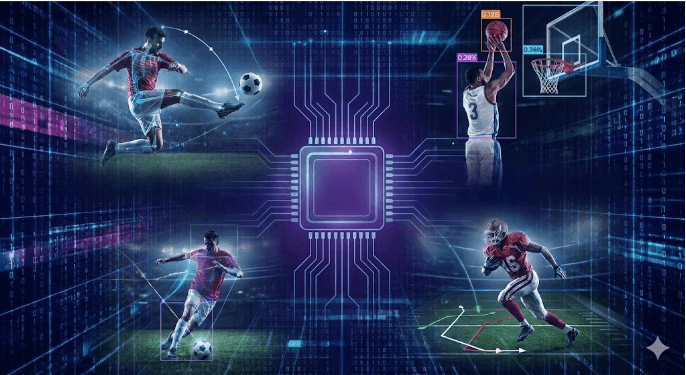
Most of the conversation around computer vision in sports focuses on match day — offside calls, player tracking, broadcast graphics. But the same technology is increasingly deployed during training sessions, and the use case is meaningfully different. A coach doesn't want to know where every player was on the pitch; they want to know whether a sprinter's hip drop on the left side is getting worse over six weeks, or whether a swimmer's catch angle is consistent across a 200m race pace set.
This guide covers what computer vision actually does during athlete training, why it's a harder problem in some ways than match-day tracking, and what the training data underneath these systems has to look like to work at the granularity coaching staff actually need.
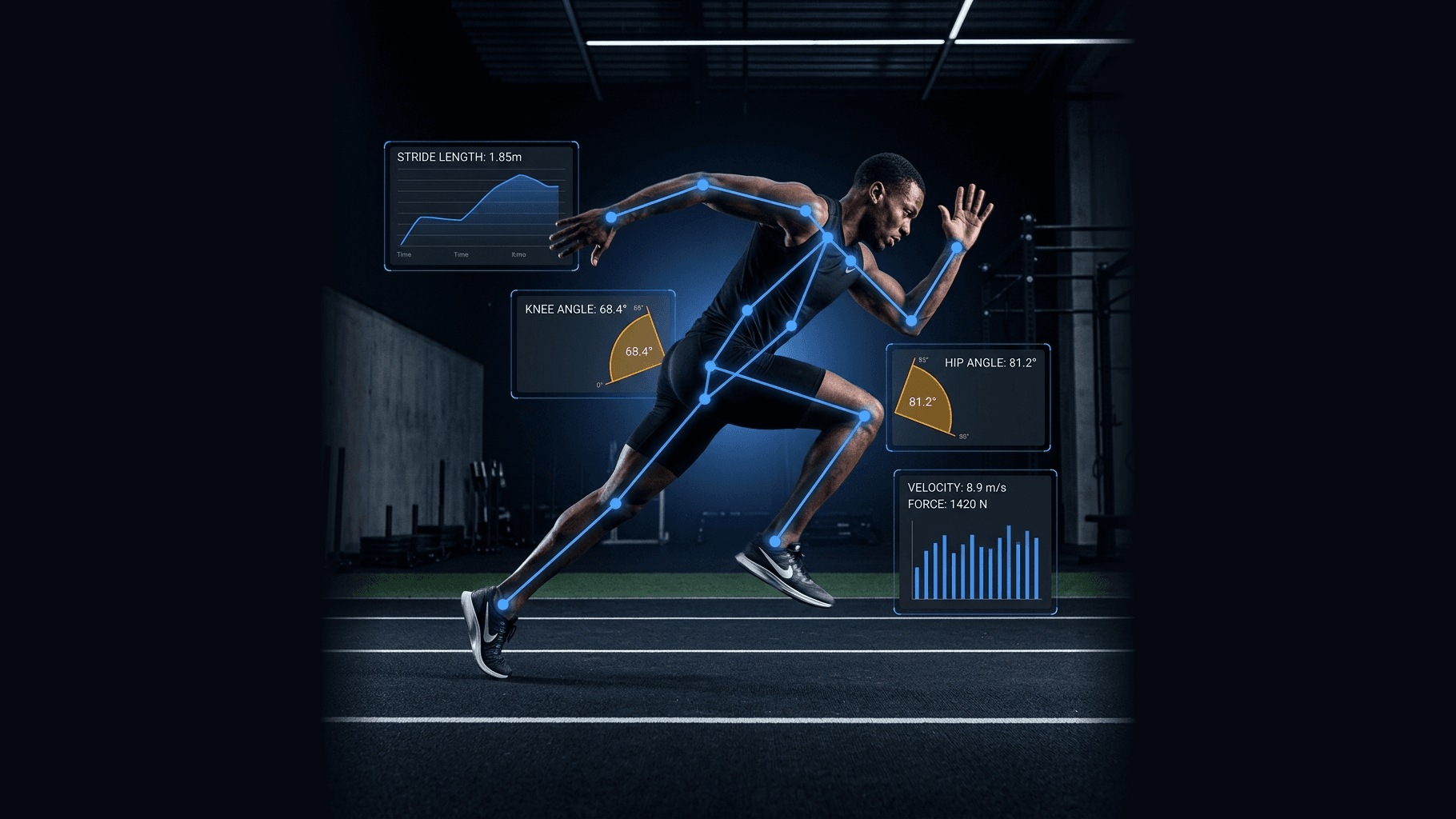 High-end technical visualization of training-session computer vision: skeletal pose overlay on an athlete mid-drill with live joint angle readouts and session load metrics.
What is computer vision in sports training?
Computer vision in sports training is the use of AI models to analyse athlete movement, technique and physical load directly from camera footage captured during practice sessions — measuring joint angles, movement mechanics, repetition consistency and physical output without wearable sensors, and producing structured data coaches can act on across individual sessions and over time.
It's the same underlying discipline as match-day tracking — detection, pose estimation, event recognition — applied to a different context with a different output requirement. In a match, you want to know what happened and when. In training, you want to know whether what's happening is correct, whether it's consistent, and whether it's changing in the right direction across sessions.
How training-session CV differs from match-day CV
The distinction matters because it changes almost everything about how a system is built and what its training data needs to contain.
| Dimension | Match-day computer vision | Training-session computer vision |
|---|---|---|
| Primary output | What happened (events, positions) | Whether it was correct (mechanics, form, load) |
| Camera setup | Fixed multi-camera broadcast rigs | Varied — facility cameras, mobile rigs, phone cameras |
| Footage conditions | Consistent stadium lighting, professional broadcast quality | Gym lighting, outdoor facilities, variable quality |
| Analysis timescale | Single match | Repeated sessions compared across weeks and months |
| Object of interest | All players simultaneously | Often one athlete or small group in isolation |
| Annotation depth required | Event classification, bounding boxes, broad positional data | Dense skeletal keypoints, joint angle measurements, movement phase labels |
| Accuracy bar | Position-accurate to ~10–30cm for tactical analysis | Biomechanically precise to ~1–5° for technique correction |
The accuracy bar is the critical difference. Knowing a player was in the left channel is sufficient for tactical analysis. Knowing whether a sprinter's knee drive reaches 90° of hip flexion — and whether it's consistent across every stride of a 60m rep — requires a different level of annotation precision and a different training data strategy.
The five core applications of computer vision in athlete training
1. Technique and biomechanics analysis
The most direct application. A computer vision system running pose estimation on training footage can extract joint angles, segment positions and movement patterns frame by frame — and compare those against a reference model, against the athlete's own historical baseline, or against a sport-specific biomechanical standard.
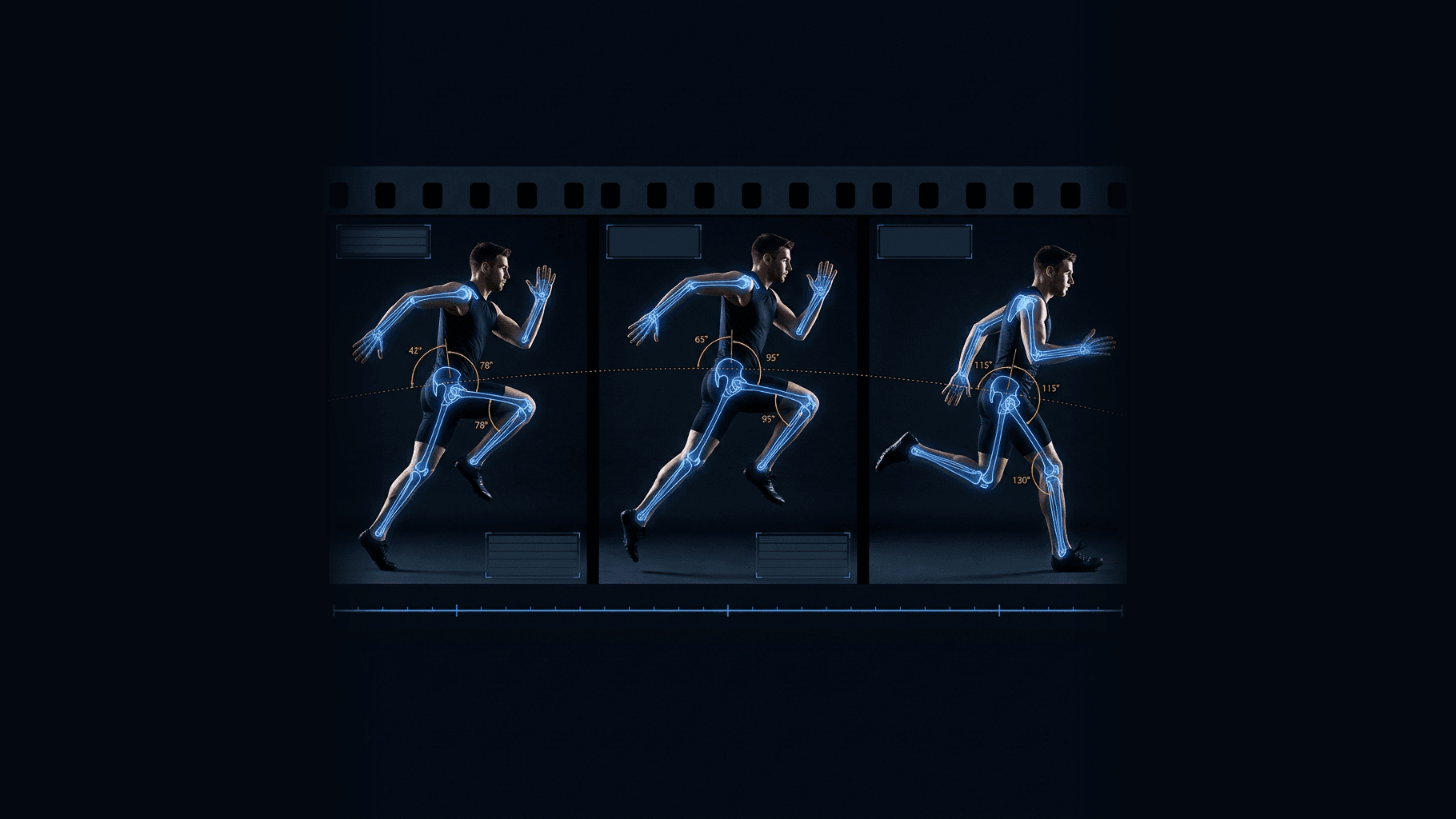 Frame-by-frame biomechanical breakdown of a sprint stride: hip flexion, knee drive and trunk lean measured directly from camera footage against the athlete's baseline.
In practice this means:
- A sprint coach seeing hip flexion, trunk lean and arm drive data for every rep in a session, not just watching the rep and writing notes
- A swimming coach getting catch angle and hand entry position data from overhead and underwater cameras without manually coding video frame by frame
- A boxing coach seeing shoulder rotation and hip loading data across combinations to identify where power is leaking from the kinetic chain
The value isn't that AI replaces the coach's eye — it's that it gives the coach data at a scale and precision that manual observation can't produce. A coach watching a 90-minute training session can't hold detailed biomechanical data from 200 sprint reps in their head. A CV system can.
2. Load tracking without wearables
One of the most commercially significant training applications. Load monitoring — tracking how much physical work an athlete has done, in what intensity zones, to manage injury risk and training adaptation — has traditionally required GPS vests or heart rate monitors.
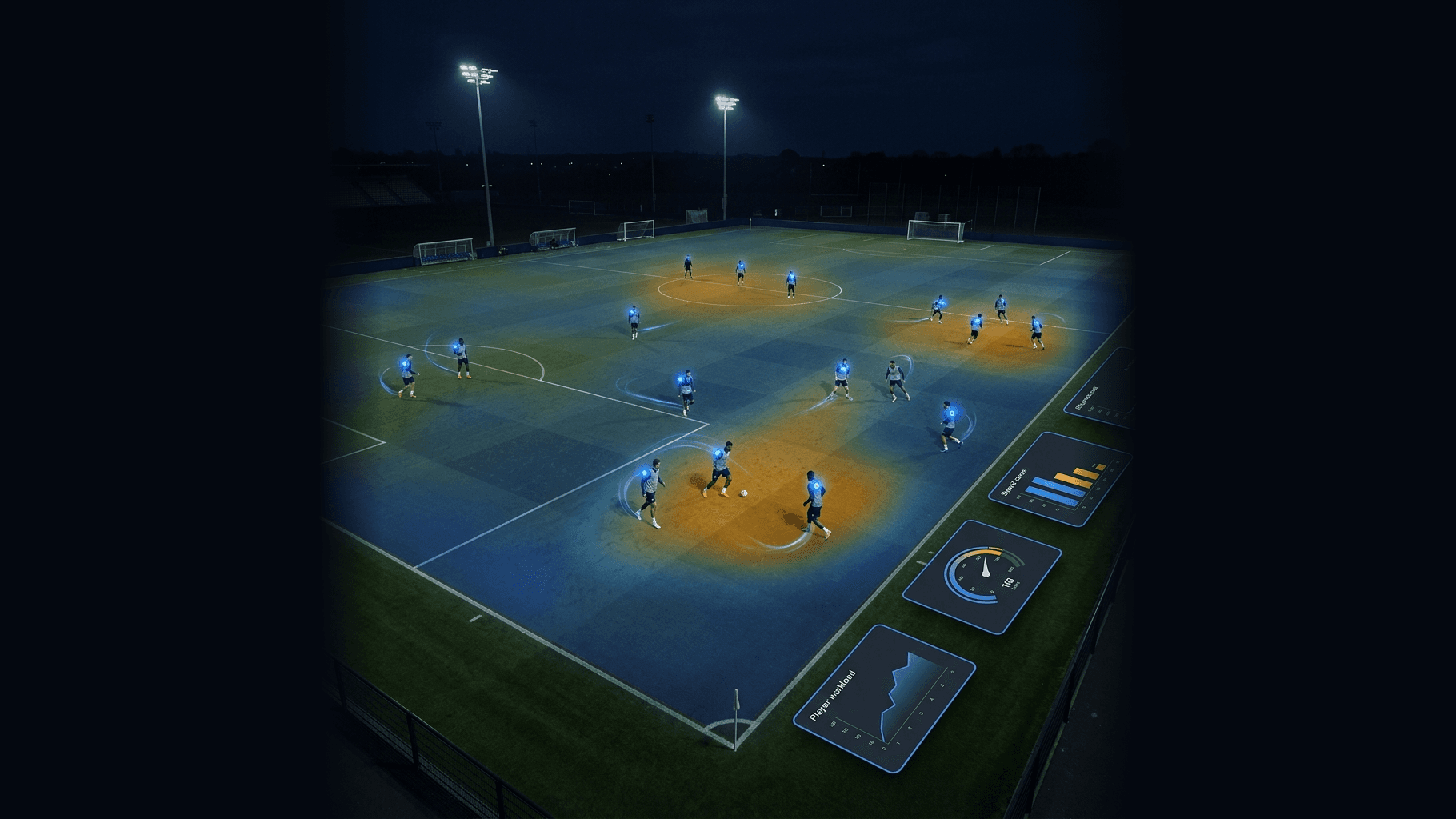 Camera-based load monitoring across a full squad training session: movement heat map, speed zone distribution and acceleration counts derived from optical tracking alone.
Computer vision-based load tracking extracts the same data from camera footage:
- Distance covered and speed profile from position tracking across sessions
- Acceleration and deceleration counts, which are the highest injury-risk load markers in most team sports
- High-speed running volume across the session
For environments where wearables aren't practical — contact sports where devices risk breakage, aquatic sports where waterproofing is a constraint, or simply contexts where fitting a full squad with GPS hardware every session creates logistical friction — optical load tracking removes the dependency. As covered in our analysis of wearables and sensor fusion, the industry trend is combining both sources; but optical load tracking is increasingly viable as a standalone option for training contexts.
3. Repetition counting and session segmentation
A training session isn't a continuous stream of action — it's structured sets, reps, drills and rest periods. Automating the identification of where each repetition starts and ends, and classifying what type of drill is occurring, is foundational for everything downstream.
If a system can't reliably identify that an athlete just completed rep 12 of a Nordic hamstring curl series — and distinguish it from the rest period before rep 13 — it can't reliably aggregate technique metrics across the set, compare rep 1 against rep 12 for fatigue-linked form breakdown, or flag the specific rep in the session where an asymmetry appeared.
Repetition segmentation from video is a classification problem that requires training data labelled at the movement-phase level, not just the clip level — and it's sport and exercise specific. The segmentation logic for a 100m sprint rep looks nothing like the segmentation for a volleyball serve or a gymnastics vault.
4. Longitudinal tracking: the same athlete across sessions
This is what makes training-session computer vision commercially distinct from match-day systems. A match tells you what happened once. Training data tells you whether an athlete is improving, plateauing, developing a compensation pattern, or showing early signs of a movement quality drop that precedes injury.
Computer vision systems that track individual athletes across sessions can:
- Build a biomechanical baseline for each athlete specifically — not compared against a generic model but against their own established pattern
- Detect statistically significant changes in technique over time that might be invisible in any single session
- Flag movement asymmetries or progressive form breakdown that coaches would likely miss across a large squad training simultaneously
For this to work, the underlying system needs consistent identity tracking across sessions (knowing that athlete X in Tuesday's session is the same person as in Friday's session) and annotation that's structured to support longitudinal comparison — consistent keypoint labelling conventions across the full dataset, not just within a single session.
5. Automated video feedback for individual athletes
A direct output of technique analysis is automated, clip-based feedback delivered to the athlete directly. Rather than a coach writing feedback notes after watching back video, a CV system can automatically flag the specific rep where a joint angle deviated from the athlete's baseline, clip the relevant footage, and deliver structured feedback linked to the exact moment — either within a coaching platform or as a standalone review.
This is the same capability that underlies remote scouting platforms, applied in a training context rather than a talent identification one. The difference is that training feedback loops benefit from consistency across sessions, whereas a scouting assessment is typically a one-time evaluation.
Sport-by-sport: what training CV actually measures
| Sport | Primary technique metrics | Primary load metrics | Key CV challenge |
|---|---|---|---|
| Athletics / sprinting | Stride length, hip flexion, arm drive, contact time | Sprint distance, speed zones, acceleration reps | High speed — 10m splits require very high frame rate annotation |
| Swimming | Catch angle, hand entry, stroke rate, body roll, kick tempo | Distance, split times, stroke count per length | Underwater camera footage with optical distortion and visibility variation |
| Boxing / MMA | Shoulder rotation, hip loading, guard position, reaction time | Work rate, round-by-round output | Mutual occlusion between two athletes in close contact |
| Gymnastics | Body alignment, joint extension, landing mechanics | Volume of high-impact reps | Extreme joint extension ranges outside standard pose model training distributions |
| Football / soccer | Passing mechanics, shooting technique, change of direction | Distance, sprint count, deceleration load | Large groups training simultaneously, multiple drills running in parallel |
| Basketball | Shot mechanics, footwork, defensive stance | Sprint count, acceleration volume, jump load | Indoor lighting variation, high density of players in confined spaces |
Each sport not only requires different metrics but different annotation schemas — which is why training data for these systems has to be sport-specific from the schema design stage, not adapted from a generic movement dataset.
Why training-session footage is harder to annotate than match footage
This is where most teams building training analysis systems underestimate the problem.
Match footage is standardised. A professional broadcast feed comes from fixed cameras with known positions, consistent broadcast-quality lighting, and a production team ensuring the key action is always in frame. The annotation challenge is about volume and sport-specific knowledge.
Training footage is not standardised. A facility training session might be captured by a single camera on a tripod at one end of the pitch, a ceiling-mounted camera in a gym, or a coach holding a phone. Lighting varies between indoor and outdoor sessions, morning and afternoon. Athletes move in and out of frame depending on the drill. The same movement — a sprint, a squat, a throw — might be captured from a completely different angle on Tuesday versus Friday.
This means annotated training data has to deliberately represent:
- Varied camera positions and angles for the same movement type — a model trained only on side-view sprints won't reliably estimate joint angles from a rear-facing camera
- Varied lighting conditions — fluorescent gym lighting and outdoor midday sun produce different image characteristics even for the same facility
- Movement phase labels, not just clip labels — knowing that a video clip contains a Nordic hamstring curl is insufficient; the model needs to know where the eccentric phase ends and the concentric phase begins, frame by frame
- Fatigue-state variation within a session — technique in rep 1 of a set looks different from rep 12, and training data needs to represent the full intra-session range, not just clean early-rep examples
The depth of annotation required here is meaningfully greater than most match-day annotation. A bounding box on a player tells you where they are; a biomechanically labelled keypoint set at a specific movement phase tells you what they're doing and whether it's correct. The difference in annotation time, annotator expertise and QA rigour required is substantial.
What training data for sports training CV models needs to contain
| Requirement | Why it matters | What it rules out |
|---|---|---|
| Dense skeletal keypoints at 17–29 points | Joint angle calculation requires precise keypoint placement, not approximate bounding boxes | Generic activity recognition datasets labelled with clip-level class labels only |
| Movement phase labels within each rep | Segmenting and comparing phases requires frame-level phase classification, not just rep-level boundaries | Clip-level or event-level annotation without intra-rep structure |
| Multi-angle coverage of the same movement | Models deployed on varied camera setups need training data representing that variety | Single-angle datasets, however precisely annotated |
| Longitudinal consistency across sessions | Tracking the same athlete's mechanics over time requires consistent keypoint labelling conventions across the whole dataset | Datasets assembled from different annotators using different labelling conventions |
| Sport-specific movement taxonomy | Drill types, phase definitions and correction criteria differ by sport | Generic human pose datasets not built around any specific sport's movement vocabulary |
| Fatigue and quality variation within sets | Models need to recognise form breakdown across a set, not just clean early-rep technique | Datasets that cherry-pick only well-executed examples |
For a deeper look at how dataset structure decisions affect model performance, our guide to building sports CV training datasets covers the full pipeline from objective definition through QA.
The annotator expertise requirement
Annotating training footage for biomechanical analysis isn't a task a general labeller can do reliably. Knowing where to place a keypoint on a knee during the eccentric phase of a Nordic curl — precisely enough that the resulting joint angle measurement is biomechanically meaningful — requires understanding of the movement, the anatomy, and the sport context well enough to make consistent decisions across thousands of frames.
This is the same principle that applies across every sports annotation domain: a labeller who doesn't understand the sport produces labels that reflect their best guess, not ground truth. In a match-annotation context, a mislabelled pass is a wrong event label. In a biomechanics context, a misplaced keypoint is a wrong joint angle measurement — and a system trained on wrong joint angles will give athletes systematically incorrect technique feedback. The downstream consequence is more direct, and the quality bar accordingly higher.
Frequently asked questions
What is computer vision in sports training? Computer vision in sports training is the use of AI to analyse athlete movement from camera footage during practice sessions — measuring technique, tracking physical load and monitoring consistency across sessions without wearable sensors. Unlike match-day tracking, the primary output is whether movement is mechanically correct and whether it's improving over time, not just where players are or what events occurred.
How does computer vision analyse athlete technique? By running pose estimation models on training footage to extract joint positions frame by frame, then calculating joint angles, segment positions and movement patterns from those keypoints. The resulting measurements can be compared against a sport-specific reference model, the athlete's own established baseline, or between the start and end of a session to detect fatigue-linked form breakdown.
Can computer vision replace GPS vests for load tracking in training? For most team sport training contexts, optical load tracking from camera footage can produce distance covered, speed profiles and acceleration/deceleration counts that are directly comparable to GPS output — without each athlete needing a device. It's not equivalent for physiological data (heart rate, core temperature) that wearables measure directly, but for movement-based load metrics it removes the wearable hardware dependency entirely.
Why is training-session footage harder to annotate than match footage? Match footage comes from fixed, calibrated broadcast cameras with consistent professional lighting. Training footage comes from a wide variety of camera positions, facility types and lighting conditions that change session to session. Annotating it for biomechanical analysis also requires movement phase labels at the frame level — not just event or clip labels — and a higher degree of anatomical knowledge than standard sports annotation requires.
How does a CV system track the same athlete's technique across multiple sessions? Through consistent athlete re-identification across sessions, combined with annotation conventions that produce comparable data across the full dataset. If two sessions are annotated with different keypoint placement conventions, longitudinal comparison produces noise rather than signal — making cross-session consistency in annotation quality as important as within-session accuracy.
Which sports currently use computer vision for training analysis? Athletics and sprint training, swimming, gymnastics, football and basketball coaching platforms, and combat sports technique analysis are the most active current deployments. The use case exists in any sport with repeatable, measurable movement patterns, and is spreading as the hardware cost of facility cameras drops and models become easier to deploy without dedicated tracking rigs.
How much annotated training footage is needed to build a reliable sports technique model? Enough to represent the full range of variation the model will encounter in deployment — camera angles, lighting conditions, athlete body types, skill levels, fatigue states and drill types. There's no universal number, but the practical answer is that datasets assembled from a single facility or camera setup systematically underperform on the varied input conditions real training environments produce. Diversity of examples matters as much as total volume.
Can existing match-day computer vision models be reused for training analysis? Not without significant retraining. Match-day models are trained on broadcast footage with consistent camera positions and typically produce positional data sufficient for tactical analysis — not the biomechanically precise joint angle data training analysis requires. Adapting them means building training datasets specifically for the facility environment and technique metrics in question, not assuming a match-day model will generalise.
What is the difference between pose estimation and skeleton tracking in sports training? Pose estimation predicts the positions of a defined set of body keypoints from a single frame — where each joint is, right now. Skeleton tracking links those estimates across frames to produce continuous joint position data over time. Training analysis needs both: pose estimation for per-frame biomechanical measurement, and tracking to build the rep-level and session-level data structure coaches actually use. Both require dedicated annotated training data, as covered in our guide to skeletal tracking versus bounding boxes.
The takeaway
Computer vision in sports training is a different product from match-day tracking — different output, different annotation depth, different accuracy requirements, and different training data strategy. The coaches and performance scientists who get the most from it are the ones who treat it as a measurement system that needs to be calibrated for their specific facility, their specific sport and their specific biomechanical questions — not as a general-purpose tracking product repurposed from match analysis.
Building that system requires training data built specifically for the training context: dense skeletal keypoints, movement phase labels, multi-angle coverage of the same drills, and consistent annotation conventions across sessions that make longitudinal comparison meaningful.
If you're building a sports training analysis platform and need annotation that reaches the biomechanical precision coaching applications actually require, see how Train Matricx works or review our annotated dataset results. We annotate a free pilot clip first so you can assess the quality against your own standard before committing to any volume.

Client results

“Train Matricx didn't just provide labeling — they became an extension of our team. With 6K+ football matches annotated and counting at 98% accuracy, they are our premier data partner.”

Billy Brush
Founder & CEO, Dark Horse AI
Don't take our word for it. Test the labels.
Send us the footage your current vendor gets wrong — the occluded players, the motion blur, the edge cases. We annotate it and return a QA report you can check frame by frame.
- Your hardest clip, annotated in 48 hours
- Full QA report with per-frame accuracy
- No commitment, no contract, no card