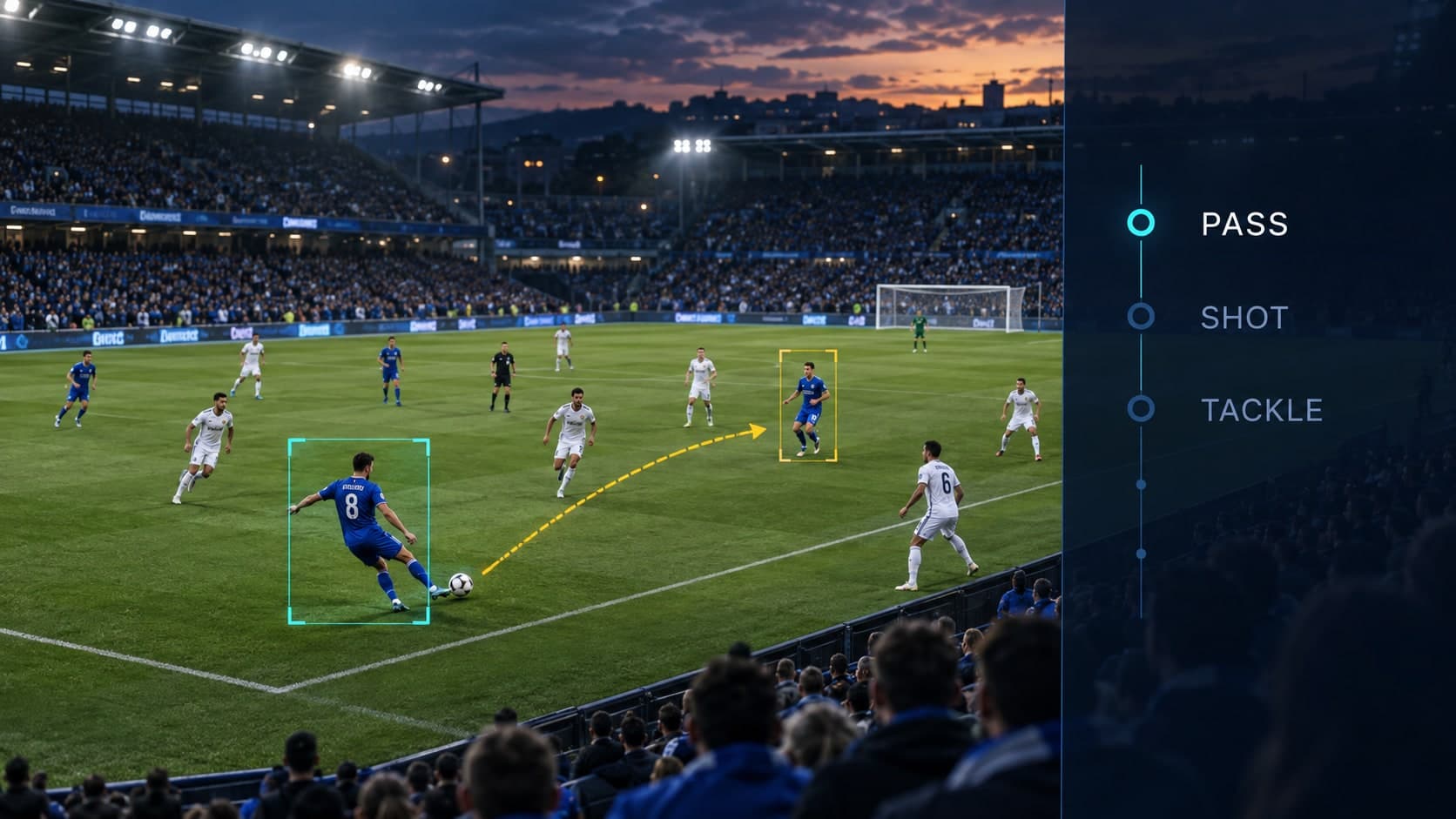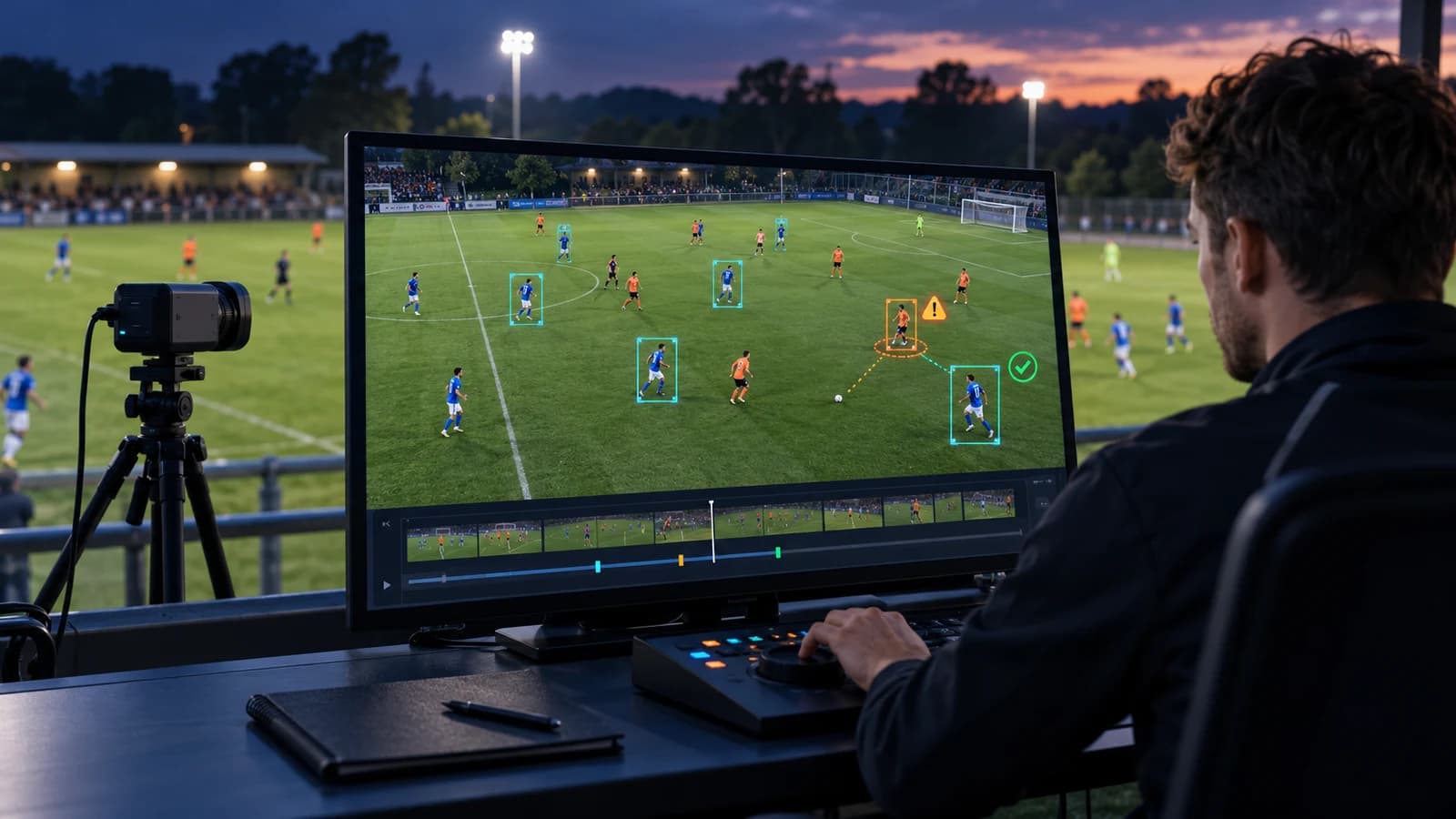
Yes, for the events coaches pay to analyse. AI auto-tagging on sports cameras is now reliable for clear, rule-defined moments such as kick-offs, goals and set pieces. It is much less reliable for the dense on-ball events (passes, duels, turnovers) and for the identity questions (which player was it?) that turn a highlight reel into match data. A human QA layer closes that gap, and it does not have to slow delivery down.
This post is for product and engineering leads at sports camera and video platforms that sell automatic tagging to clubs. It covers what the published evidence says about auto-tagging accuracy, the edge cases we run into when tagging youth football footage, and three ways to add human review to an automated pipeline.
Key Takeaways
- Camera platforms already auto-tag the easy events. Veo's AI tags goals, kick-offs, set pieces and shots on goal, and marks each AI-created tag with an "AI" symbol (Veo, February 2023).
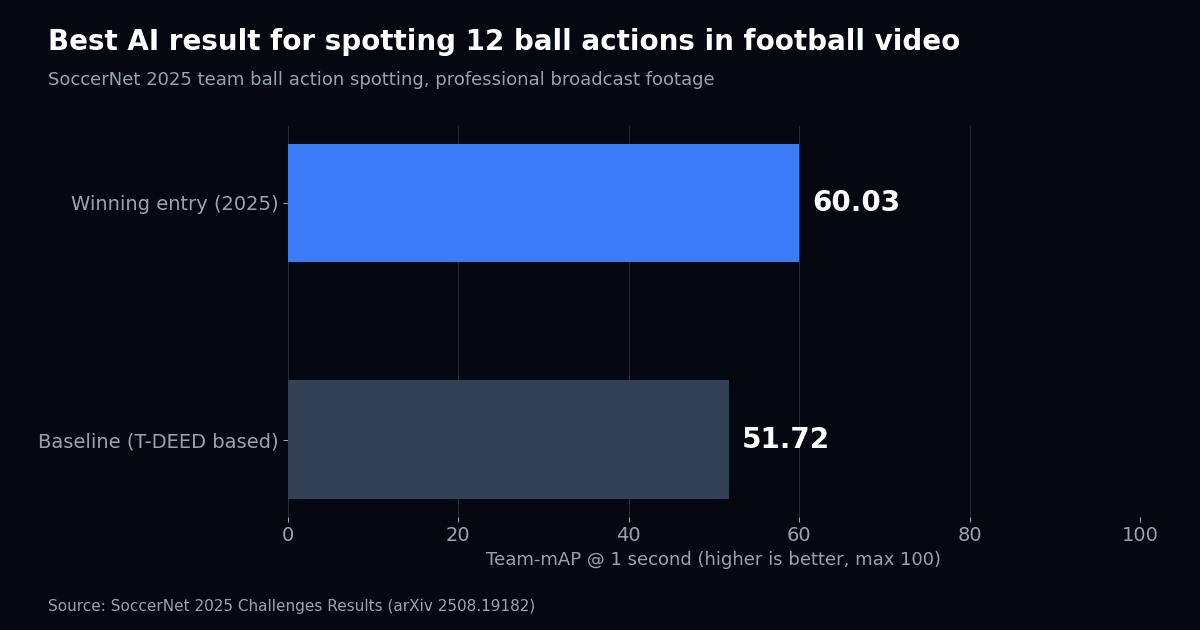
- Dense event detection is still an open research problem. The best entry in the SoccerNet 2025 team ball action spotting challenge scored 60.03 Team-mAP for 12 ball actions within one second, on professional broadcast footage (SoccerNet 2025 Challenges Results).
- Human taggers are not perfect either, so the target is agreement against written definitions, not "100% accuracy".
- In our youth football tagging work, most of the hard calls are about identity, not about spotting the action: shirt numbers that don't match the lineup, similar kits and players the camera cannot see.
- You can add human QA as a review of flagged tags, a full review, or human tagging with AI pre-fills. The right choice depends on what your customers do with the data.
What does AI auto-tagging on sports cameras do well today?
Auto-tagging handles clear, low-frequency events with a fixed visual or rule signature. A kick-off, a goal, a corner or a penalty happens a few times a match, looks similar every time and can often be confirmed from game state. These are the events camera platforms ship first.
Veo is a useful public example. In February 2023 it announced that "set pieces and shots on goal are included in the tagged events in all games recorded with Veo", in addition to goals, kick-offs and final whistles. It also noted that "you can always tell if a tag is created by our AI as they are marked with an 'AI' symbol", and that users can still create their own tags in the Veo Editor (Veo, February 2023).
The platform keeps AI tags and human tags visibly separate and leaves room for people to add what the model did not catch.
Automation is also running at very large scale. A September 2025 Sports Video Group interview reported that Pixellot's AI-powered systems "deliver more than 150,000 live events each month across 19 sports worldwide", and its North America president said the company can run them "with minimal human input" (Sports Video Group, 19 September 2025). That figure is about automated production (filming, following play and streaming), not event-tagging accuracy, but it shows how much footage now exists with no human watching it.
For highlight reels and quick review, this level of automation is often enough. A coach who wants to rewatch every corner gets real value from it.
Where auto-tagging still falls short
Detecting every on-ball action, and assigning it to the right team and player, is still well below human level. The clearest public benchmark is SoccerNet, an academic challenge series for football video understanding.
In the 2025 team ball action spotting task, models had to find 12 ball-related actions, such as passes, shots and goals, in untrimmed football videos and say which team performed each one. The challenge used 77 annotated English Football League games, with 22 more games reserved for evaluation. The winning team scored a Team-mAP of 60.03 with a one-second tolerance, up from a baseline of 51.72 (SoccerNet 2025 Challenges Results).
For a camera company, two details of that benchmark matter:
- It is measured on broadcast footage. Broadcast video has close-ups, replays and camera operators following the ball. A fixed wide-angle camera at a youth match gives the model smaller players, more occlusion and fewer clear views of the ball.
- mAP is not a "percentage correct". It summarises precision and recall across confidence thresholds. A score of 60 leaves substantial room for actions that are missed, mistimed or credited to the wrong team.
Tracking-based detection does better on some categories. A 2022 study that detected events from player and ball tracking data reported a detection rate above 90% "in most event categories", benchmarked against manually annotated events (Vidal-Codina et al., 2022). That is "most", not all, and it depends on having good tracking data, which is the hard part with a single amateur camera.
The practical gap is identity. Even when a model detects a pass correctly, someone still has to say who passed to whom. That step needs readable shirt numbers, a correct lineup and a rule for every case where neither is available. Our guide to player re-ID labeling rules covers that problem in detail.
Are human taggers actually more accurate?
Human taggers are more accurate on dense events, but they are not perfect, so the goal is agreement against written definitions. When two independent groups of Opta operators tagged the same Spanish league match, their agreement on team events gave kappa values of 0.92 and 0.94, where 1.0 would be perfect agreement (Liu et al., 2013).
That is high, but it is not 1.0, and those were trained professional operators working to one shared rulebook. Agreement at that level depends on shared definitions. In practice, a human QA layer is only as good as the rules it applies.
This changes what a camera company should ask for. "Are your taggers accurate?" has no useful answer. These questions do:
- What are your written definitions for each event?
- What is your agreement rate between two reviewers on a sample?
- What happens to a tag that two reviewers disagree on?
Our guide on how to measure annotation quality explains the metrics worth requesting.
What edge cases come up in youth football footage?
In our youth football tagging work, most of the hard calls are about identity and match context, not about spotting the action. These are the cases that come up most often, and the rules we apply to them.
Shirt numbers that don't match the lineup
Youth teams often play in whatever shirts are available. The number on a player's back may not match the number in the official lineup. Our rule: identify players by name from the team's lineup sheet, and treat the shirt number as a hint, not as proof.
A model that reads shirt numbers will confidently assign events to the wrong player in this situation. A human reviewer working from the lineup sheet is far less likely to.
Which goalkeeper to log
Goalkeepers change shirts, swap at half-time or wear a colour close to the other team's. Our rule: the goalkeeper named on the lineup is the starter, and that is who we log unless the footage clearly shows a substitution. The rule works even when no number is visible.
Players the camera cannot see
A wide fixed camera loses players at the far touchline, behind other players, and during fast transitions. When a player cannot be identified from the footage, the event is still logged and the player field is marked as unknown. A guessed name is worse than a blank, because nobody downstream can tell it was a guess.
Questions in one batch, not every day
This one is about process, not footage. Questions sent one at a time, as they come up, turn into a daily back-and-forth that a customer's staff rarely have time for. Our process is to review every match in a batch first, comparing lineups against footage, put every open question into one document per batch, send it once, and start tagging after the answers come back.
For a camera company, this matters because the cost of human QA is not only tagging hours. It is also the time your own staff spend answering questions. Ask any QA partner how they batch them.
How we structure review
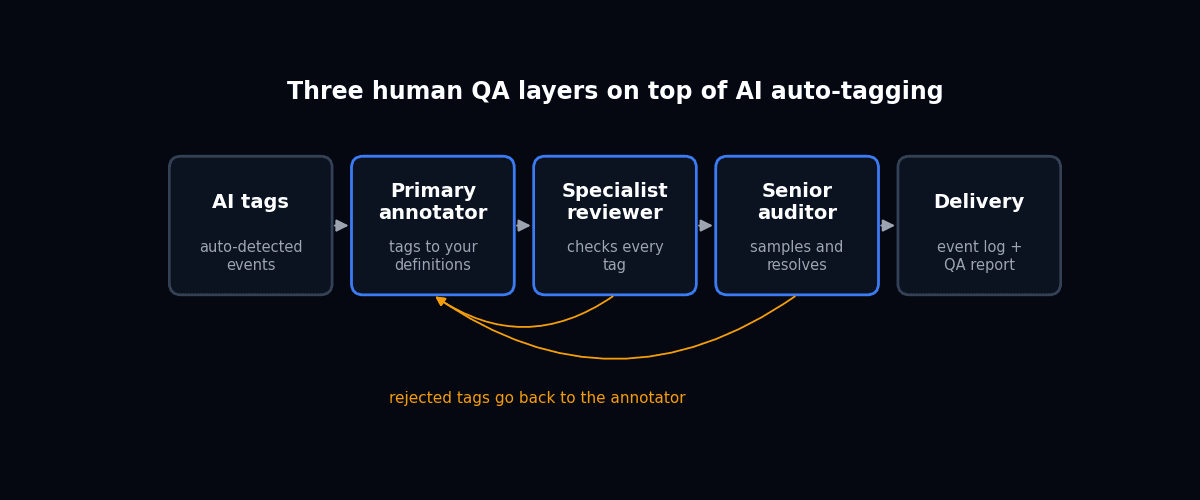
Our standard QA design has three layers: a primary annotator, a specialist reviewer and a senior auditor. The first layer tags, the second checks the tags against the definitions, and the third samples finished matches and resolves disagreements.
How do you add a human QA layer without losing speed?
Match the review model to what your customers do with the data. There are three common set-ups, from lightest to heaviest.
| Set-up | How it works | Best for | Trade-off |
|---|---|---|---|
| Review flagged tags | Humans check only low-confidence AI tags and events the AI marks as uncertain | Highlight products, quick-review tools | Misses errors the model is confident about |
| Full review | Humans check every AI tag and add what the model missed | Match stats that coaches and scouts act on | More hours per match |
| Human tagging with AI pre-fill | AI proposes events, humans tag the match to the full schema and use AI tags as a starting point | Player-level data, custom definitions, training data | Slowest, but most consistent |
Turnaround depends more on staffing than on the set-up. A full review of a 90-minute match can still come back next day if the QA team has capacity agreed in advance and the match volume is predictable. Spikes, such as a weekend with every age group playing, are where turnaround slips. Agree capacity per week, not per match.
Cost follows the same logic. It depends on how many event types you tag, how precise each label needs to be and how many review layers you run. A goals-and-set-pieces check is a much smaller job than tagging every touch with player IDs. Our guide to what sports video annotation costs covers the pricing models.
If you are deciding whether to build this team yourself, our comparison of in-house and outsourced sports annotation sets out the trade-offs.
What should you ask a human QA partner?
Ask for evidence on your own footage, not a general accuracy claim. Before signing, a camera or platform company should get answers to these:
- Definitions. Will they tag to your event definitions, and can they show you theirs? A shared sports event taxonomy is a good starting point.
- Edge-case rulebook. Do they keep a written rulebook for identity, unknown players and goalkeepers, and will they share it with you?
- Agreement report. Can they report reviewer agreement on a sample of your matches?
- Question handling. How do they batch questions, and who on your side needs to answer them?
- Capacity. How many matches per week can they commit to at your turnaround, and what happens on peak weekends?
- Pilot. Will they tag a match from your own cameras before you commit?
Our post on vendor onboarding and ramp time explains what a realistic first month looks like.
Frequently Asked Questions
Is AI auto-tagging accurate enough for youth football?
It is accurate enough for highlights of clear events such as goals, kick-offs and set pieces. For player-level event data, published benchmarks on broadcast footage are still well below human level, and youth footage from a single wide camera is harder. Most platforms that sell match data add some human review.
What is a human-in-the-loop QA layer for sports video?
It is a step where trained reviewers check AI-generated tags against written event definitions, correct errors, add missed events and resolve identity questions before data reaches the customer. It can cover every tag or only the tags the model is unsure about.
How long does human QA add to turnaround?
It depends on schema size and capacity, not just on the review itself. With capacity agreed in advance, a full review of a 90-minute match can be delivered next day. Unplanned volume spikes are what cause delays.
Bottom line
Auto-tagging has made the easy events cheap. The value camera and platform companies sell to clubs, which is player-level match data that coaches act on, still depends on getting identity and dense events right. That part needs written rules and human review.
- Let AI handle the clear, rule-defined events.
- Put human review where errors cost your customer trust: identity, passes, duels and turnovers.
- Judge any QA partner on definitions, agreement and a pilot on your own footage.
If you want to see what a reviewed match looks like on your own cameras, our free annotation pilot tags a clip from your own footage, with a full QA report.

Client results

“Train Matricx didn't just provide labeling — they became an extension of our team. With 6K+ football matches annotated and counting at 98% accuracy, they are our premier data partner.”

Billy Brush
Founder & CEO, Dark Horse AI
Don't take our word for it. Test the labels.
Send us the footage your current vendor gets wrong — the occluded players, the motion blur, the edge cases. We annotate it and return a QA report you can check frame by frame.
- Your hardest clip, annotated in 48 hours
- Full QA report with per-frame accuracy
- No commitment, no contract, no card