"How much does it cost to annotate our footage?" is usually the first question a sports CV team asks a vendor, and the hardest to get a straight answer to. Most providers dodge it because the honest answer is "it depends." But it depends on a knowable set of factors, and once you understand them you can estimate your own cost and spot when a quote is too good to be true.
This guide explains how sports video annotation is priced in 2026, what actually drives the number, and why the cheapest quote often ends up the most expensive.
 High-end technical visualization of the sports video annotation pricing engine, mapping objects per frame, frame-rate/sampling, and annotation complexity to estimate project costs.
How much does sports video annotation cost?
Sports video annotation is typically priced one of three ways — per hour of annotator time, per labeled object or frame, or as a fixed monthly retainer for a dedicated team — and the real cost is driven by annotation complexity, not video length. A minute of simple bounding-box detection and a minute of dense 22-point pose tracking with occlusion handling can differ in cost by 10x or more. The number that actually matters is not the price per label, but the cost per usable label after rework, because cheap, low-quality annotation gets re-done at your expense.
There is no universal per-minute rate, because "a minute of sports footage" isn't a fixed unit of work. What determines the price is how much labeling that minute requires.
The three ways sports annotation is priced
| Pricing model | How it works | Best for |
|---|---|---|
| Per hour of annotator time | You pay for labeler hours, sometimes tiered by skill | Complex, variable, or research-stage work where scope is unclear |
| Per unit (object / frame / keypoint) | A rate per labeled item — per bounding box, per tracked frame, per skeleton | Well-defined, high-volume tasks with a stable schema |
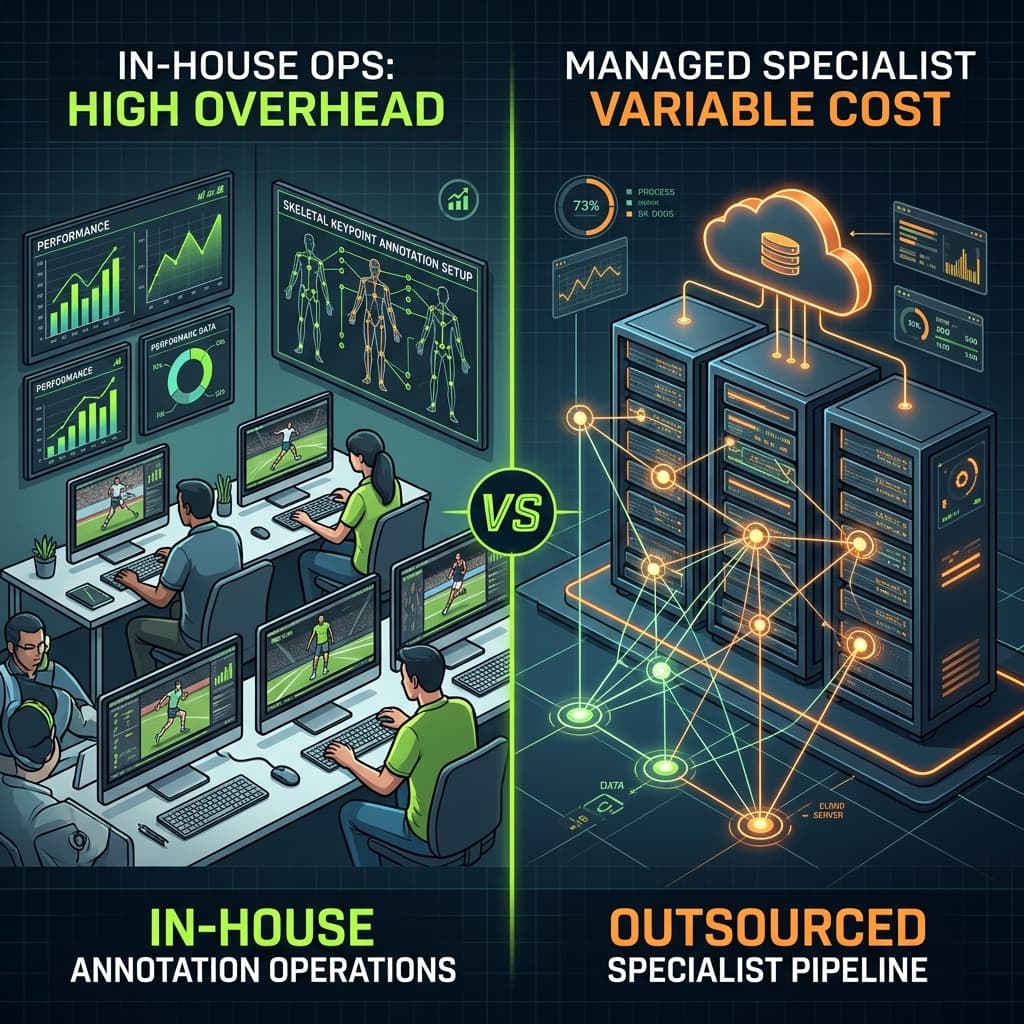
| Dedicated team / monthly retainer | A fixed monthly cost for a set number of annotators working only on your data | Ongoing pipelines that need continuity, ramp-up, and deep sport knowledge |
Most early-stage teams start with per-unit or per-hour pricing for a defined batch, then move to a dedicated-team retainer once annotation becomes continuous. A retainer usually lowers effective per-label cost because the team stops re-learning your schema every batch.
The seven factors that drive the price
Two projects with the same footage length can differ enormously in cost. Here's what moves the number:
- Annotation type. Bounding boxes are cheapest. Tracking (persistent IDs across frames) costs more. Dense skeletal/pose annotation and segmentation cost the most. See skeletal tracking vs bounding boxes for why the gap is so wide.
- Objects per frame. A tennis clip has two players and a ball. A football clip has 22 players, a ball, and officials. More objects per frame means more labels per frame.
- Frame rate / sampling. Annotating every frame at 50fps for DRS-grade ball contact is far more work than sampling one frame per second for coarse tracking.
- Occlusion and complexity. Contact sports (rugby, football, hockey) with heavy player overlap require slower, more careful work and more QA to prevent ID switching.
- Schema precision. Frame-accurate event timestamps and tight keypoint tolerances take more time than loose bounding boxes. For how this plays out in match event work, see our buyer's guide to football data tagging services.
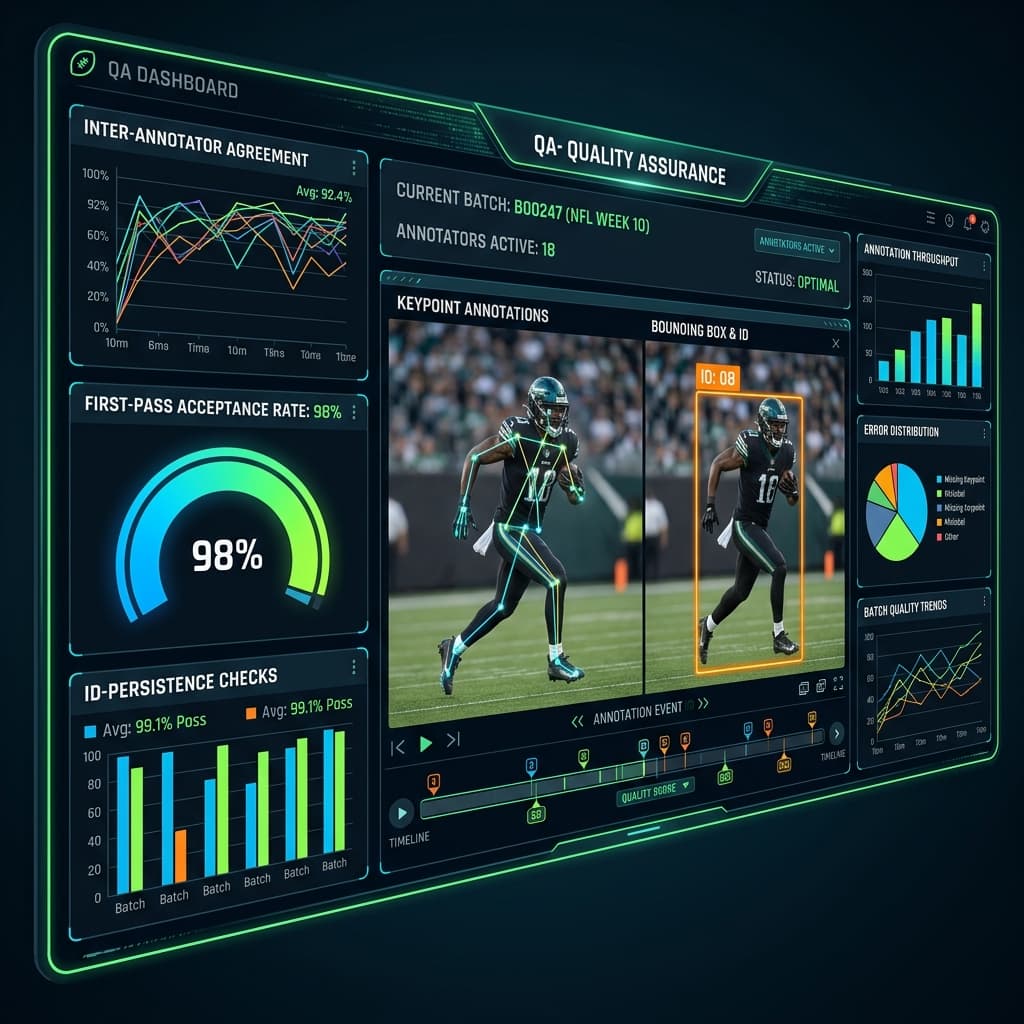
- QA depth. Real quality assurance — a second review layer, agreement checks, ID-persistence audits — adds cost but removes the far larger cost of rework.
- Volume and continuity. Larger, ongoing engagements lower the per-unit rate; one-off small batches carry more setup overhead per label.
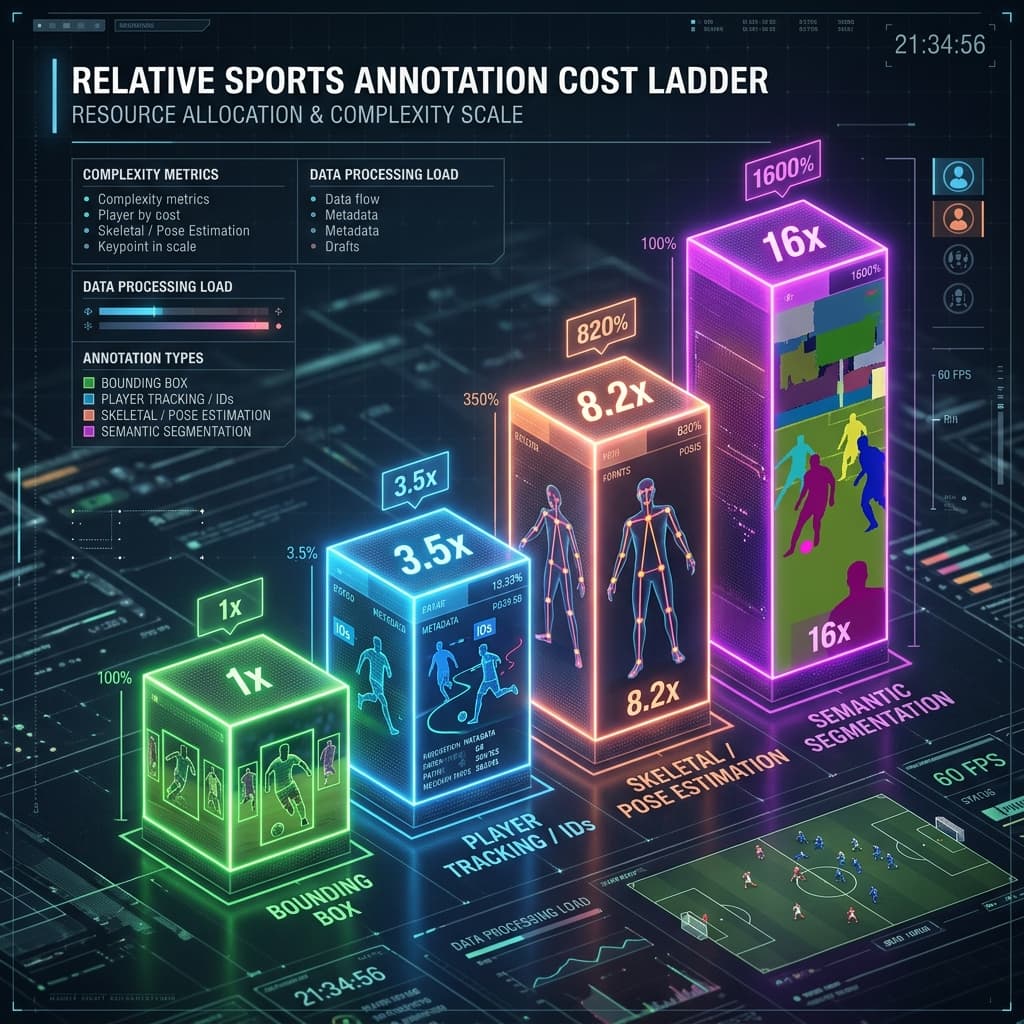 A relative sports annotation cost ladder, showing resource allocation scale climbing from simple bounding boxes to tracking, skeletal pose estimation, and semantic segmentation.
The hidden cost nobody quotes: rework
Here's the trap. The cheapest quotes come from generalist, crowdsourced labeling services. Their price per label is low because their labelers don't know the sport. What you receive back looks plausible but contains sport-specific errors: mislabeled events, missed ball contacts, switched IDs, wrong poses.
Then your ML engineers spend days or weeks cleaning it. That cleanup is the most expensive labor on your team, and it's a cost that never appeared in the quote. A label that costs half as much but has to be redone once is more expensive than a correct label at full price — and it also cost you engineering time and a delayed model.
This is why the honest metric is cost per usable label after rework, not the headline rate. We report quality as 98% accepted first-pass — about a 2% rework rate, verified across 6,000+ matches — specifically so the cost you're quoted is close to the cost you actually pay, with no cleanup tax on the back end.
How to estimate your own annotation cost
You can rough out a project before you ever contact a vendor:
- Define the annotation type (detection, tracking, pose, segmentation, or multi-task).
- Count objects per frame and how many frames you'll actually label (footage length × sampling rate).
- Rate the complexity — occlusion level, precision required, schema density.
- Multiply out the labeling units, then add a QA layer.
- Compare quotes on usable output, not headline rate — ask each vendor their first-pass acceptance or rework rate.
If a vendor can't tell you their rework rate, that's a signal: they either don't measure quality or don't want you to see it.
Ways to lower cost without lowering quality
- Tighten your schema first. Ambiguous label definitions cause rework. A clear schema is the cheapest quality investment you can make — see our dataset-building guide.
- Sample intelligently. You rarely need every frame. Label at the rate your model actually needs.
- Batch continuously. A dedicated team that already knows your schema is cheaper per label than restarting with a new crew each time.
- Use model-assisted pre-labeling with human review, where appropriate, so specialists verify and correct rather than label from scratch.
Frequently asked questions
What's a typical price per minute for sports annotation? There isn't one, because a minute of simple detection and a minute of dense pose tracking are completely different amounts of work. Price by annotation type, objects per frame, and complexity — not by raw video length.
Why are some annotation quotes so much cheaper? Usually because they use generalist labelers with no sport knowledge and little QA. The low rate is real, but so is the rework you'll pay for later in engineering time. Compare on cost per usable label.
Is a dedicated team more expensive than per-label pricing? Higher fixed monthly cost, but often lower effective per-label cost for ongoing work, because the team stops re-learning your schema and quality stabilizes. It fits continuous pipelines better than one-off batches.
How can I predict cost before committing? Estimate labeling units (frames × objects × complexity), add QA, and ask each vendor for their first-pass acceptance rate. Better still, run a small paid or free pilot on real footage and measure actual output.
The most accurate quote is a pilot on your own footage
Any estimate on paper is an approximation until someone annotates your actual footage. The fastest way to know your real cost and quality is to run a pilot: send us your hardest clip, we annotate it with full QA and return it with a quality report in 48 hours — no commitment. You'll see exactly what our labels look like on your data before we talk pricing at all.

Client results

“Train Matricx didn't just provide labeling — they became an extension of our team. With 6K+ football matches annotated and counting at 98% accuracy, they are our premier data partner.”

Billy Brush
Founder & CEO, Dark Horse AI
Don't take our word for it. Test the labels.
Send us the footage your current vendor gets wrong — the occluded players, the motion blur, the edge cases. We annotate it and return a QA report you can check frame by frame.
- Your hardest clip, annotated in 48 hours
- Full QA report with per-frame accuracy
- No commitment, no contract, no card