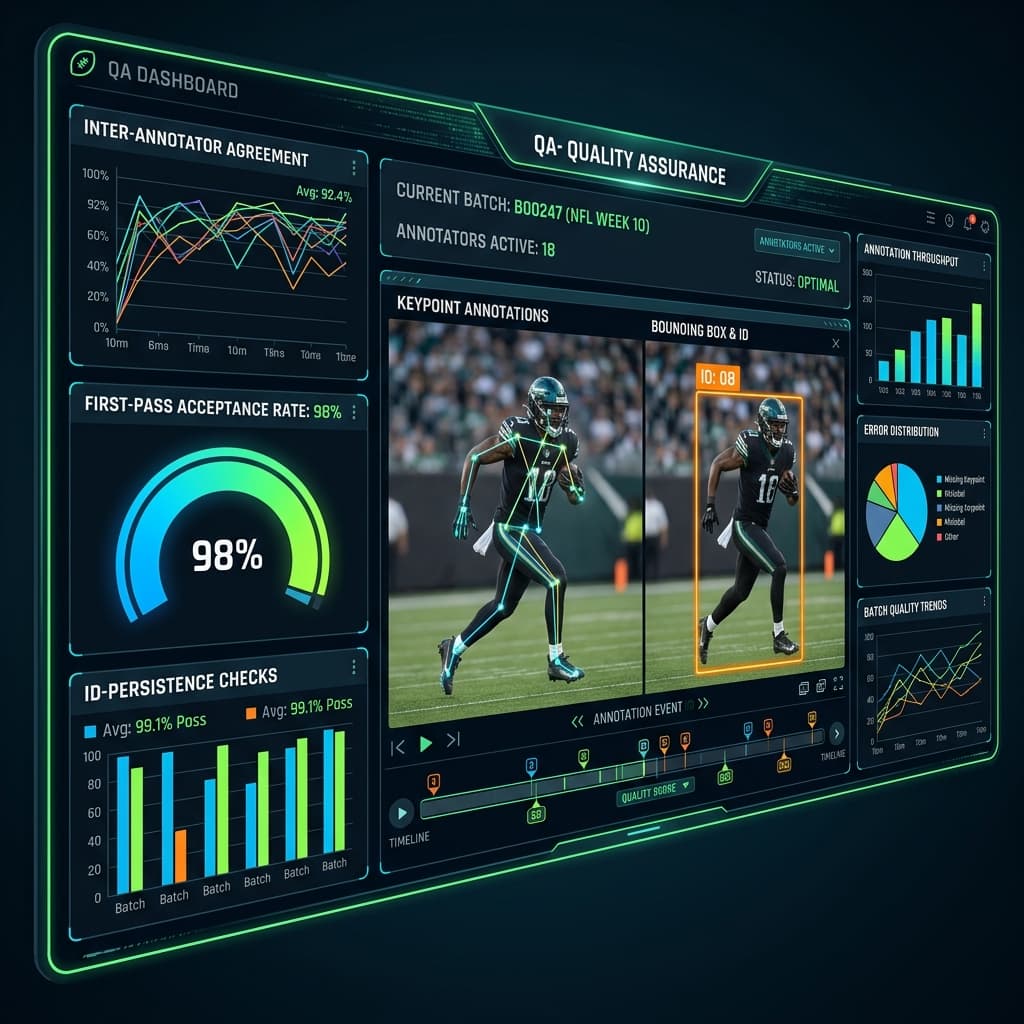
Every sports computer vision team hits the same fork in the road. Your model needs more labeled footage than you can produce internally, and you have to decide: hire and manage your own annotation team, or outsource to a specialist vendor. Get this decision wrong and you either burn engineering time managing labelers or hand your training data to a generalist who mislabels the sport.
This guide breaks down the real cost and risk of each path, and how to tell which one fits your stage.
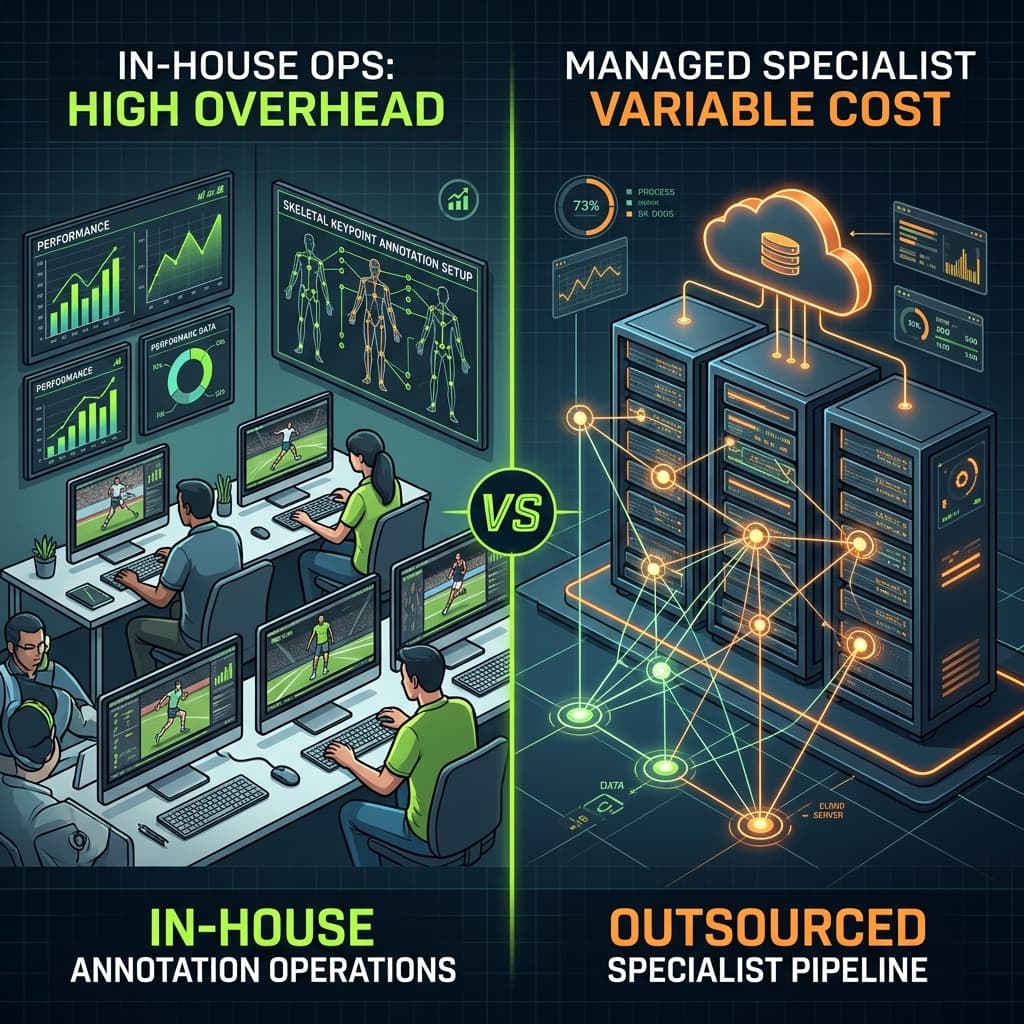 High-end technical split visualization comparing the high overhead of in-house annotation operations vs the cloud-managed scaling of a specialist pipeline.
Should you build an in-house annotation team or outsource it?
For most seed-to-Series-B sports CV teams, outsourcing to a specialist annotation vendor is the lower-cost, lower-risk choice — because the true cost of an in-house team is not the labeler salaries, it's the engineering time spent hiring, training, tooling, and running QA. Building in-house only pays off once your annotation volume is large, continuous, and stable enough to keep a full-time team fully utilized year-round, and you have someone whose actual job is to run it.
The decision is rarely about price per label. It's about where your team's scarce time goes, and whether the people producing your ground truth understand the sport well enough to label it correctly.
The real cost of building in-house (what the salary line hides)
The obvious cost of an in-house team is annotator pay. The hidden costs are what make build-vs-buy math surprising:
| Cost center | What it actually involves |
|---|---|
| Recruiting & ramp | Sourcing, interviewing, and onboarding annotators; 4–8 weeks before a new hire is producing reliable sport-specific labels. A vendor has a ramp too: see vendor onboarding and ramp time |
| Tooling & infrastructure | Annotation platform licenses (CVAT, Encord, etc.), storage, review pipelines, format-conversion scripts |
| Training & taxonomy | Teaching labelers the difference between a tackle and an interception, ball-contact frames, occlusion rules — every sport, every edge case |
| QA overhead | Someone senior reviewing labels, measuring agreement, catching ID switches. This is usually an ML engineer's time |
| Management | A lead who plans throughput, handles attrition, and owns quality — a real headcount, not a side project |
| Utilization risk | Annotation demand is spiky (pre-season, new-sport expansion). A fixed team is either overloaded or idle |
The line that sinks most in-house builds is the fourth and fifth: your ML engineers end up running the labeling operation instead of building models. That's the most expensive labor on the team spent on the least leveraged work.
When building in-house genuinely makes sense
Outsourcing is not always right. Build in-house when:
- Volume is high and continuous. You have a steady, year-round pipeline large enough to keep a full team busy every week. Idle annotators are pure loss.
- The work is deeply proprietary. Your labeling taxonomy is a core, secret part of your IP and you're unwilling to share footage under NDA (though most vendors work fine under NDA).
- You already have an annotation manager. Someone whose full-time job is running the team, not an engineer moonlighting as one.
- Latency to iterate is critical. You retune the schema daily and want labelers in the same standups as your researchers.
If two or more of these are true, in-house can be the right long-term muscle to build.
When outsourcing to a specialist wins
Outsource when:
- Your volume is variable or growing in bursts — new sport, new season, a big customer deployment. A vendor scales up and back down without you carrying fixed headcount.
- You need sport-specific accuracy now, and can't wait 4–8 weeks per hire to build sport expertise from scratch.
- Your engineers' time is your constraint. Every hour they don't spend managing labelers is an hour on the model.
- You want quality accountability on someone else's balance sheet — a vendor whose entire business is annotation quality, with QA built in rather than bolted on.
This is exactly the position most seed–Series B camera-system and analytics startups are in: real volume, spiky demand, tiny engineering team, and no appetite to become a labeling company on the side.
For football match event data specifically, our football data tagging services guide sets out the options and the questions to ask a tagging partner.
The generalist trap: why "cheaper" outsourcing can cost more
Not all outsourcing is equal. The cheapest crowdsourced labeling services use generalist labelers with no sport knowledge, and in sports CV that produces a specific, expensive failure mode:
- Tackles labeled as interceptions, and vice versa.
- Ball-contact frames missed entirely — fatal for trajectory and DRS-style models.
- Player IDs that switch every time two players overlap (see catastrophic ID switching).
- Poses labeled by someone who doesn't know what a legal bowling action or an offside line looks like.
You pay a low price per label, then your ML engineers spend weeks cleaning it — which is the in-house cost you were trying to avoid, now with worse data. The comparison that matters isn't price per label. It's cost per usable label after rework. This is why we report our quality as 98% accepted first-pass: roughly 2% rework, verified across 6,000+ matches for our flagship client, so the data your team receives is production-ready rather than a cleanup project.
A simple decision framework
Run your situation through these four questions:
- Is annotation demand steady or spiky? Steady and large → lean build. Spiky or growing → lean buy.
- Who would run the team? A dedicated annotation manager → build is viable. An ML engineer → buy; don't burn that person on ops.
- How sport-specific is the labeling? Highly specialized and you have no in-house sport expertise → buy from a specialist, or you'll spend months training labelers.
- What's your real constraint — money or engineering time? If engineering time is the bottleneck (it usually is at seed–Series B), buy.
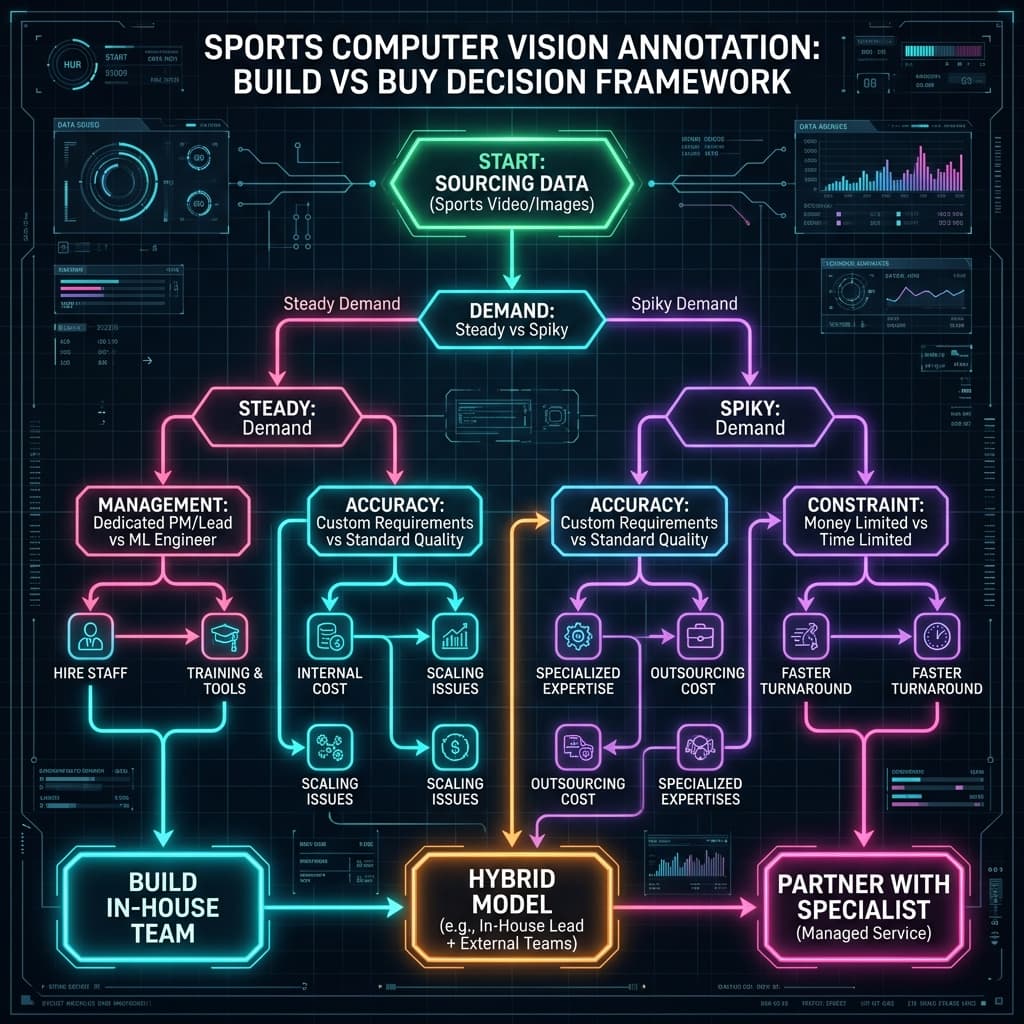 A decision framework diagram evaluating demand stability, management availability, accuracy needs, and resource constraints to determine build, buy, or hybrid outcomes.
The hybrid model most teams actually land on
In practice, many mature sports CV teams run a hybrid: a small in-house group for the most sensitive, fast-iterating work, and a specialist vendor for volume and burst capacity. The vendor absorbs the spikes and the sport-specific heavy lifting; the in-house group stays close to the researchers. This gives you scale-on-demand without carrying a large fixed team through slow periods — the same reason we keep 30 dedicated annotators plus a 100+ vetted specialist pool rather than a single fixed roster.
Frequently asked questions
Is outsourcing annotation cheaper than hiring in-house? Usually, once you count total cost rather than salaries alone. In-house adds recruiting, tooling, training, QA, and management time — often paid in scarce engineering hours. Outsourcing converts that into a variable cost you only pay when you have work.
Will an outsourced team understand my sport? A generalist labeling service won't. A specialist sports-annotation vendor will, because sport-specific accuracy is the entire product. Ask any vendor how they train labelers on your sport's edge cases before you commit.
How do I keep my footage secure with an outsourced vendor? Work under an NDA and confirm the vendor's data-handling process. Proprietary footage is standard in this industry; a serious vendor will have a clear answer on storage, access, and deletion.
Can I start outsourced and move in-house later? Yes, and many teams do. Outsourcing early lets you ship models while you learn what your steady-state volume and taxonomy actually are — the information you need to size an in-house team correctly instead of guessing.
The lowest-risk way to test the buy option
If you're leaning toward outsourcing but want proof before committing, don't start with a contract — start with a clip. Send us the single hardest piece of footage you have: the occlusion-heavy sequence, the fast small-object tracking, the edge case your current pipeline gets wrong. We'll annotate it with full QA, return it with a quality report inside 48 hours, and you can measure it against your own bar before spending a dollar.

Client results

“Train Matricx didn't just provide labeling — they became an extension of our team. With 6K+ football matches annotated and counting at 98% accuracy, they are our premier data partner.”

Billy Brush
Founder & CEO, Dark Horse AI
Don't take our word for it. Test the labels.
Send us the footage your current vendor gets wrong — the occluded players, the motion blur, the edge cases. We annotate it and return a QA report you can check frame by frame.
- Your hardest clip, annotated in 48 hours
- Full QA report with per-frame accuracy
- No commitment, no contract, no card