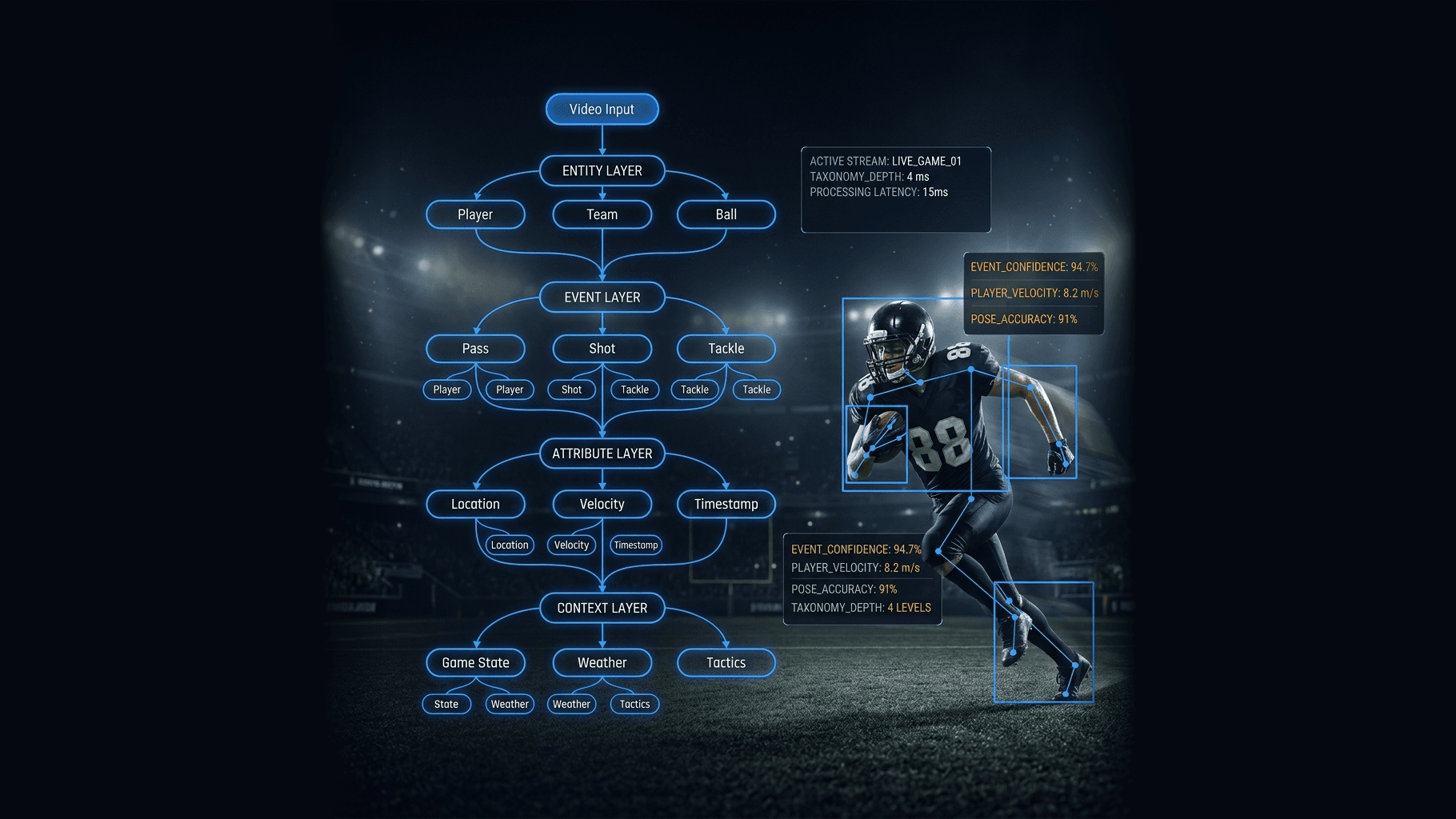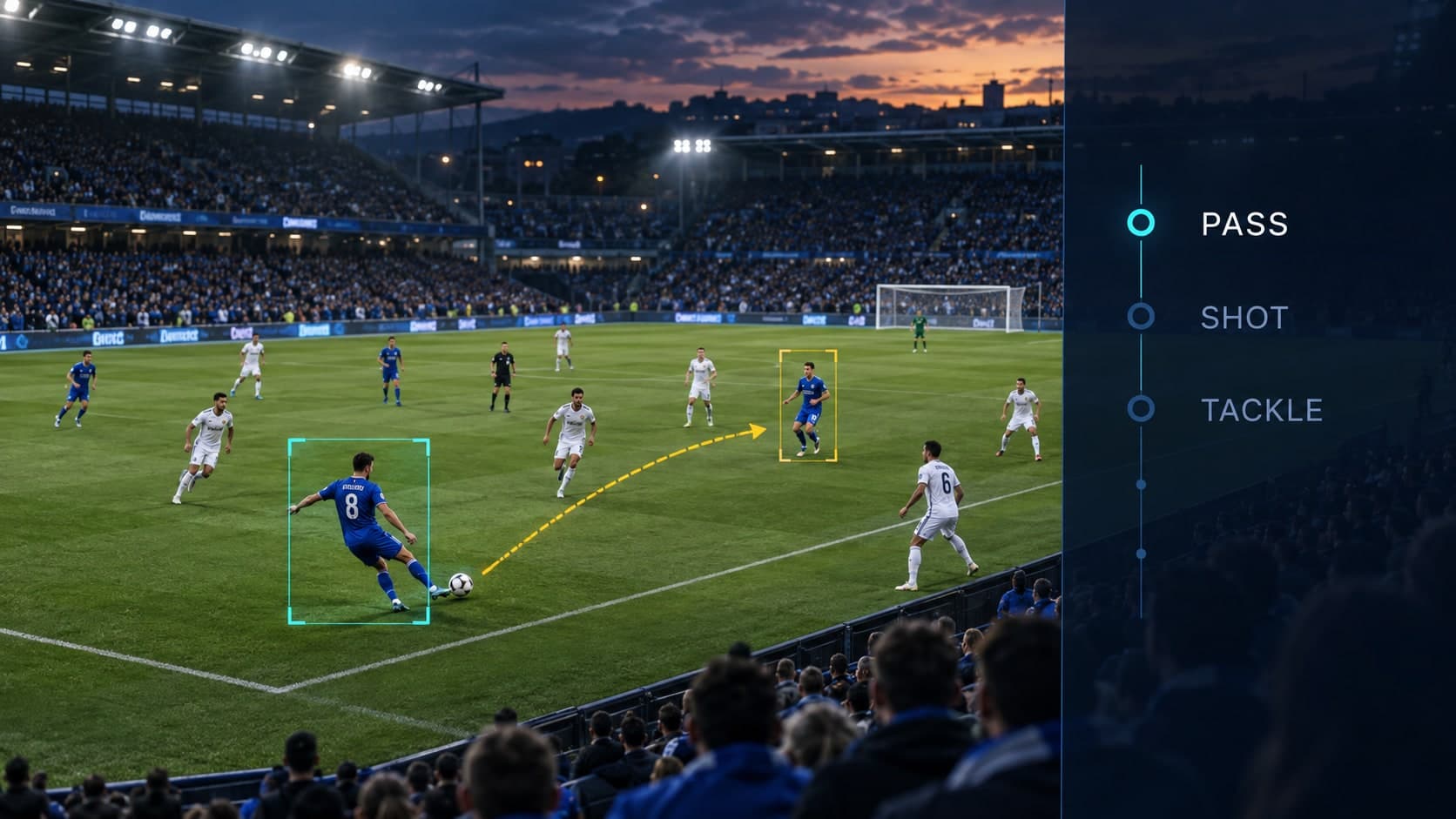
Football data tagging is the process of turning match video into structured data by labelling each on-ball action, such as a pass, shot, tackle or set piece, with its time, player, team and outcome. Clubs use tagged data for performance analysis and scouting. Federations and academies use it for matches that data providers do not collect, and sports AI companies use it as training data for models that detect events automatically.
If you are comparing football or sports data tagging services, the hard part is not finding one. It is knowing which kind of service fits your footage, your definitions and how accurate the output needs to be. This guide explains how match tagging works, what the research says about its accuracy, and how the main options compare.
Key Takeaways
- Event data records what happened; tracking data records where every player was. As of September 2026, Hudl StatsBomb reports over 3,400 events per match, and Stats Perform says its Opta Vision tracking produces over 2 million data points per game.
- Even expert taggers do not agree perfectly. When two independent groups of Opta operators tagged the same Spanish league match, agreement on team events gave kappa values of 0.92 and 0.94, where 1.0 would be perfect agreement (Liu et al., 2013).
- You have four routes to tagged match data: buy it from a data provider, tag in-house with analysis software, use AI auto-tagging, or hire a tagging service. They differ most on custom definitions and on who owns quality.
- Ask any tagging partner for its event definitions, its QA layers and an agreement or error report before you commit, and test it on your own footage.
What is the difference between event data and tracking data?
Event data is a log of actions; tracking data is a continuous record of positions. Stats Perform defines event data as "a record of every action in a match, captured in real time and post match through expert human analysts, optical tracking and proprietary AI models". It defines tracking data as a record of "the position of every player on the pitch throughout the match" (Stats Perform glossary).
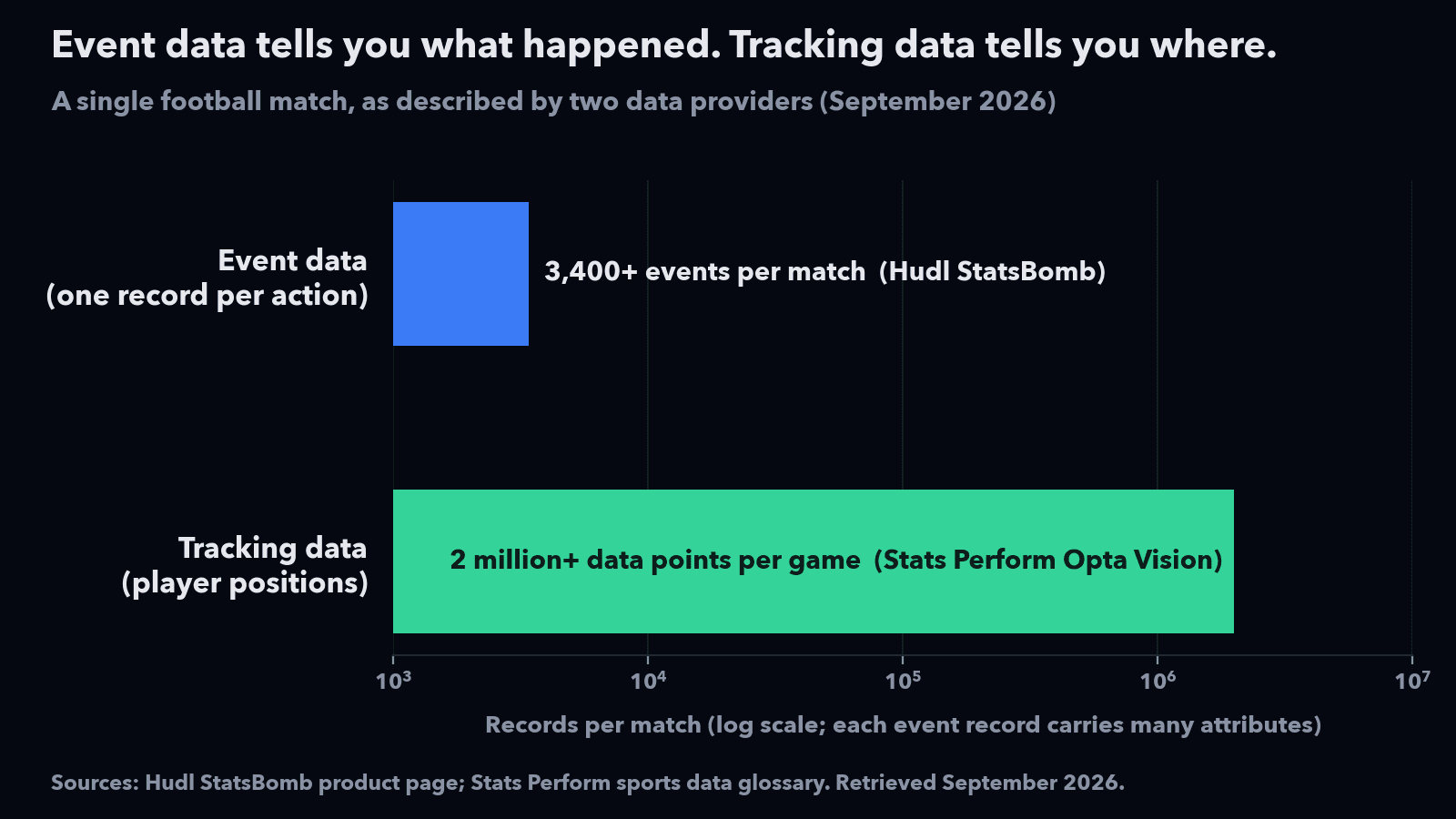
The two answer different questions. Event data tells an analyst that a player completed a progressive pass under pressure. Tracking data tells them where the other 21 players were when it happened. This guide focuses on event data, because that is what manual tagging produces. Tracking is far denser: Stats Perform says its Opta Vision tracking produces over 2 million data points per game (Stats Perform glossary). Tracking at that density is captured by camera systems and computer vision, not manual tagging.
A third term you will meet is live data, which Stats Perform describes as match action "as it happens" and "what sportsbooks price and manage in-play markets on". Post-match tagging trades that speed for more time to get each label right.
What gets tagged in a football match?
A football tagging schema usually covers on-ball actions, set pieces, goalkeeper actions and, for tactical work, phases of play. Opta's published Event Definitions group actions into categories such as goals and shots, passes, touches, duels and goalkeeper actions, each with a written rule for what counts.
A typical schema looks like this:
| Category | Example tags | Common extra fields |
|---|---|---|
| Passing | Pass, cross, through ball, long ball | Outcome, start and end location, body part |
| Shooting | Shot, goal, blocked shot | On or off target, xG (expected goals) inputs, situation |
| Duels | Tackle, aerial duel, dribble | Won or lost, location |
| Set pieces | Corner, free kick, throw-in, goal kick | Taker, delivery type |
| Goalkeeping | Save, claim, punch | Shot type faced |
| Phases | Build-up, counter-attack, pressing sequence | Start and end time |
The definitions matter more than the list. "Key pass" or "high press" can mean different things at two clubs, and a service tagging to the wrong definition produces data that looks complete but answers the wrong question. Our guide to designing a sports event taxonomy covers how to write definitions a tagging team can apply consistently.
How does football match tagging work?
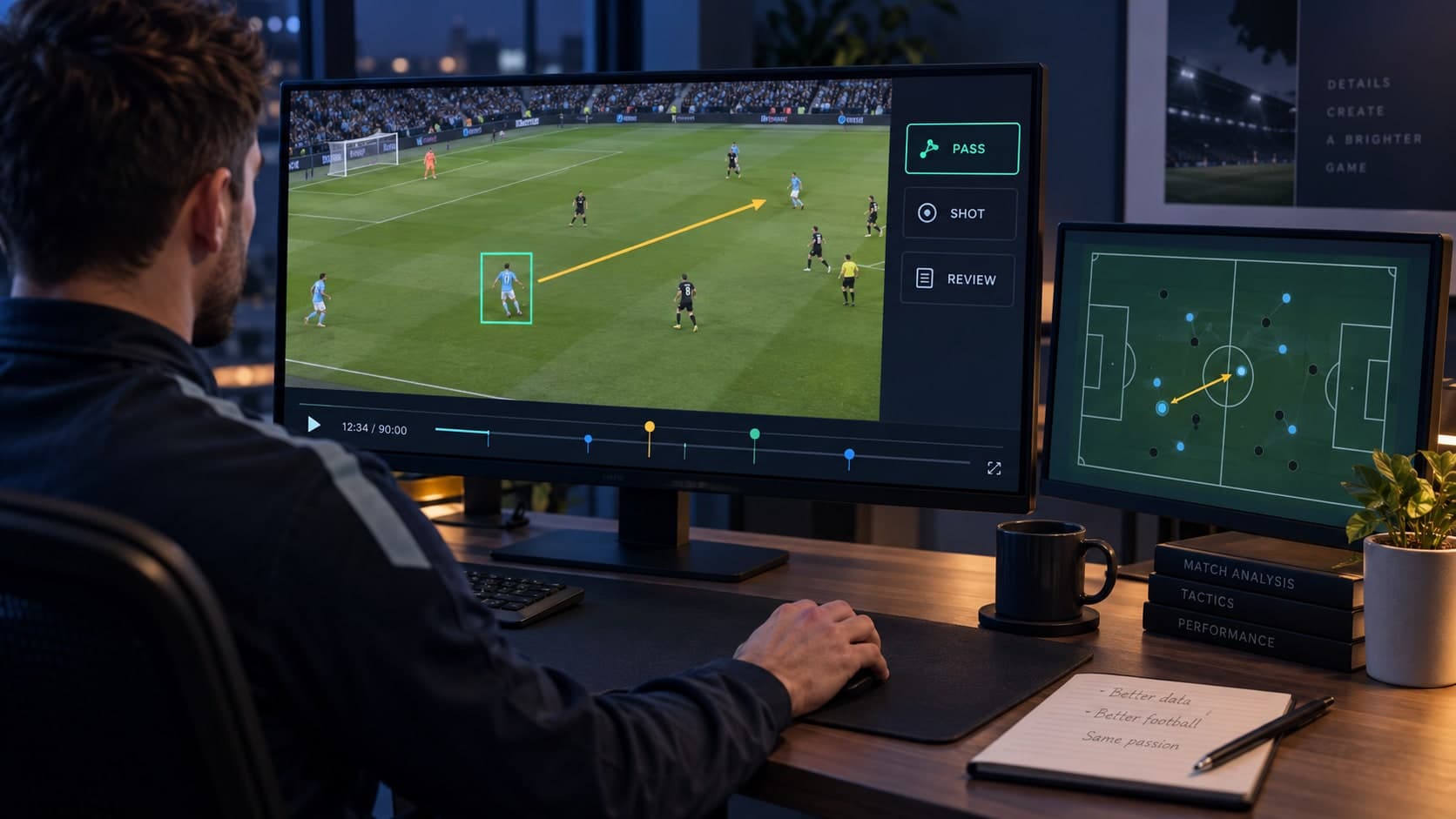
Illustration of a match-tagging workspace.
A reliable tagging workflow separates the first tag from the checks that make it trustworthy. The review, audit and reconciliation steps exist to catch the errors a single pass leaves behind.
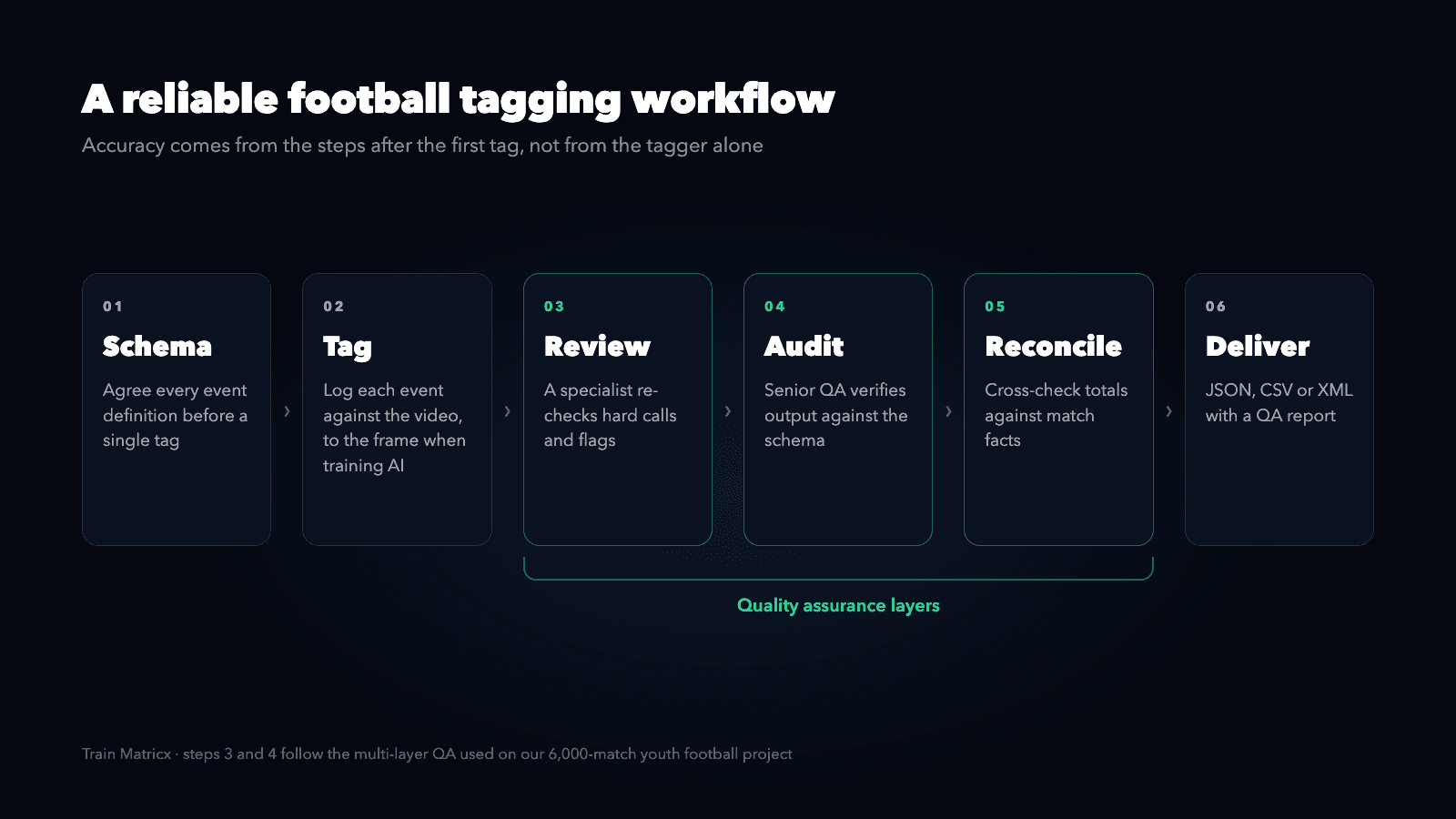
- Schema. Agree event definitions, extra fields and edge cases before tagging starts.
- Tag. Trained taggers log each event against the video. For analysis, the nearest second is often enough. For AI training data, each event should be stamped to the exact frame.
- Review. A specialist re-checks difficult calls, such as whether a deflected pass counts as a completion, and anything a tagger flagged as uncertain.
- Audit. A senior reviewer verifies the output against the schema before it leaves the team.
- Reconcile. Totals are cross-checked against facts that are already known, such as goals against the final score.
- Deliver. Data is exported in the client's format, with a report of what was checked and what was found.
In the annotation tool we built for basketball box scoring, events are stamped to the video frame on screen rather than to a rounded second. A label a tagger cannot confirm, such as an unreadable shirt number, is flagged into a review queue instead of guessed. If an official final score is entered, the tool also warns before export when derived points do not match it; in football, the equivalent check is goals against the result.
How accurate is football event data?
Expert football event data can be highly reliable, but it is not perfect, which is why the quality process matters as much as the taggers. One peer-reviewed study, published in the International Journal of Performance Analysis in Sport, tested this directly on Opta's live collection system.
Liu, Hopkins, Gómez Ruano and Sampedro had two groups of experienced operators tag the same Spanish league match independently, then measured how closely the groups agreed (Liu et al., 2013). Kappa measures agreement after allowing for chance, and 1.0 is perfect agreement. They reported:
- Team events: agreement between the groups gave kappa values of 0.92 and 0.94, which the authors describe as very good agreement.
- Goalkeeper actions: kappa values of 0.92 and 0.86.
- Timing: an average difference in event time of 0.06 seconds, plus or minus 0.04.
- Match actions and individual outfield player indicators: intra-class correlations from 0.88 to 1.00, where 1.00 is perfect agreement.
Two lessons follow, with the caveat that this is one match, in a study published in 2013. First, agreement below 1.0 among professional operators means some disagreement is normal. A vendor promising zero errors is not describing reality. Second, reliability varies by event type: the lowest single value reported, 0.86, was for goalkeeper actions. Ask a tagging partner which events it finds hardest and how it checks them.
For the metrics worth requesting, such as inter-annotator agreement and first-pass acceptance, see our guide on how to tell if an annotation vendor's labels are good.
What are your options for getting tagged football data?
There are four routes to tagged match data, and the right one depends on whether you need standard data for covered competitions or custom data for your own footage.
| Option | Examples | Best for | Custom definitions | Your own footage | Who owns quality |
|---|---|---|---|---|---|
| Buy from a data provider | Stats Perform Opta, Hudl StatsBomb | Professional competitions the provider already covers | Usually the provider's | Only matches in the provider's coverage | Provider |
| Tag in-house with software | Hudl Sportscode | Clubs with analyst time and their own tagging style | Fully custom | Yes | Your analysts |
| AI auto-tagging | Metrica Sports Smart Tagging | Automatic first-pass tags for phases and set pieces | Auto-detected categories | Yes | Not stated; review output before use |
| Tagging service | Driblab Data Tagging On Demand; managed annotation teams | Matches no provider covers: ready-made metrics and xG (Driblab) or tagging to your own schema (managed teams) | Varies by service | Yes | Varies; agree it in the contract |
Based on each company's public product pages, September 2026.
Data providers
Data providers sell event data collected to their own standards. As of September 2026, Hudl StatsBomb reports over 3,400 events per match across 190+ competitions, "collected by AI and pitch detection computer vision" and "validated with manual interventions from expert collectors" (Hudl StatsBomb). The trade-off is coverage. If your matches are academy, women's lower-league or amateur fixtures a provider does not collect, the data does not exist to buy.
Tagging in-house with analysis software
Tools such as Hudl Sportscode give analysts customisable coding tools and live capture for tagging their own matches. You get complete control over definitions, but every hour of tagging is an hour of analyst time. Quality depends on how consistently your own staff apply the definitions.
AI auto-tagging
AI tagging tools detect events automatically. Metrica Sports describes its Smart Tagging as an AI-driven feature that detects build-ups, counter-attacks, direct and organised attacks, shots and crosses, set pieces such as corners and throw-ins, and sprints (Metrica Sports, 2024). The categories are the tool's, and the announcement does not describe a human review step, so budget time to check the output before you rely on it. Our guide on whether AI auto-tagging still needs human QA covers where automatic tags miss and how to review them.
Tagging services
Tagging services take your footage and return data. On-demand tagging services let you upload a match and receive event data back. Driblab's Data Tagging On Demand, for example, lets clubs, federations, academies and agencies upload their own match videos. They receive events, metrics and models such as expected goals through an API, CSV or Driblab's own platform (Driblab, 2023). Managed annotation teams such as Train Matricx tag to a schema you define, which suits custom definitions and AI training data.
Is outsourced football tagging more accurate than in-house tagging?
Neither is more accurate by default. Accuracy comes from written definitions, trained taggers and independent review, not from where the team sits. In-house analysts know the club's definitions but often check their own work. A tagging service can add independent review and report agreement scores, but that only helps if it tags to your definitions. The fair way to compare is to have both tag the same match and measure how closely they agree, the same method Liu et al. used.
For the build-or-buy decision in more depth, see our comparison of in-house and outsourced sports annotation.
How much does football data tagging cost, and how long does it take?
Price and turnaround depend mostly on how many events you tag, how precise each label must be, and how many QA layers you need. A shots-and-goals schema on a single camera angle is a different job from frame-accurate tagging of every touch with player IDs.
There is no standard per-match rate. Annotation is usually priced per hour of annotator time, per labelled unit, or as a monthly retainer for a dedicated team, and the schema decides which works out cheapest.
The main cost drivers are:
- Schema depth. Tagging every pass with start and end locations takes far longer than tagging shots and set pieces.
- Precision. Frame-accurate timestamps and locations cost more than nearest-second tags.
- Footage quality. Wide single-camera youth football is usually harder to read than multi-angle broadcast.
- QA layers. Each independent review adds time but reduces errors that reach your analysis.
- Turnaround. Next-day delivery at volume needs a larger team than a weekly batch.
For pricing models and worked estimates, see our guide to what sports video annotation costs.
On turnaround, a managed team can run fast at scale when the process is set up for it. For Dark Horse AI, Train Matricx tagged more than 6,000 youth football (soccer) matches to a 30+ class taxonomy. New uploads were delivered within a 24-hour service level, through a three-layer QA process of primary annotator, specialist reviewer and senior auditor.
Tagging for match analysis vs tagging for AI training data
Tagging for AI training data needs stricter timing, stricter consistency and machine-readable output than tagging for coaches. A coach watching a clip reel forgives a tag that lands a second early; a model learning to detect passes does not.
| Requirement | Match analysis | AI training data |
|---|---|---|
| Timing | Nearest second is usually fine | Exact frame, consistent across taggers |
| Definitions | Club's own interpretation | Written rules applied identically every time |
| Consistency checks | Spot checks | Agreement metrics and audit trails |
| Output | Clips, dashboards, reports | JSON or CSV matched to the training pipeline |
| Uncertain labels | Often left to the tagger's judgement | Flagged for review, never guessed |
If you are building an event detection model rather than a report, our guide to computer vision for football player tracking and event logging explains how tagged events feed those models.
How to choose a football data tagging service
Choose on evidence from your own footage, not on the vendor's sample clips. These eight questions separate a reliable tagging partner from a risky one:
- Can you show me your written event definitions? Without them, consistency depends on each tagger's interpretation.
- Will you tag to our definitions? Essential if you already have an analysis model or dashboard.
- How many QA layers does each match go through, and who performs them?
- What agreement or error metrics do you report per delivery, and how is each one defined?
- How do you handle events a tagger is unsure about? "Flag and review" is the answer you want.
- Do you stamp events to the frame or to the second? This matters for AI training data.
- What formats do you deliver? Ask for the format your pipeline already reads.
- Will you tag a pilot match or clip from our footage before we commit?
For a broader vendor evaluation, see our buyer's checklist for sports annotation companies.
Frequently asked questions
What is data tagging in football?
Data tagging in football is labelling match video with structured records of each action, such as passes, shots, tackles and set pieces, including the time, player, team and outcome. The result is event data that analysts, scouts and machine learning models can query.
How quickly can a tagging service deliver a tagged match?
It depends on the schema and the number of QA layers. A shots-and-set-pieces schema is quick, while tagging every touch with locations through several reviews takes much longer. At scale, a managed team can work to a 24-hour turnaround per match: on its 6,000-match project for Dark Horse AI, Train Matricx delivered newly uploaded matches within 24 hours.
Can tagged event data contain errors?
Yes, even from experts. When two independent groups of Opta operators tagged the same match, agreement on team events gave kappa values of 0.92 and 0.94 (1.0 would be perfect agreement), and their event times differed by an average of 0.06 seconds (Liu et al., 2013). Independent review and agreement checks are how a tagging service catches the errors that remain.
Should a club tag matches in-house or outsource them?
In-house tagging suits clubs with analyst time and a settled tagging style. Outsourcing suits matches no provider covers, custom schemas at volume, and AI training data. You can also combine the two, tagging key matches in-house and outsourcing the rest.
Can AI tag football matches automatically?
Yes, for some categories. Tools such as Metrica Sports' Smart Tagging automatically detect phases like counter-attacks and build-ups, set pieces and shots. Custom definitions, uncertain calls and data used to train other models still benefit from human tagging and review.
See the difference on your own match
A reliable way to judge a tagging service is to give it your hardest footage and your own definitions, then check the output yourself.
Train Matricx tags football matches to your schema with sport-trained annotators, multi-layer QA and delivery in JSON, CSV, XML or a custom format. Start with a free pilot: send us a clip, and we will tag it and return a full QA report with accuracy scores, with no contract and no payment.
Written by the Train Matricx annotation team. Figures were checked against each company's public pages and the cited study in September 2026. Spot an error? Email info@trainmatricx.com.

Client results

“Train Matricx didn't just provide labeling — they became an extension of our team. With 6K+ football matches annotated and counting at 98% accuracy, they are our premier data partner.”

Billy Brush
Founder & CEO, Dark Horse AI
Don't take our word for it. Test the labels.
Send us the footage your current vendor gets wrong — the occluded players, the motion blur, the edge cases. We annotate it and return a QA report you can check frame by frame.
- Your hardest clip, annotated in 48 hours
- Full QA report with per-frame accuracy
- No commitment, no contract, no card