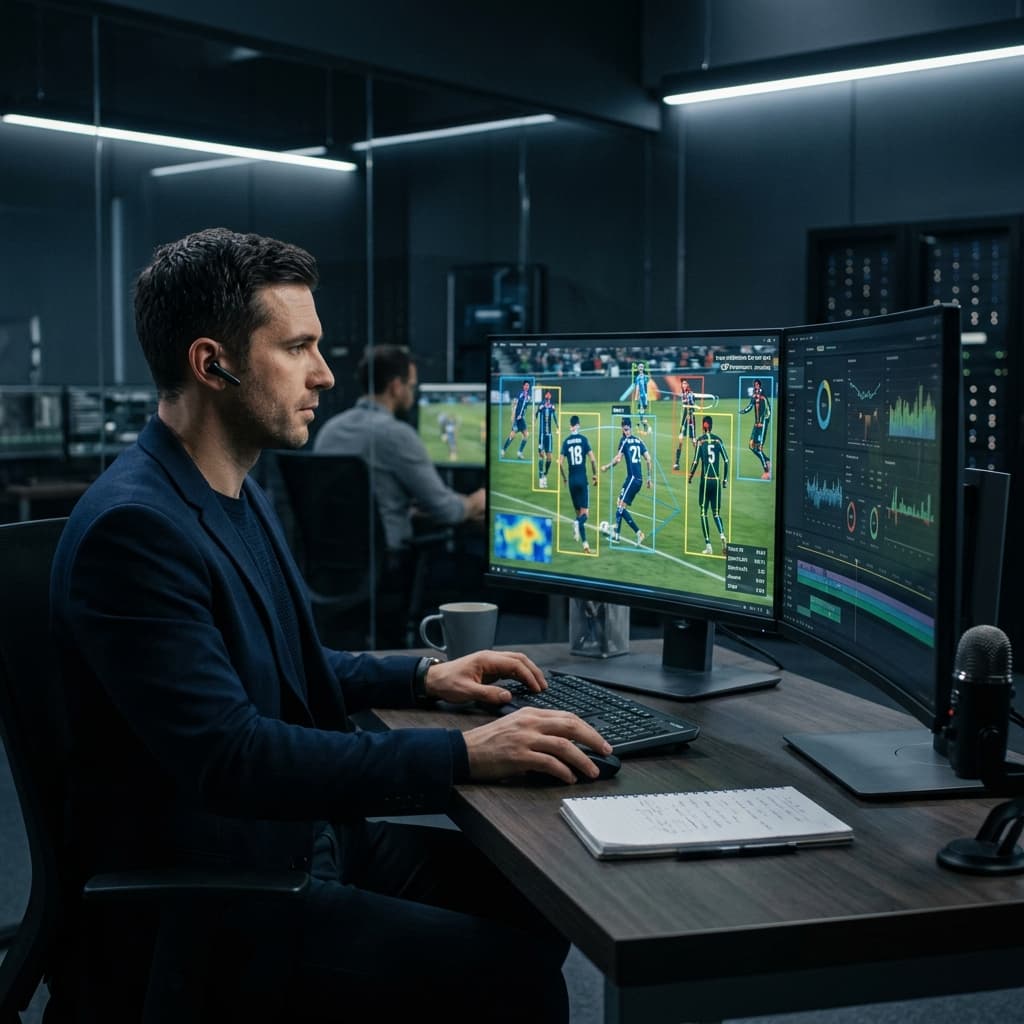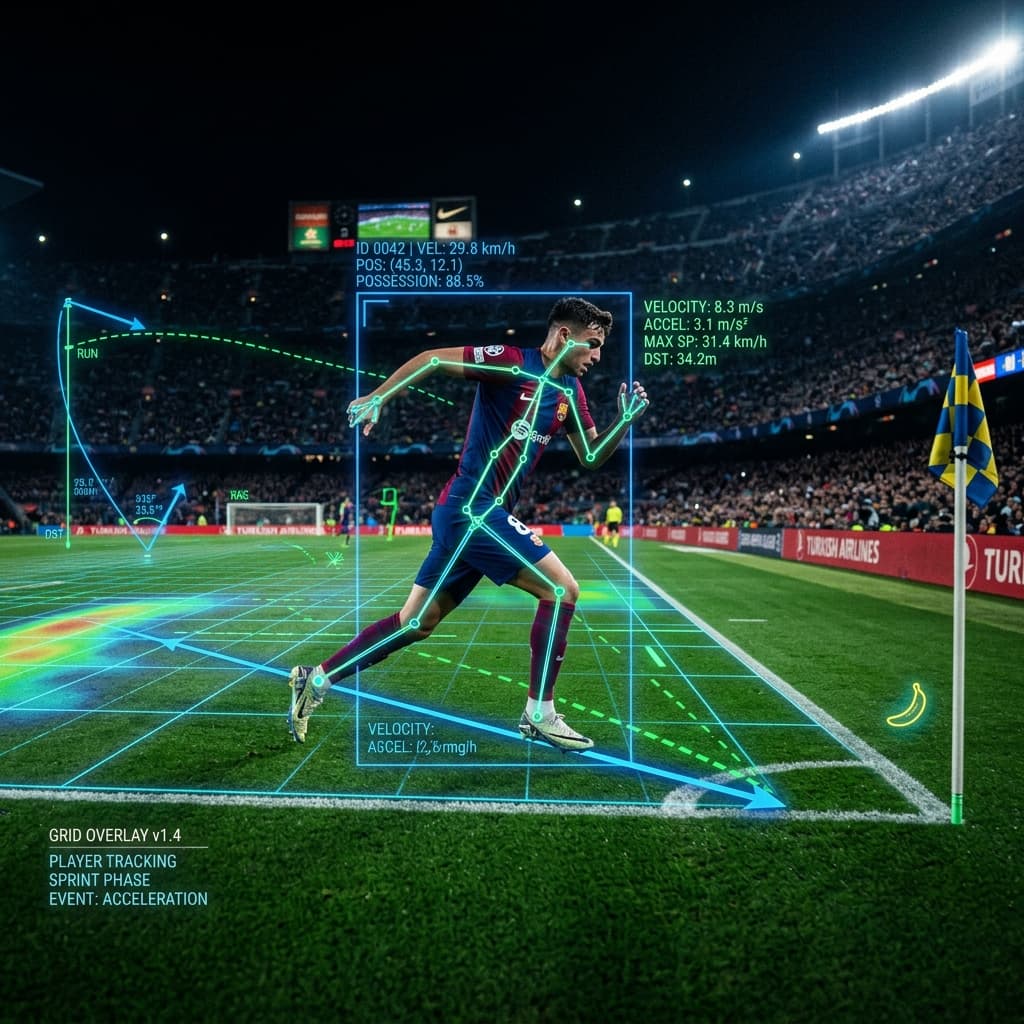
Most sports AI teams eventually find out that cheap annotation is not cheap. A dataset that looks complete can still train a broken model — if the event labels are inconsistent, if player IDs drift through occlusion, if the schema was never designed for the model's actual objective. The cost shows up later, in engineers spending weeks cleaning data instead of improving the model.
This post defines the six things that genuinely separate elite sports data annotation from annotation that looks right on delivery but fails in training.
The standard is higher than it looks
Sports footage is one of the hardest annotation environments in computer vision. It is not difficult because the objects are unusual. It is difficult because correct labels require understanding the sport — the rules, the events, the spatial context, the tactical intent — not just the pixels.
A bounding box on a player is visually straightforward. A tackle classification is not. Was it a legal shoulder challenge? A tactical foul? A blocking foul in basketball? A stumping chance in cricket? The label depends on what actually happened in the sport, not what is geometrically visible in the frame.
This is why the six non-negotiables below are not about technology. They are about whether the annotation team can do the job correctly.
Non-negotiable 1: annotators who understand the sport
The most important factor in sports annotation quality is not the tool, the price, or the platform. It is whether the people drawing boxes and labels understand what is happening in the footage.
Sport-aware annotators catch what generic annotators miss:
- The moment a tackle begins vs. when contact occurs
- Whether a ball deflected off boot, knee or chest before going out
- Whether a player was under defensive pressure when releasing the ball
- Whether two players in contact represents a legal action or a foul
These distinctions are what your event recognition model needs to learn. If the ground truth contains misclassifications here, the model learns those misclassifications.
The question to ask any annotation vendor: who labels the data, how are they trained on this sport specifically, and can you review a sample of their output before production begins?
Non-negotiable 2: schema design before any labeling starts
The best sports annotation projects start with a documented schema — a complete definition of every label, attribute, edge case and delivery format — before a single frame is annotated.
A schema answers:
- What counts as a "pass" in this sport? When does it start, when does it end?
- How do we label a deflection that changes the intended event type?
- What do we annotate when the ball is not visible?
- How are player IDs linked to events?
- What happens when an event spans a camera cut?
Without this, different annotators answer these questions differently. The result is training data that looks complete but contains inconsistency that no architecture change can remove.
A vendor that accepts footage and begins labeling without a taxonomy discussion is not a specialist. They are a generic service that happens to be working on sports footage.
Non-negotiable 3: temporal QA, not just frame QA
Frame-level QA catches visual errors: a box placed too loosely, a keypoint in the wrong position. It is necessary but not sufficient for sports annotation.
Temporal QA catches the errors that matter most for tracking and event models:
- A player ID that changes identity during an occlusion
- An event start frame that shifts by 3 frames across similar clips
- A tracking sequence where the ball disappears at contact and reappears two frames late
- Skeletal keypoints that are geometrically valid per frame but violate biomechanical continuity across the motion
These are invisible in frame-level QA. They only appear when you inspect the sequence. And they directly cause model drift, broken metrics and unreliable inference.
Ask any potential partner: does your QA team review full sequences or sample individual frames?
Non-negotiable 4: a pilot you can evaluate yourself
Accuracy claims mean nothing without context. "98% accuracy" tells you nothing about what was measured, how the ground truth was defined, or whether the metric applies to your specific use case.
The only reliable quality signal is reviewing actual labeled output on footage representative of your production environment — including hard scenarios: occlusion, fast ball movement, camera cuts, crowded scenes, ambiguous events.
Any annotation partner worth working with will offer a pilot. If they resist, that is the answer.
Evaluate the pilot against your own QA criteria, not the vendor's claimed accuracy. Your model will be trained on this data. You need to trust it independently. Our guide to measuring annotation quality lists the checks to run.
Non-negotiable 5: scalability without drift
A vendor that performs well on 500 frames may not perform well on 500,000. Scaling annotation volume introduces drift if the team does not have rigorous annotator onboarding, calibration rounds, reviewer auditing and a single source of truth for annotation rules. We publish our own onboarding and calibration standards so you can compare.
The specific risks at scale:
- New annotators interpret edge cases differently from the original team
- Reviewer fatigue introduces inconsistency in QA
- Schema guidelines accumulate exceptions that are never documented
- Delivery formats shift across batches without the client noticing
Before committing to a large project, ask how the vendor maintains consistency as volume grows. Ask how new annotators are trained and calibrated. Ask how schema updates are propagated to the full team. The vendor checklist turns these questions into a list you can send, and the pricing guide explains what drives the quote you get back.
Non-negotiable 6: data security matched to the sensitivity of the footage
Sports footage can contain proprietary match video, unreleased broadcast assets, club training sessions, athlete performance data and competitive tactical information. This is not equivalent to public image data.
Verify:
- Who has access to raw footage during annotation
- Whether annotators can download or export files
- How data is transferred, stored and deleted after delivery
- That deliverables remain the client's property with no vendor usage rights
This is not a box-ticking exercise for enterprise procurement. It is the minimum standard for any vendor handling commercially sensitive sports data.
How Train Matricx meets these standards
Train Matricx provides managed sports data annotation with sport-trained annotators, custom schema design, sequence-level QA and validated delivery across football, cricket, basketball, tennis and other sports.
Every project begins with a taxonomy review and pilot before any volume is committed. QA is structured around both visual accuracy and sport-logic verification. Delivery formats are agreed during scoping, not retrofitted after annotation.
See how we work or review results from live client projects. We offer a free pilot clip — annotated to our production standard — so you can evaluate quality before any commitment.
Frequently asked questions
What makes the best sports data annotation company? Six things: annotators with genuine sport knowledge, schema design before production starts, temporal QA across full sequences (not just individual frames), a pilot you can independently evaluate, proven ability to maintain consistency at scale, and clear data security and ownership terms.
Why does sport-specific expertise matter more than price? Because annotation errors that look minor at the frame level compound across training. A wrong event label, a broken player ID or a misclassified ball contact trains the model to reproduce that error. Fixing a model trained on bad data costs more in engineering time than the annotation savings achieved.
How do I test a sports annotation vendor before committing? Request a pilot annotation on footage that includes hard scenarios specific to your sport — occlusion, fast ball movement, ambiguous events. Evaluate the output with a domain expert and against your own QA criteria. Do not base the decision on claimed accuracy metrics from the vendor.
What should a sports annotation schema include? A schema should define: object classes, event classes and taxonomy, keypoint placement rules, visibility and occlusion handling, player ID continuity rules, event start and end frame definitions, confidence values, delivery format and edge case decisions. It should be documented before any labeling begins.
Can general annotation companies handle sports data? General companies can handle simple detection tasks on sports footage. They struggle with event classification, player re-identification through occlusion, temporal continuity and domain-specific edge cases — because these require annotators who understand the sport, not just annotation tooling.

Client results

“Train Matricx didn't just provide labeling — they became an extension of our team. With 6K+ football matches annotated and counting at 98% accuracy, they are our premier data partner.”

Billy Brush
Founder & CEO, Dark Horse AI
Don't take our word for it. Test the labels.
Send us the footage your current vendor gets wrong — the occluded players, the motion blur, the edge cases. We annotate it and return a QA report you can check frame by frame.
- Your hardest clip, annotated in 48 hours
- Full QA report with per-frame accuracy
- No commitment, no contract, no card