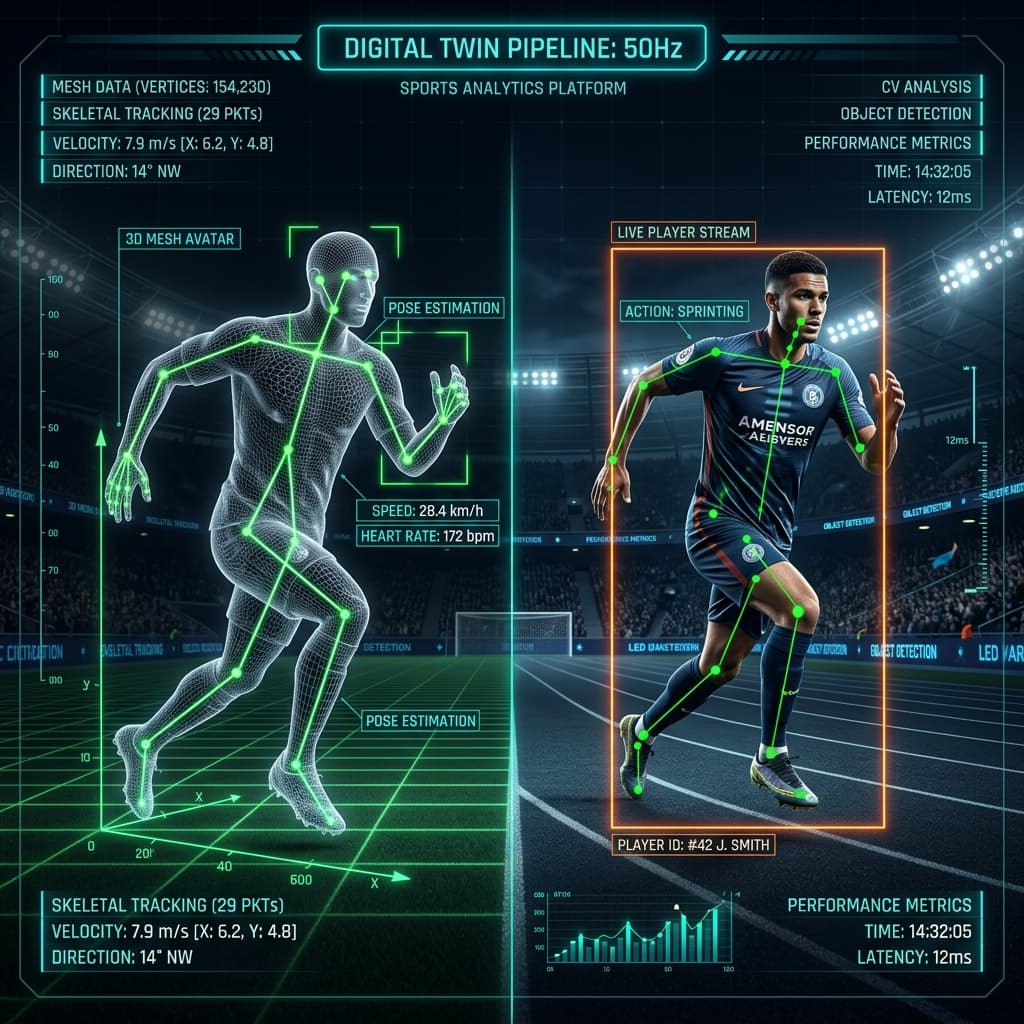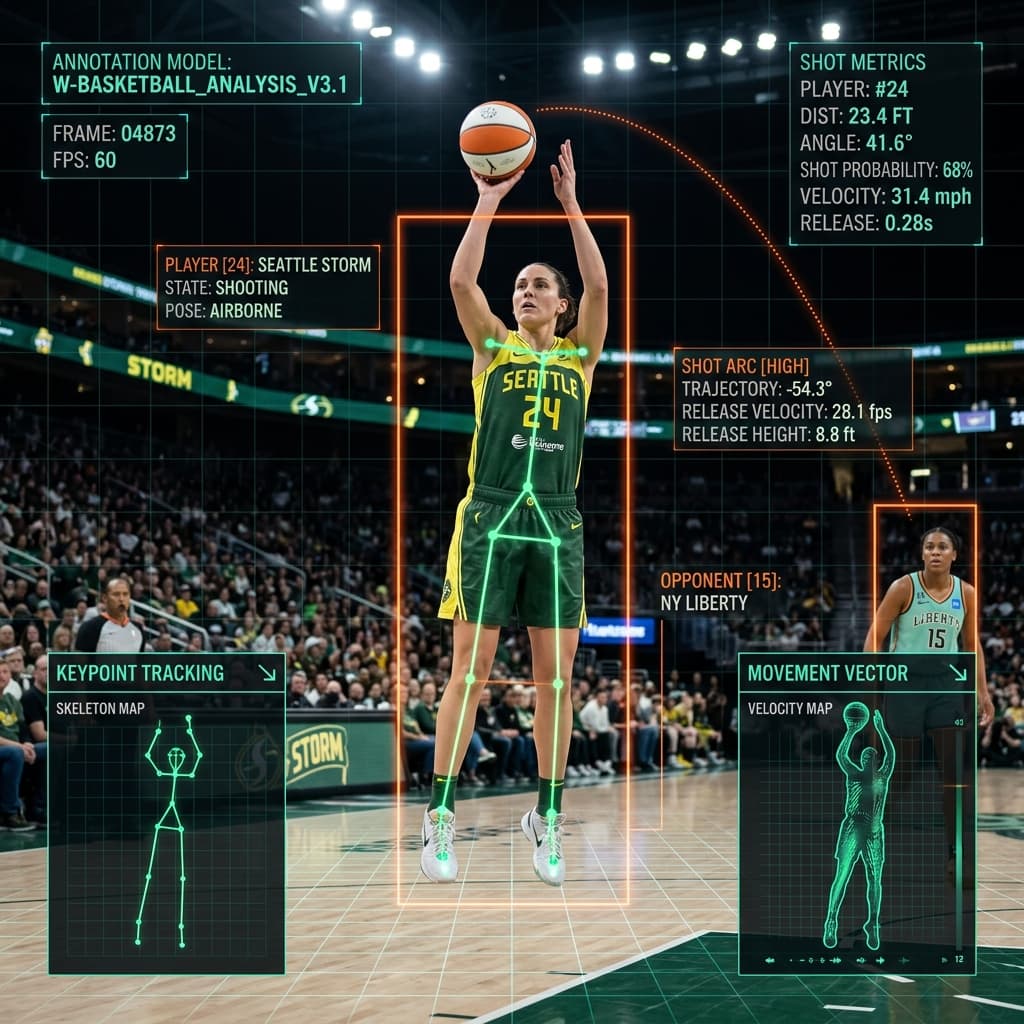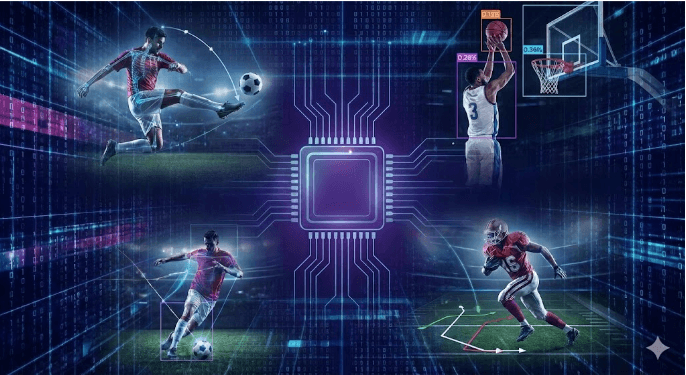
Computer vision in sports has moved from research labs to live stadiums. Semi-automated offside in the Champions League, ball-tracking in cricket and tennis, automated camera systems at grassroots football grounds, all of it runs on models that watch video and turn it into structured data.
This guide explains how computer vision in sports actually works, where it's being used today, and the part most teams underestimate: the training data that decides whether any of it performs. It's written for the people building these systems, not for a glossary.
What is computer vision in sports?
Computer vision in sports is the use of AI models to interpret sports video, detecting and tracking players, the ball, and officials, recognizing events like passes, shots and fouls, and converting raw footage into structured data for analytics, broadcast, and officiating. Because it's optical, it needs no wearable sensors and can be applied to live feeds or historical footage.
That structured output, who is where, what happened, and exactly when, is what powers everything downstream, from a coach's tactical dashboard to a broadcaster's AR overlay. For the full breakdown of how detection, tracking and event recognition fit together, see our complete guide to computer vision in sports.
How computer vision in sports works
Most sports CV systems run the same pipeline, regardless of sport:
- Capture — broadcast feeds, fixed tactical cameras, or automated multi-camera rigs record the action.
- Detection — a model finds objects in each frame: players, the ball, the referee, the goal.
- Tracking — detections are linked across frames so each player keeps a consistent identity over time.
- Event recognition — the system classifies what's happening: a pass, a tackle, a shot, a substitution.
- Analytics — the structured output feeds tactical models, performance metrics, broadcast graphics, or officiating tools.
| Stage | What it produces | Where it breaks |
|---|---|---|
| Detection | Bounding boxes, keypoints | Small/blurred objects (a fast ball) |
| Tracking | Persistent player IDs | Occlusion, players crossing |
| Event recognition | Labeled events + timestamps | Ambiguous or rare events |
| Analytics | Metrics, overlays, insights | Any upstream error compounds here |
Every stage depends on the one before it. A detection miss becomes a tracking error becomes a wrong stat. That's why data quality matters more than model novelty, a point we'll come back to.
Core applications of computer vision in sports
Officiating and fair play
The most visible use. High-speed cameras and CV models support goal-line technology, semi-automated offside (mapping a player's limbs against the last defender), and video review. These systems need millimeter spatial accuracy and frame-perfect timing.
Player tracking and load management
Optical tracking maps each player's position several times per second without GPS vests. Teams use it for distance covered, sprint counts, and workload, increasingly with skeletal tracking to flag fatigue or asymmetry that can precede injury.
Tactical analysis
CV turns formations and movement into data: spacing, pressing triggers, pass networks, defensive shape. Analysts get heat maps and tactical phases instead of re-watching full matches.
Broadcast and AR graphics
Virtual offside lines, ball-trajectory trails, shot maps, and live win-probability graphics all sit on top of CV tracking. Here even a few frames of error visibly breaks the overlay, so the data bar is unforgiving.
Computer vision in sports training
Beyond match day, computer vision in sports training analyzes technique, posture, and repeatable movement patterns. With accurate pose and skeletal data, models compare sessions over time, surface technical habits, and give coaches structured feedback that used to require an expert eye and hours of tape.
Computer vision by sport
Models don't transfer cleanly between sports, the rules, camera angles, and events differ, so the data has to be sport-specific.
Football (soccer): player and team detection, ball tracking, and event logging (passes, tackles, shots, offside phases), often with 22-point skeletal tracking for posture and technique.
Basketball: heavy occlusion in a confined court; pick-and-roll detection, player spacing, and automated shot charts with x/y coordinates per shot.
Cricket: small, fast, frequently occluded ball; ball-trajectory and pitch-map tracking for DRS-style analysis, plus skeletal tracking of batting and bowling mechanics.
Tennis and golf: individual biomechanics and ball physics, trajectory prediction, swing analysis, and the kinetic chain of a serve or drive.
The real bottleneck: training data
Here's what teams learn the hard way. A model doesn't inherently know the difference between a tackle and an interception, or between a referee and a player in the front row. It learns from labeled examples, thousands of hours of video annotated by people.
This is sports data annotation, and it's where most projects quietly fail:
- Generic labelers don't understand the sport. They confuse events, miss ball contact, and mislabel poses, and the model learns the mistakes.
- Hard frames break automation. Occlusions and fast motion are exactly where auto-labeling fails and where models need the most reliable data.
- Inconsistency is invisible until it isn't. Two annotators labeling the same clip differently injects noise that caps your model's ceiling.
The result is engineers spending weeks cleaning labels instead of improving models, and product timelines slipping. The fix isn't a better algorithm; it's sport-specific, expert-verified data with real quality control.
Build in-house or partner?
Most teams can't justify hiring and training a sport-expert annotation team in-house, the volume is spiky and the expertise is niche. The alternative is a specialist partner who already has sport-trained annotators and a QA pipeline.
If you're evaluating that route, it's worth comparing sports computer vision companies on domain expertise and quality process, not just price. The cheapest label is expensive if your engineers have to redo it.
At Train Matricx, this is the entire focus: we've delivered 6,000+ annotated football matches for a single client with roughly 98% of work accepted on the first pass. That number comes from sport-trained annotators and a three-layer QA process, not from volume alone.
Frequently asked questions
What is computer vision used for in sports? Tracking players and the ball, recognizing events (passes, shots, fouls), supporting officiating (offside, goal-line), generating broadcast graphics, and analyzing technique and workload in training.
How accurate is computer vision in sports? Accuracy depends almost entirely on training-data quality. Detection on clean frames is highly reliable; the hard cases, occlusion, fast motion, rare events, are where accuracy is won or lost, and where expert annotation matters most.
Does computer vision in sports need wearable sensors? No. It's optical, working from camera footage alone, so it can be applied to live broadcasts or historical video without players wearing anything.
Why is training data so important for sports AI? Models learn from labeled examples. If labels are inconsistent or wrong, the model learns those errors. Sport-specific, expert-verified annotation is what makes the difference between a demo and a production system.
What sports can computer vision be used for? Effectively any sport, football, basketball, cricket, tennis, golf, hockey and more, but each needs its own taxonomy and annotation approach because events and camera setups differ.
The takeaway
Computer vision in sports is no longer experimental, it's in officiating, broadcast, analytics, and coaching. But the systems that work share one thing: clean, sport-specific training data. The model gets the headlines; the data does the work.
If you're building sports CV models and the data is your bottleneck, see how we work or explore our case studies. Send us a hard clip and we'll annotate it free, so you can judge the quality before committing.

Client results

“Train Matricx didn't just provide labeling — they became an extension of our team. With 6K+ football matches annotated and counting at 98% accuracy, they are our premier data partner.”

Billy Brush
Founder & CEO, Dark Horse AI
Don't take our word for it. Test the labels.
Send us the footage your current vendor gets wrong — the occluded players, the motion blur, the edge cases. We annotate it and return a QA report you can check frame by frame.
- Your hardest clip, annotated in 48 hours
- Full QA report with per-frame accuracy
- No commitment, no contract, no card