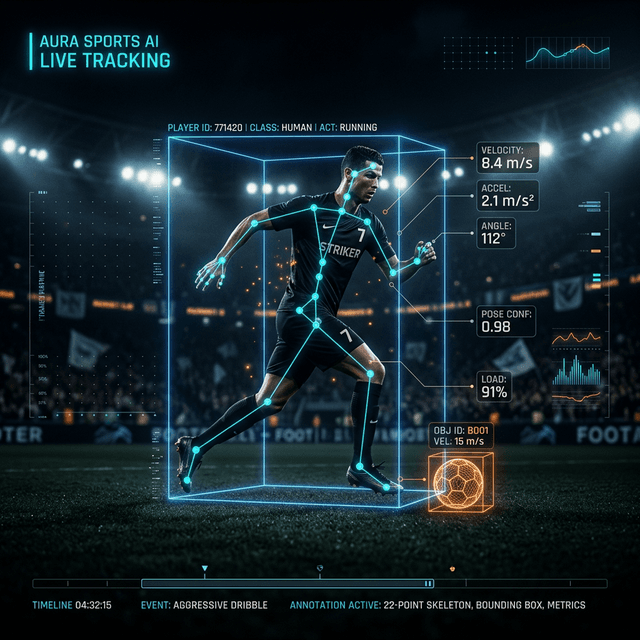
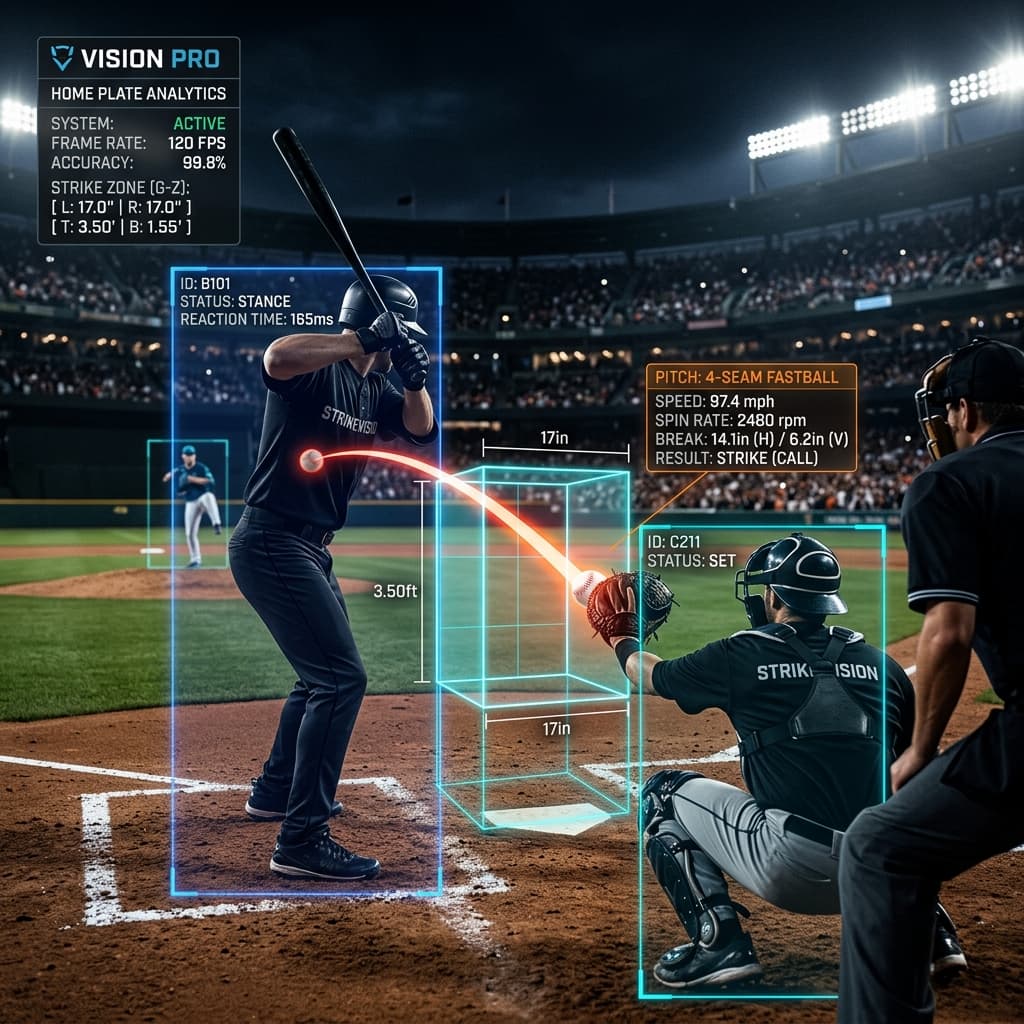
European leagues are expected to authorize wearable use during live competition in 2026, a meaningful regulatory shift that extends a model already running at scale in the NHL, where RFID tags embedded in pucks and jerseys work alongside camera-based tracking, not instead of it. This matters more than it sounds: it signals that the industry has settled on a clear answer to a question that's been open for years, are wearables or computer vision the future of sports tracking? The answer turning out to be neither alone.
This guide covers why sensor fusion, combining wearable sensor data with computer vision, is becoming the standard, what each technology is actually good at, and why the training data underneath computer vision doesn't become less important as wearables get more common.
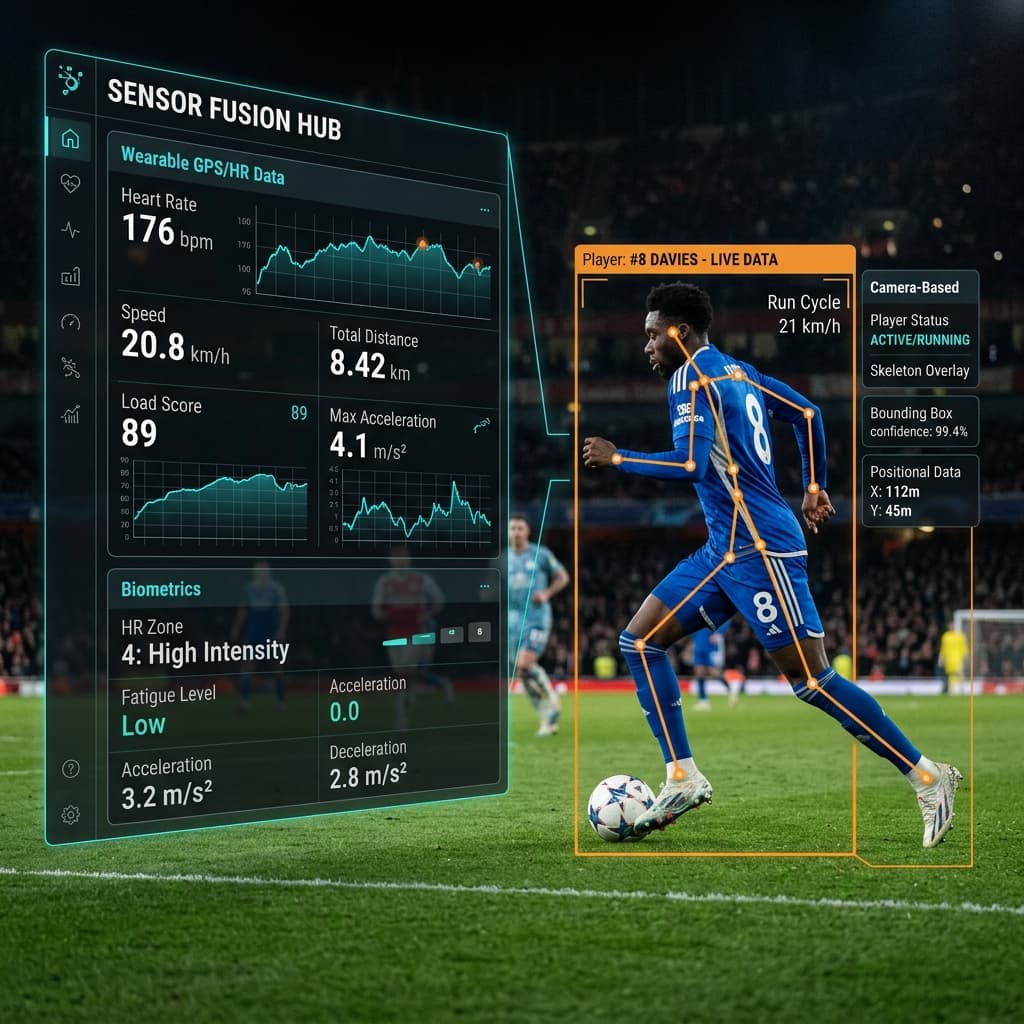 High-end technical visualization of sports sensor fusion: combining wearable telemetry data (GPS, heart rate, acceleration) with camera-based player bounding boxes and pose tracking.
What is sensor fusion in sports AI?
Sensor fusion in sports AI is the combination of wearable sensor data, GPS, accelerometers, RFID and inertial measurement units, with camera-based computer vision tracking, using each technology's strengths to compensate for the other's weaknesses, rather than relying on either approach alone.
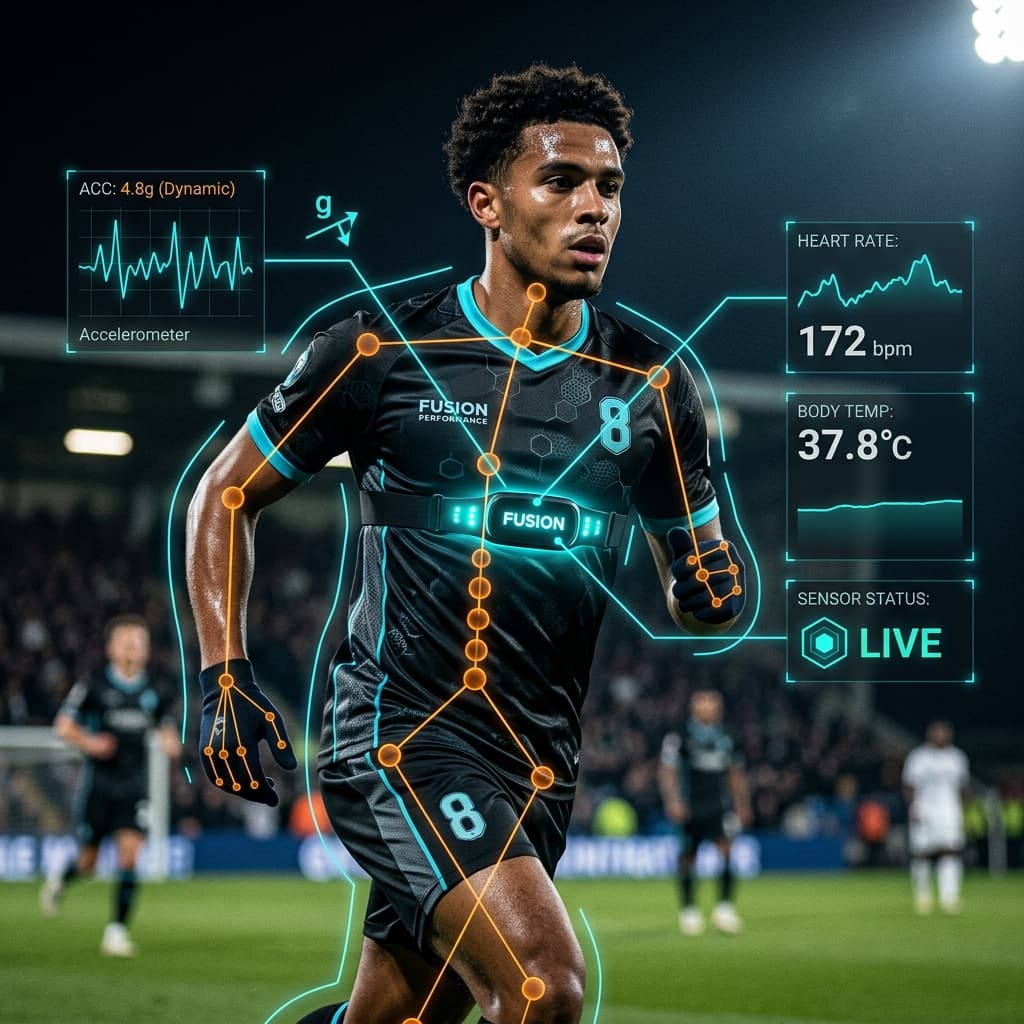 Live athlete analysis fusing body skeletal tracking coordinates with chest strap telemetry including accelerometer load and heart rate.
Wearables are excellent at measuring things happening directly on or inside the athlete's body or equipment, acceleration, heart rate, exact load. Computer vision is excellent at measuring things that require visual or tactical context, what event occurred, where a player is relative to teammates and opponents, whether a movement was legal. Neither fully replaces the other.
What wearables do better than computer vision
Direct physiological measurement. A wearable accelerometer or heart rate monitor measures what's actually happening inside an athlete's body or equipment directly. Computer vision can estimate physical exertion from movement patterns, but it's an inference, not a direct measurement, and direct measurement is more reliable for load management and injury risk monitoring.
Reliability through occlusion. A wearable sensor doesn't care whether the athlete is visible to a camera. It continues recording through a pile-up, a scrum, a crowded goal-line scramble, exactly the scenarios where computer vision tracking is hardest, as covered in detail in our breakdowns of rugby's scrum and ruck occlusion problems and the NHL's puck battles along the boards.
Precision for specific physical metrics. GPS and inertial sensors can measure distance covered, top speed and acceleration with a level of granularity that's difficult to match optically, particularly across a full match or training session rather than isolated moments.
What computer vision does better than wearables
Tactical and contextual understanding. A wearable can tell you an athlete accelerated rapidly. It cannot tell you whether that acceleration was a pressing trigger, a counter-attacking run, or a recovery sprint back into position, because that requires understanding the positions of every other player on the field at that moment, which is visual, tactical information no body-worn sensor captures.
Ball and equipment tracking. Most sports need to track the ball, puck or other equipment as closely as the players. A wearable on a player tells you nothing about where the ball is unless the ball itself is also instrumented, and even then, equipment-mounted sensors face their own limitations, as covered in our analysis of why ball tracking is the hardest problem in several sports.
Event and rule-based classification. Determining whether a tackle was legal, whether a player was offside, whether a shot was a clean strike, all require visual and rule-based interpretation that a wearable's motion data alone cannot provide. This is precisely the kind of officiating-grade precision problem semi-automated offside technology solves through camera-based limb tracking, not wearables.
Coverage without instrumenting every object. A computer vision system observing a match doesn't require every player, official and piece of equipment to be separately fitted with sensors, which matters enormously for officiating applications and any scenario involving objects, like a ball, that can't practically carry a sensor in every sport.
Why the NHL's model became the template
The NHL's combination of RFID tags in pucks and player jerseys with computer vision tracking offers a clear, working example of how sensor fusion plays out in practice. RFID gives precise position data even when the puck or a player briefly leaves clear camera view. Computer vision adds the tactical and event layer, what's actually happening on the ice, that position data alone can't provide.
Neither system alone matched what the combination achieves. RFID positional data without visual context can't tell you whether a particular sequence was a clean breakaway or a delayed offside. Computer vision alone struggles with exactly the high-speed, frequently occluded puck-tracking problem RFID solves more directly. The fusion approach exists because each technology's weak points are the other's strong points.
Why this changes what "good training data" means
A common assumption is that as wearables become more common and provide more direct physical measurement, the importance of computer vision training data should decrease. The opposite is closer to true.
Fusion systems need computer vision data that's specifically designed to combine with sensor data, not stand alone. Training data for a fusion pipeline needs to support synchronisation between sensor timestamps and visual frames, position data needs to be annotated in a way that can be cross-referenced against sensor-derived position data, and event labels need to be structured so they can be linked to the precise sensor readings occurring at the same moment.
The visual layer still carries all the tactical and rule-based information sensors can't provide. Even in a fully fused system, the event taxonomy, the tactical classification, the officiating-grade rule interpretation, still depends entirely on computer vision, sensors don't reduce the need for this layer, they just add a complementary data stream alongside it.
Validation becomes a cross-checking problem, not just a single-system accuracy problem. When sensor and visual data disagree on a measurement, which is correct, and why, becomes a genuine quality assurance question. Building reliable fusion systems requires training and QA processes specifically designed to reconcile two independent measurement systems, not just validate each one in isolation.
What sensor fusion training data actually requires
| Component | What it needs |
|---|---|
| Temporal synchronisation labels | Frame-accurate alignment between sensor timestamps and visual tracking data |
| Cross-validated position data | Ground truth that can be checked against both visual tracking and sensor-derived position independently |
| Event labels linked to sensor readings | Tactical and rule-based event classifications tied to the specific sensor data occurring at that moment |
| Occlusion-aware visual annotation | Clear labelling of exactly when and why visual tracking confidence drops, so the system knows when to weight sensor data more heavily |
| Discrepancy resolution rules | A defined process, built into the schema, for handling cases where sensor and visual data disagree |
This is meaningfully more involved than building a standalone computer vision dataset, because the annotation has to anticipate how the visual data will be combined with an entirely separate measurement system, not just stand on its own.
Who is adopting sensor fusion right now
Professional ice hockey, where the NHL's combined RFID and computer vision model has operated at scale for several seasons and is regularly cited as a reference model for other leagues.
European football leagues, moving toward authorizing in-competition wearable use in 2026, a regulatory shift that will create demand for fusion-ready computer vision systems across leagues that have, until now, relied on camera-based tracking alone during live matches.
Player welfare and load management programs, which increasingly combine wearable physiological data with computer vision movement analysis to build a more complete picture of injury risk than either data source alone provides.
Broadcast and performance analytics platforms, looking to layer sensor-derived physical metrics, like exact acceleration or heart rate, on top of the tactical and positional graphics that computer vision already powers.
Frequently asked questions
What is sensor fusion in sports? Sensor fusion is the combination of wearable sensor data, such as GPS, accelerometers and RFID tags, with camera-based computer vision tracking, using each technology's strengths to address the other's limitations rather than relying on either one alone.
Are wearables replacing computer vision in sports tracking? No. Wearables and computer vision measure fundamentally different things. Wearables excel at direct physiological and positional measurement, particularly through occlusion. Computer vision excels at tactical context, event classification and tracking objects like the ball that can't easily be instrumented. The industry trend is combining both, not replacing one with the other.
Why did European leagues move to authorize wearables in competition in 2026? As wearable technology has matured and proven valuable for player welfare monitoring and performance analytics in training environments, leagues have moved to extend that same data collection into live competition, following models like the NHL's combined RFID and computer vision tracking system that has operated successfully at scale.
How does the NHL combine RFID and computer vision tracking? RFID tags embedded in pucks and player jerseys provide precise position data even during occluded sequences like puck battles along the boards. Computer vision adds the tactical and event layer, classifying what's actually happening in the game, that positional data from RFID tags alone cannot provide.
Does sensor fusion reduce the need for computer vision training data? No, it changes what that training data needs to look like. Fusion systems still depend entirely on computer vision for tactical classification, rule-based event recognition and ball or equipment tracking. The training data additionally needs to support synchronisation and cross-validation with sensor data, which is a more complex requirement than building a standalone computer vision dataset.
What happens when wearable sensor data and computer vision tracking disagree? This is a genuine quality assurance challenge in fusion systems. Resolving discrepancies requires a defined process, built into the system's design, for determining which data source to trust in a given scenario, often based on known limitations of each system, such as weighting sensor data more heavily during visual occlusion.
Can wearables track the ball or equipment as well as players? Only if the ball or equipment itself is separately instrumented, which introduces its own technical and regulatory considerations. Player-worn sensors alone provide no direct information about ball or equipment position, which is why computer vision remains essential for ball tracking even in heavily sensor-instrumented sports.
What training data does a sensor fusion system need that a standalone computer vision system doesn't? Frame-accurate temporal synchronisation labels aligning sensor timestamps with visual data, position data structured to be cross-validated against sensor-derived measurements, and event labels explicitly linked to the sensor readings occurring at the same moment, none of which are necessary when building a computer vision system that operates independently.
The takeaway
Sensor fusion is becoming the standard in elite sport because wearables and computer vision solve different problems, and the industry has largely stopped treating them as competing approaches. Wearables handle direct physical measurement and occlusion-proof positioning. Computer vision handles tactical context, rule-based events and the objects that can't be instrumented. Building for this fused future requires training data designed from the start to combine with sensor data, not just stand on its own.
If you're building sensor fusion or computer vision systems for professional sport and need training data designed for this kind of integration, see how Train Matricx works or review annotated dataset results in our case studies. We annotate a free pilot clip so you can evaluate quality before committing to any volume.

Client results

“Train Matricx didn't just provide labeling — they became an extension of our team. With 6K+ football matches annotated and counting at 98% accuracy, they are our premier data partner.”

Billy Brush
Founder & CEO, Dark Horse AI
Don't take our word for it. Test the labels.
Send us the footage your current vendor gets wrong — the occluded players, the motion blur, the edge cases. We annotate it and return a QA report you can check frame by frame.
- Your hardest clip, annotated in 48 hours
- Full QA report with per-frame accuracy
- No commitment, no contract, no card