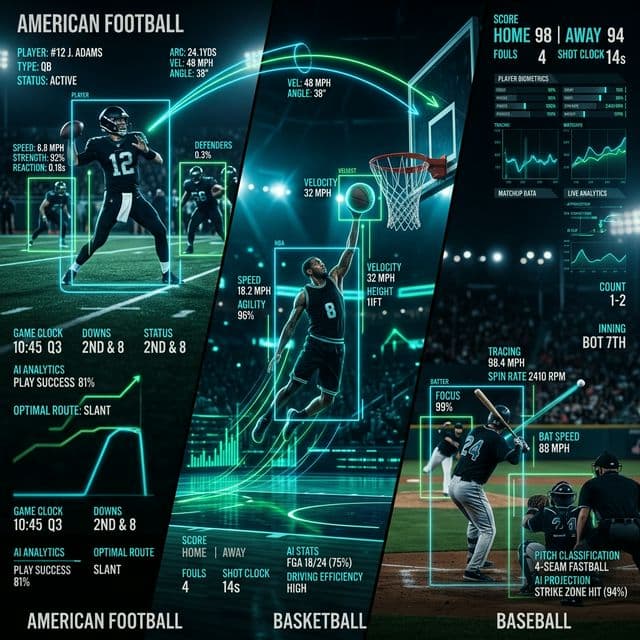
The Pivot from Prototype to Production
In 2026, the global ecosystem of Sports Tech Companies has never been more competitive. Walk onto the floor of the MIT Sloan Sports Analytics Conference or the Sports Innovation Lab, and you will see dozens of incredible computer vision prototypes.
Startups are pitching automated tactical cameras, AI-powered broadcast AR graphics, and marker-less motion capture systems. In controlled, well-lit beta environments, these algorithms perform beautifully.
However, a brutal reality sets in when Sports Tech startups attempt to scale these models into live production. A neural network trained on 50,000 frames of sunny practice footage will catastrophically hallucinate when deployed in a dimly lit, rainy stadium with 22 overlapping players.
The bottleneck isn't the algorithm. The bottleneck is scaling the Ground Truth data pipeline.
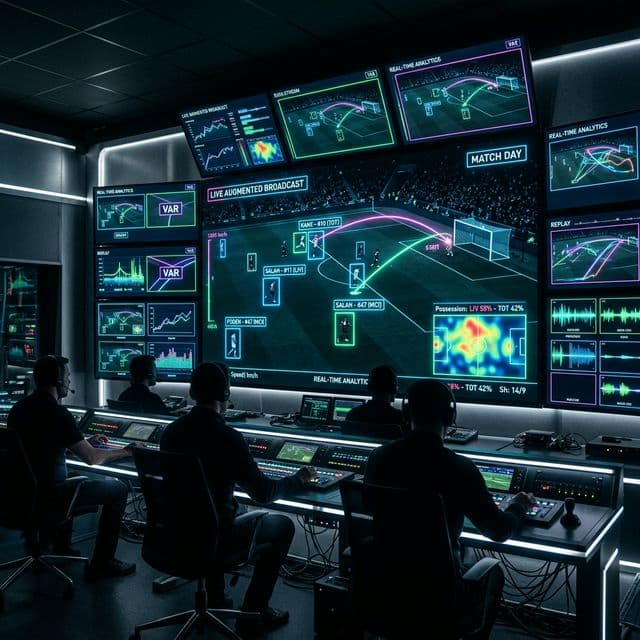 To deploy automated broadcast graphics, Sports Tech companies must train flawless real-time inference models.
1. Automated Smart Cameras: Beating the Occlusion Penalty
Companies building automated tracking cameras (systems designed to mount on stadium roofs and autonomously follow the ball or players) face a unique visual challenge: extreme distance and angle.
When a camera is looking down from 100 feet in the air, the pixel density of the players is incredibly low. A soccer ball moving at 70 mph across a green pitch is often represented by just a faint 3x3 cluster of blurred pixels.
The Annotation Challenge
To train these autonomous cameras, Sports Tech companies need millions of highly specific bounding box and polygon mask annotations. If an auto-labeler is used, it often loses the ball against the stadium background or merges overlapping player identities during a crowded corner kick.
To achieve the 99% Player Re-ID accuracy required to generate automated highlight reels, startups rely on managed human-in-the-loop workforces to perform sub-pixel tracking and interpolation.
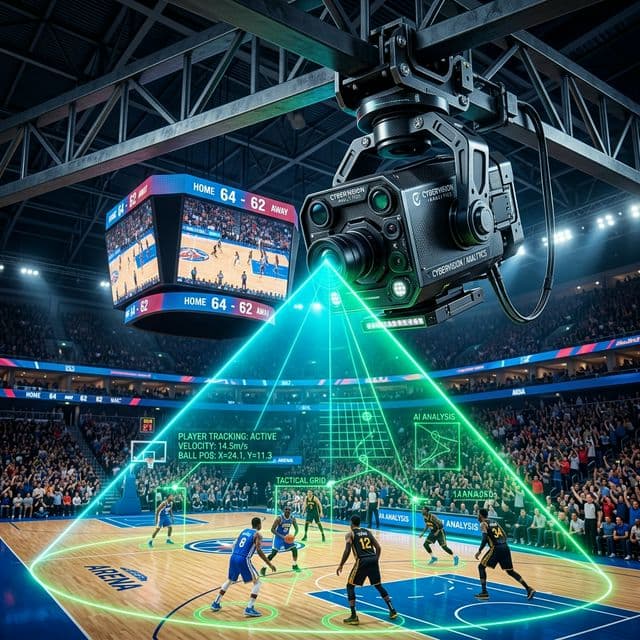 Training autonomous smart cameras requires annotators who understand wide-angle distortion and sub-pixel ball tracking.
2. Market-less MoCap and Wearables: The Skeletal Dilemma
The next frontier for Sports Tech is biomechanical analysis. High-performance athletes are increasingly relying on tablet-based swing analyzers, sprint form correctors, and injury-prevention algorithms.
Historically, this required athletes to wear intrusive tracking suits with physical ping-pong ball markers in million-dollar MoCap (Motion Capture) studios. Today, Sports Tech companies are building marker-less tracking models that run inference entirely off standard 4K video.
The Annotation Challenge
To build marker-less MoCap, companies must construct datasets featuring phenomenally complex Multi-Person Pose Estimation (MPPE).
This means manually identifying 22 to 33 individual anatomical joints on thousands of athletes in thousands of different poses. When a track-and-field sprinter drops down into the starting blocks, their body folds into extreme, unnatural angles. A generic labeling team will place an "elbow" keypoint where a "knee" should be, permanently poisoning the neural network.
Only domain-expert annotators with an understanding of human anatomical constraints can map these dense wireframes accurately.
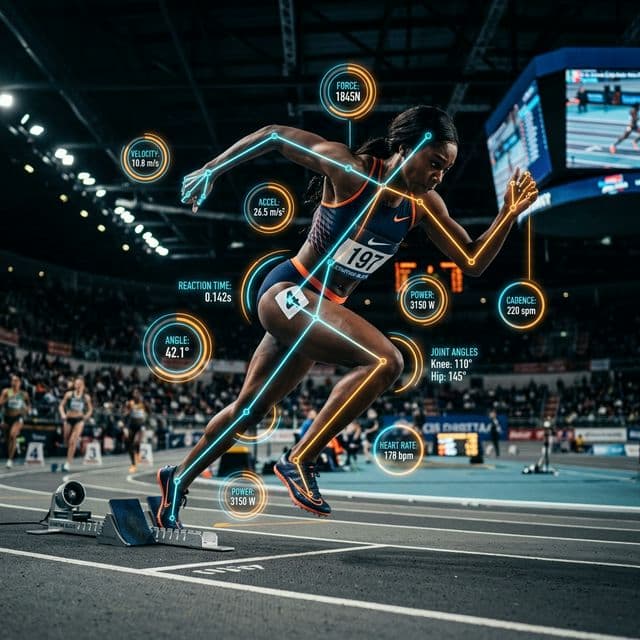 Biomechanical sports tech platforms require incredibly dense, anatomically precise 33-point skeletal Ground Truth datasets.
The Economics of Outsourcing the Data Pipeline
When a Sports Tech startup raises a Series A, the instinct is often to hire an internal team to "brute force" the data labeling problem. Within three months, CTOs universally realize this is a mistake.
Managing a workforce of 100+ annotators, building custom QA hierarchies, and auditing edge-cases is an operational nightmare. It drains venture capital and forces elite Machine Learning Engineers to act as data janitors.
For Sports Tech companies to rapidly scale from Beta to a live, broadcast-ready product, they must outsource the heavy lifting to dedicated data partners.
Why Sports Tech Startups Choose Train Matricx
At Train Matricx, we act as the invisible operational backbone for the world's fastest-growing sports technology companies.
We do not provide cheap, crowdsourced gig-workers. We deploy managed pods of elite annotators specifically trained in the physics, rules, and dimensional geometries of global sports. Whether your engineering team is building automated broadcasting cameras or marker-less injury prevention software, we seamlessly integrate directly into your tooling (CVAT, Encord, Supervisely) to generate the precise Ground Truth datasets required to scale your model.
Stop fighting bad data. Start scaling your product.
If you are a CTO or ML Engineer at a Sports Tech company, Book a Technical Scoping Call with Train Matricx today.

Client results

“Train Matricx didn't just provide labeling — they became an extension of our team. With 6K+ football matches annotated and counting at 98% accuracy, they are our premier data partner.”

Billy Brush
Founder & CEO, Dark Horse AI
Don't take our word for it. Test the labels.
Send us the footage your current vendor gets wrong — the occluded players, the motion blur, the edge cases. We annotate it and return a QA report you can check frame by frame.
- Your hardest clip, annotated in 48 hours
- Full QA report with per-frame accuracy
- No commitment, no contract, no card