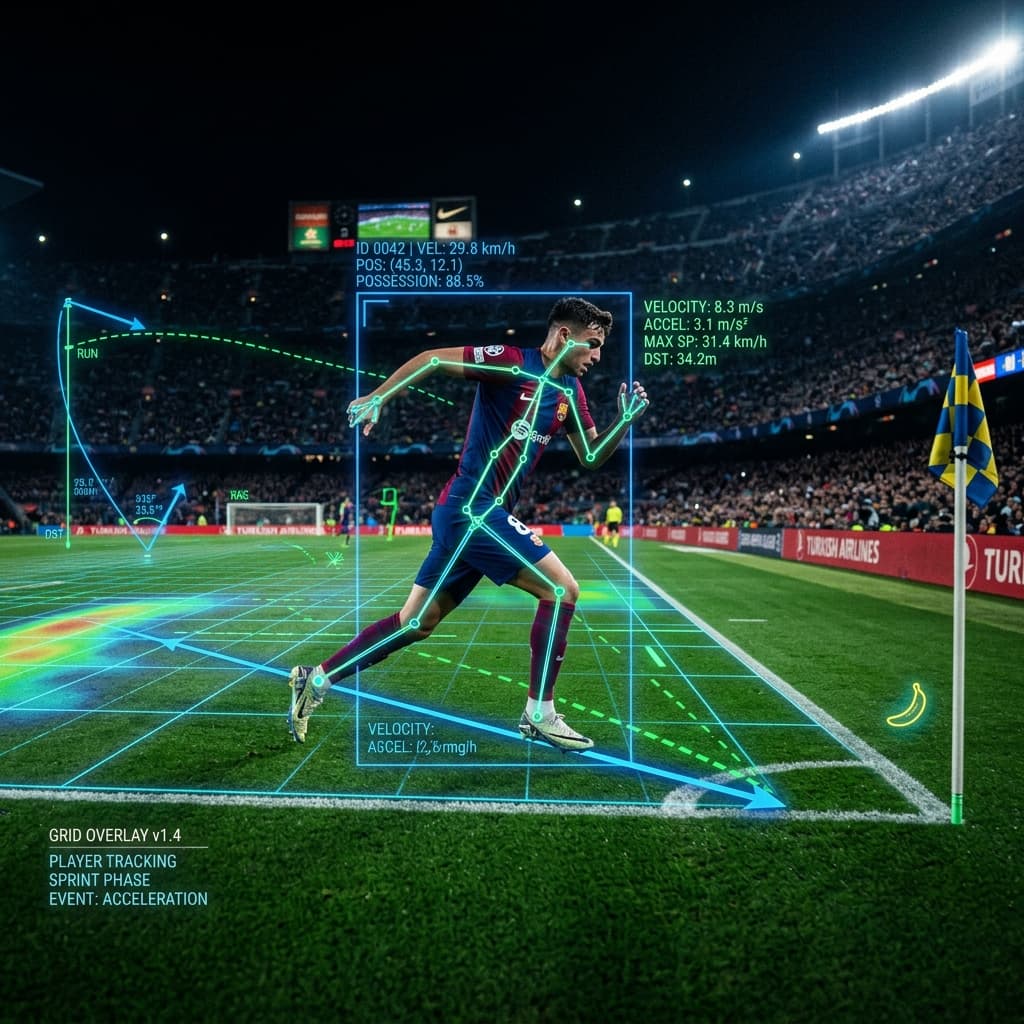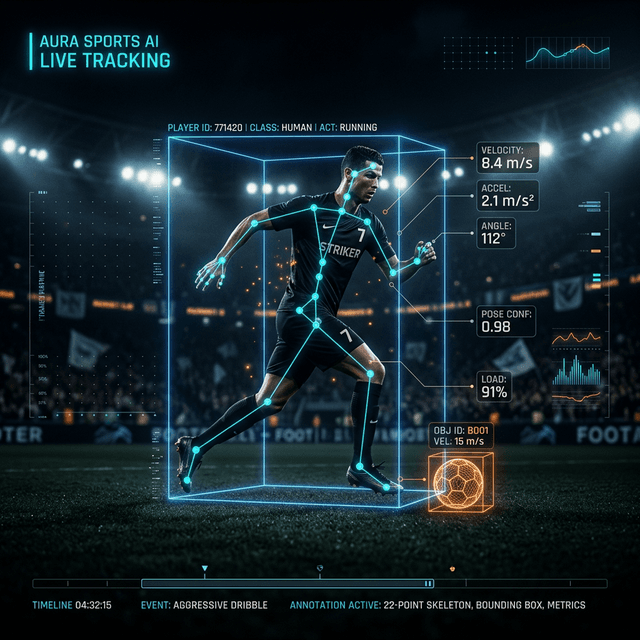
Sports annotation companies label sports video and event data so AI models can learn from it. They produce bounding boxes, player IDs, skeletal keypoints, ball trajectories, event logs and custom metadata that computer vision teams use as ground truth for training player tracking, event recognition and tactical analysis models.
Not every company that claims to annotate sports data is a sports annotation company. This guide maps the actual market, explains who the real players are, and gives you a 7-point framework for choosing the right vendor for your model.
What are sports annotation companies?
Sports annotation companies label sports footage and event data for AI training. They convert raw match video into structured datasets — bounding boxes, player IDs, skeletal keypoints, ball positions, event classifications and tactical metadata — that sports computer vision models learn from. The best providers combine data operations with genuine sport-specific domain knowledge.
The annotation layer is what most sports AI teams underinvest in. A model's accuracy ceiling is set by its training data quality. Inconsistent labels, broken player IDs, wrong event timestamps and missing occlusion handling produce models that pass benchmarks but fail in production.
The sports annotation company landscape
Sports annotation companies fall into three distinct categories. Understanding which type you are evaluating matters before you start comparing prices.
| Type | What they provide | Best for |
|---|---|---|
| General annotation platforms | Software tools for labeling; the user supplies the workforce | Teams with in-house annotators needing tooling |
| General managed annotation | Large-scale labeling workforce across many domains | High-volume, low-complexity tasks; price-sensitive projects |
| Sports specialist annotation | Sport-trained annotators, custom taxonomy, temporal QA | Sports CV models requiring event, tracking or pose data |
Most sports AI teams discover the hard way that general managed annotation fails on sports-specific tasks — not because of volume or speed, but because of domain knowledge. The annotator who knows how to draw a bounding box around a product image does not know how to distinguish a lateral press trigger from a passive defensive block in football.
Who are the main sports annotation companies?
General annotation companies with sports capability
Scale AI provides managed annotation at enterprise scale across many domains including sports. Their platform supports video annotation workflows. They are best suited to teams needing very high volume with defined, repeatable schemas. Sports-specific expertise varies by project team.
Appen is a large annotation marketplace that covers a wide range of data types. They have worked with sports datasets but operate primarily as a generalist service. Their value is breadth and volume.
iMerit provides managed annotation services with stronger quality controls than pure marketplace models. They have worked in sports adjacent contexts and offer structured QA workflows.
CloudFactory provides managed human-in-the-loop data operations with emphasis on quality management at scale. They serve enterprise clients across computer vision domains including video and sports.
Sama focuses on ethical data annotation with managed workforce teams. They handle video annotation across domains and have served sports and entertainment clients.
Sports specialist annotation companies
Train Matricx provides managed sports data annotation as its sole focus. The company works exclusively on sports footage — football, cricket, basketball, tennis and others — with sport-trained annotators, custom event taxonomies, temporal QA and validated delivery formats. Their positioning is as the training data layer for sports computer vision companies: the annotation partner that model builders use when they need ground truth that reflects the actual rules and movement patterns of the sport.
What makes sports annotation different from general data labeling
The gap between general annotation and sports annotation is not a technology gap. It is a knowledge gap.
General annotation tasks assume the label is visible. A product image contains a shirt; draw a box around it. A road scene contains a car; draw a box around it. The annotation task is a visual identification problem.
Sports annotation tasks require interpretation. A frame contains two players in contact. Is this a tackle, a shoulder challenge, a foul, a legal block or an accidental collision? The answer depends on the sport's rules, the context of the play, the phase of the game and the intent of the movement — none of which are visible in a single frame.
This is why sport-specific domain knowledge is not a differentiator to market. It is a prerequisite to doing the job correctly.
The specific challenges that separate sports annotation from general labeling:
- Occlusion: players overlap constantly — during corners, screens, rebounds, tackles and defensive blocks. Identity must be maintained through partial and full occlusion, not reset.
- Temporal continuity: a single correct frame is not a useful dataset. Player IDs, ball positions and event labels must remain consistent across entire sequences.
- Small fast objects: balls occupy less than 0.1% of a broadcast frame and frequently appear as motion blur rather than a discrete shape.
- Rule-based event taxonomy: event labels like "pressing trigger", "pick and roll", "DRS-relevant delivery" or "set piece routine" require annotators who understand the sport, not just the pixels.
- Multi-camera synchronisation: identity and event labels must match across multiple camera angles with frame-accurate timestamps.
7 criteria for evaluating sports annotation companies
1. Sport-specific domain expertise
Ask who annotates the data. Ask how they are trained, and how long they take to become productive on a new schema. Ask for a sample output on a clip from your sport that includes difficult scenarios — occlusion, fast ball movement, ambiguous events. A vendor that cannot produce a confident pilot output on hard footage will not perform at scale.
2. Custom schema design
Production sports annotation starts with schema design, not labeling. A schema defines every label, attribute, edge case and delivery format before a single frame is annotated. Vendors who accept footage and start labeling without a documented schema produce inconsistent output regardless of annotator quality.
Verify that the vendor will design a schema matched to your model objective — not retrofit a generic one. Our dataset-building guide shows what a documented schema contains.
3. Temporal consistency
Ask specifically how the vendor maintains player identity through occlusion, camera cuts and crowded scenes. Ask whether QA reviews full sequences or only samples individual frames. Broken tracking IDs compound downstream: wrong distance covered, broken heat maps, incorrect possession attribution, unreliable tactical timelines.
4. QA with domain verification
There are two types of errors in sports annotation: visual errors (box placement, keypoint position) and domain errors (wrong event label, swapped player ID, missing ball contact frame). Most annotation QA only catches visual errors. A sports-specialist vendor's QA should catch both.
Ask for the QA process documentation. Ask how reviewer disagreements are resolved. Ask what happens when a sports-logic error is found late in a batch. For the numbers to request, see how to measure annotation quality.
5. Pilot dataset before production
Any credible sports annotation vendor should offer a pilot — a small labeled sample you can evaluate against your own QA before committing to full volume. This is the only reliable way to assess actual output quality. Claimed accuracy percentages and client testimonials are not substitutes for reviewing labeled output on your own footage. If you are still deciding whether to outsource at all, read in-house versus outsourced annotation; for budget, see what sports video annotation costs.
6. Delivery format and pipeline compatibility
Your annotation partner's output needs to be ingestible by your training pipeline without significant transformation work. Common delivery formats include COCO JSON, YOLO, CSV event logs and custom JSON schemas. Agree the format and test it during the pilot — not after 100,000 frames are labeled.
7. Security and data ownership
Sports footage often contains proprietary match video, unreleased broadcast assets, player performance data and club tactical information. Verify who can access raw footage during the project, how files are transferred and stored, and that all deliverables remain your property. Review privacy and legal terms before signing.
Red flags when comparing sports annotation companies
- No sport-specific portfolio examples: if samples are mostly retail, traffic, or medical imagery, ask for sports-specific work before proceeding.
- No schema discussion in scoping: a vendor that does not ask about your model objective or event taxonomy before starting is not a sports specialist.
- No pilot offer: any serious vendor should allow you to evaluate a sample output before committing to volume.
- Accuracy claims without definitions: "99% accuracy" is meaningless without specifying what is being measured and how.
- Unclear QA process: if QA is described as "our team reviews the work," the process is undefined and the quality is unverifiable.
- Weak data security documentation: proprietary sports footage is not equivalent to public image data and should not be treated as such.
Vendor evaluation checklist
Use this before signing any sports annotation company:
- Can they label footage from your specific sport — not sports in general?
- Do they design a custom schema before production, not after?
- Can they maintain player ID continuity through occlusion and camera cuts?
- Will they provide a pilot dataset for your QA review?
- Does their QA process include sport-logic checks, not just visual checks?
- Can they deliver in your required format (COCO, YOLO, JSON, CSV)?
- Can they scale volume without annotation team drift or label inconsistency?
- Do they have documented data access, security and ownership terms?
Frequently asked questions
What are sports annotation companies? Sports annotation companies label sports video and event data for AI model training. They convert match footage into structured datasets — bounding boxes, player IDs, skeletal keypoints, ball positions and event logs — that computer vision teams use as ground truth. The best providers combine annotation operations with genuine sport-specific knowledge, not just visual labeling capability.
Why can't I use a general annotation company for sports data? General annotation companies label what is visually visible. Sports data requires interpreting what is happening within the rules and context of the sport. A generic annotator may draw a correct bounding box on a frame where two players collide — but cannot reliably distinguish a foul, a legal challenge, a tactical block or a set piece situation. That context is what makes the label useful for a sports AI model.
What annotation types do sports AI models need? Depending on the model objective: bounding boxes for player and ball detection, persistent IDs for tracking, skeletal keypoints for pose and biomechanics, segmentation masks for broadcast AR and field zones, and event logs with frame-accurate timestamps and contextual attributes for action recognition and tactical analysis.
How do I verify the quality of a sports annotation vendor? Request a pilot annotation on representative footage — including hard scenarios like occlusion, fast ball movement and ambiguous events. Evaluate the output with a domain expert or against your own QA standards. Claimed accuracy metrics from the vendor are not reliable substitutes for reviewing actual labeled output.
What is the difference between a sports annotation company and a sports data provider? A sports data provider delivers finished statistics, event feeds and analytics. A sports annotation company creates custom training data for AI models. If you are building or improving a computer vision model, you need annotation services. If you need results data for analysis, you need a data provider.
What is temporal consistency in sports annotation? Temporal consistency means the same player, ball or event is correctly linked across a sequence of frames — not just correctly labeled in a single frame. It matters for tracking models, which need identity to remain stable through occlusion and camera cuts, and for event models, which need frame-accurate start and end timestamps linked to the correct player IDs.
How many frames does a sports annotation project typically require? It depends on the model and sport. A player detection model may need thousands of labeled frames across varied match conditions. A full player tracking model over a 90-minute football match at 25 fps requires 135,000 frames per match. Production models for professional sports products are typically trained on data spanning hundreds of matches.
What delivery formats do sports annotation companies use? Common formats include COCO JSON for detection and segmentation, YOLO for object detection, CSV or JSON for event logs and tracking sequences, and custom schemas for proprietary pipelines. Agree on format during scoping and validate it with a sample output before full production begins.
What should a sports annotation pilot include? A useful pilot should include footage that represents your hardest production scenarios: occlusion, fast ball movement, crowded scenes and ambiguous events. Easy footage is not a reliable quality signal. Review the pilot against your own QA criteria, not against the vendor's claimed accuracy.
The takeaway
The sports annotation market has many options. Most are general annotation services that can handle sports footage to a point. The distinction between a general annotator and a sports specialist becomes visible in the hardest scenarios — occlusion, temporal continuity, event taxonomy and domain-specific edge cases — which are exactly the scenarios your model most needs to learn from.
If you are evaluating sports annotation partners, see how Train Matricx works or review annotated dataset results in our case studies. We annotate a free pilot clip so you can assess quality directly before committing to any volume.

Client results

“Train Matricx didn't just provide labeling — they became an extension of our team. With 6K+ football matches annotated and counting at 98% accuracy, they are our premier data partner.”

Billy Brush
Founder & CEO, Dark Horse AI
Don't take our word for it. Test the labels.
Send us the footage your current vendor gets wrong — the occluded players, the motion blur, the edge cases. We annotate it and return a QA report you can check frame by frame.
- Your hardest clip, annotated in 48 hours
- Full QA report with per-frame accuracy
- No commitment, no contract, no card