Rugby combines two computer vision challenges that rarely appear together at this intensity: continuous, open-field running similar to football, and repeated, prolonged physical contact events — scrums, rucks, mauls and tackles — that create some of the densest, longest-duration occlusion scenarios in any tracked sport. A scrum can last ten seconds or more with sixteen players locked together in a single visual mass.
This guide covers how computer vision works in rugby, why the sport's contact structure creates annotation challenges that don't exist in most other team sports, and what training data requirements look like for tackle, scrum and player tracking systems.
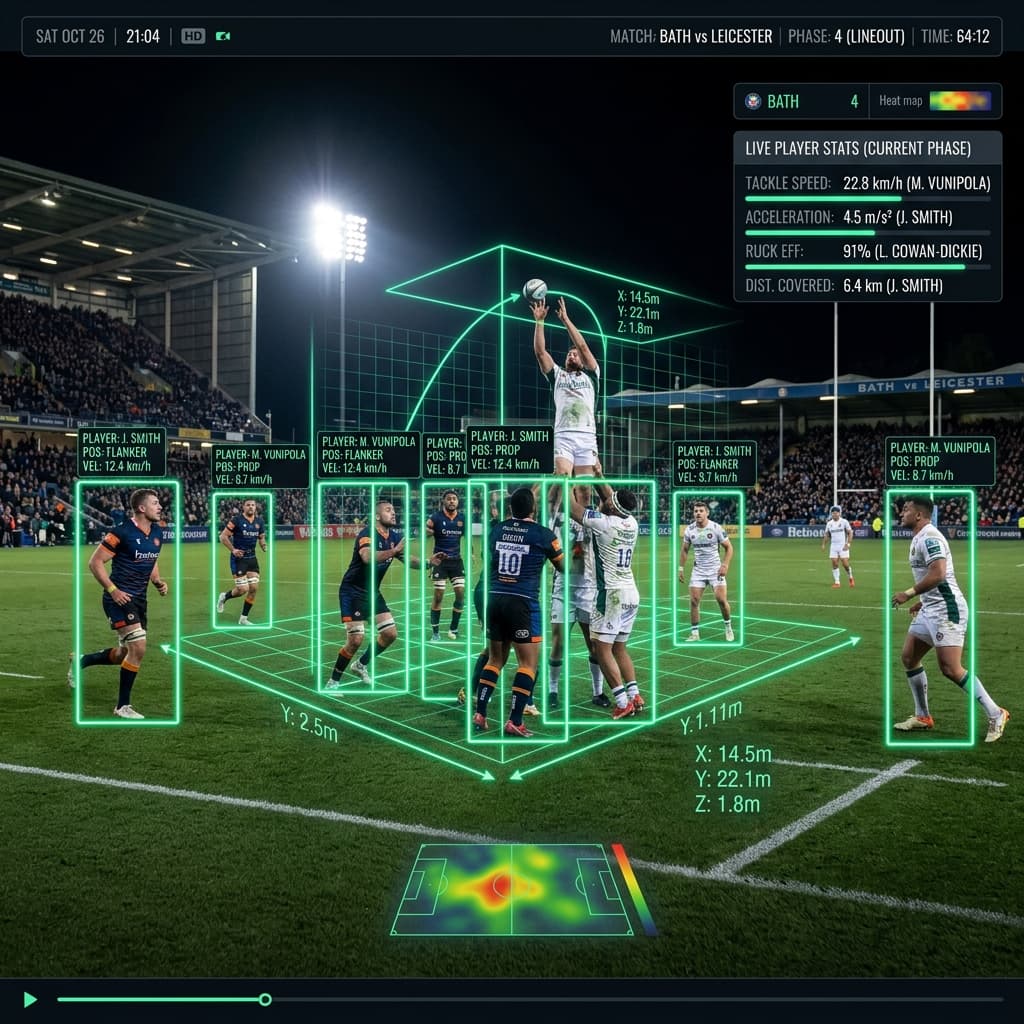 High-end technical sports analytics visualization showing rugby player tracking, tackle event classification, and scrum formation overlays.
What is rugby computer vision?
Rugby computer vision is the use of AI to interpret rugby footage — tracking players across open play and structured contact phases, detecting and classifying tackles, rucks, mauls and scrums, recognising territorial and possession events, and converting match video into structured data for coaching, broadcast and AI model training.
Rugby's structure alternates between open, fast-moving phases similar to football or rugby league, and set-piece or contact phases — scrums, rucks, mauls, lineouts — where play is contested in a tightly packed, often stationary formation. Each phase type requires a different computer vision approach, and several of rugby's defining events have no equivalent annotation problem in other major sports.
Why rugby presents a distinct computer vision problem
The scrum is one of the densest occlusion scenarios in sport. Sixteen players — eight per team — bind together in three rows, heads down, in continuous physical contact for the duration of the scrum. From any camera angle, the majority of players inside a scrum are partially or fully hidden by teammates and opponents. This is denser and more prolonged than the line-of-scrimmage occlusion in American football or the screen occlusion in basketball — a rugby scrum can remain locked in this state for ten seconds or more before the ball emerges.
Rucks and mauls create rolling, evolving occlusion. Unlike a scrum, which is a relatively stable formation, a ruck (players bound over the ball on the ground) or a maul (players bound around a ball carrier, moving) constantly changes shape as players join, leave and reposition. The occlusion pattern is not fixed — it evolves frame by frame as the contact situation develops, requiring continuous re-evaluation rather than a single static occlusion model.
The tackle is both a discrete event and a continuous process. A rugby tackle has a clear initiation point (contact) but can continue for several seconds afterward as players compete for the ball on the ground, attempt to release it, or contest the resulting ruck. Classifying "the tackle" as a single event versus understanding the full tackle-to-ruck sequence requires an event taxonomy that captures the transition between phases, not just a single moment.
Player identification through extensive physical contact. Rugby's open and consistent jersey design (no helmets, generally clear numbering) makes baseline identification easier than in American football or ice hockey. But sustained physical contact during tackles, rucks and mauls means players are frequently in extended contact with multiple others, and identity must be maintained through these contact sequences for accurate individual performance data.
Territorial and phase-based analytics require contextual understanding. Much of rugby analytics is built around phase count (how many tackles/rucks occur before a try or loss of possession), territory gained per phase, and go-forward ball (whether a carry gains ground). Extracting this requires linking individual events into possession sequences with positional context — a higher-order classification task built on top of basic detection and tracking.
The five applications of rugby computer vision
| Application | What it produces | Primary buyers |
|---|---|---|
| Player tracking | Positions, speed, distance, tackle involvement | Professional clubs, national unions |
| Tackle analysis | Tackle success, technique, dominant/passive classification | Coaching, player welfare, scouting |
| Breakdown analysis | Ruck speed, ball retention, contest outcome | Tactical analytics, coaching |
| Set-piece tracking | Scrum and lineout formation, outcome, infringement | Coaching, officiating support |
| Territory and phase analytics | Metres gained, phase count, possession sequences | Broadcast, performance analytics |
Each application builds on a different combination of detection, tracking and event classification, and several — particularly breakdown and set-piece analysis — require annotation taxonomies that have no direct equivalent in football, basketball or American football.
Player tracking through rugby's contact phases
Open play tracking
In open play, rugby player tracking resembles football: players are detected and tracked across a large field, with identity maintained through the kind of incidental occlusion that occurs when players run past or alongside each other. This is the most tractable part of the rugby tracking problem and benefits from approaches similar to those used in other field sports.
Tackle-phase identity continuity
A tackle brings two or more players into sustained contact, often resulting in both falling to the ground, followed immediately by a contest for the ball that draws in additional players from both teams. Maintaining identity through this sequence — from the moment of contact, through the players going to ground, through the ruck that frequently follows — requires training data that explicitly represents this multi-second contact-to-breakdown sequence as a continuous tracking challenge, not a series of independent occlusion events.
Player welfare and tackle technique analysis
Tackle technique analysis — assessing whether a tackle was executed with safe technique (head position, body height, contact point) — has become a significant application of rugby computer vision driven by player welfare and concussion-reduction initiatives at the professional and union level. This requires dense skeletal keypoint tracking specifically at the moment of contact, annotated by people who understand both the biomechanics of safe tackling technique and the sport's laws around legal and illegal contact.
Scrum and set-piece analysis
The scrum as a structured, low-visibility event
Unlike open play, a scrum is a defined formation with known starting positions for all sixteen players, which provides useful structural information even when individual players are not clearly visible. Computer vision systems for scrum analysis often rely on this structural prior — knowing where each position should be based on the team's typical scrum formation — combined with whatever visual information is available (overall scrum movement, ball emergence point, team that wins possession) rather than attempting to track each individual player's limbs throughout.
Training data for scrum analysis needs to capture scrum outcomes (which team won the put-in, whether the scrum collapsed, penalty outcomes), overall directional movement (which team is driving forward), and ball emergence timing and location — annotated with an understanding of scrum laws, since referee decisions around scrum infringements are based on specific technical fouls that require rugby-specific knowledge to identify even when visible.
Lineout tracking
A lineout — where players from both teams form parallel lines to contest a throw-in — involves a vertical jumping and lifting contest that is structurally distinct from any other rugby event. Tracking lineout outcomes requires detecting jumper height and timing, lifting support, and the eventual ball winner, in a contest that happens quickly and at height, often with players' bodies overlapping during the lift and catch.
Breakdown analysis: rucks and mauls
The "breakdown" — the contest for the ball after a tackle, comprising the ruck — is one of the most tactically significant and most visually complex events in rugby. Modern rugby analytics places heavy emphasis on "ruck speed" (how quickly the ball is recycled), which is a strong predictor of attacking effectiveness.
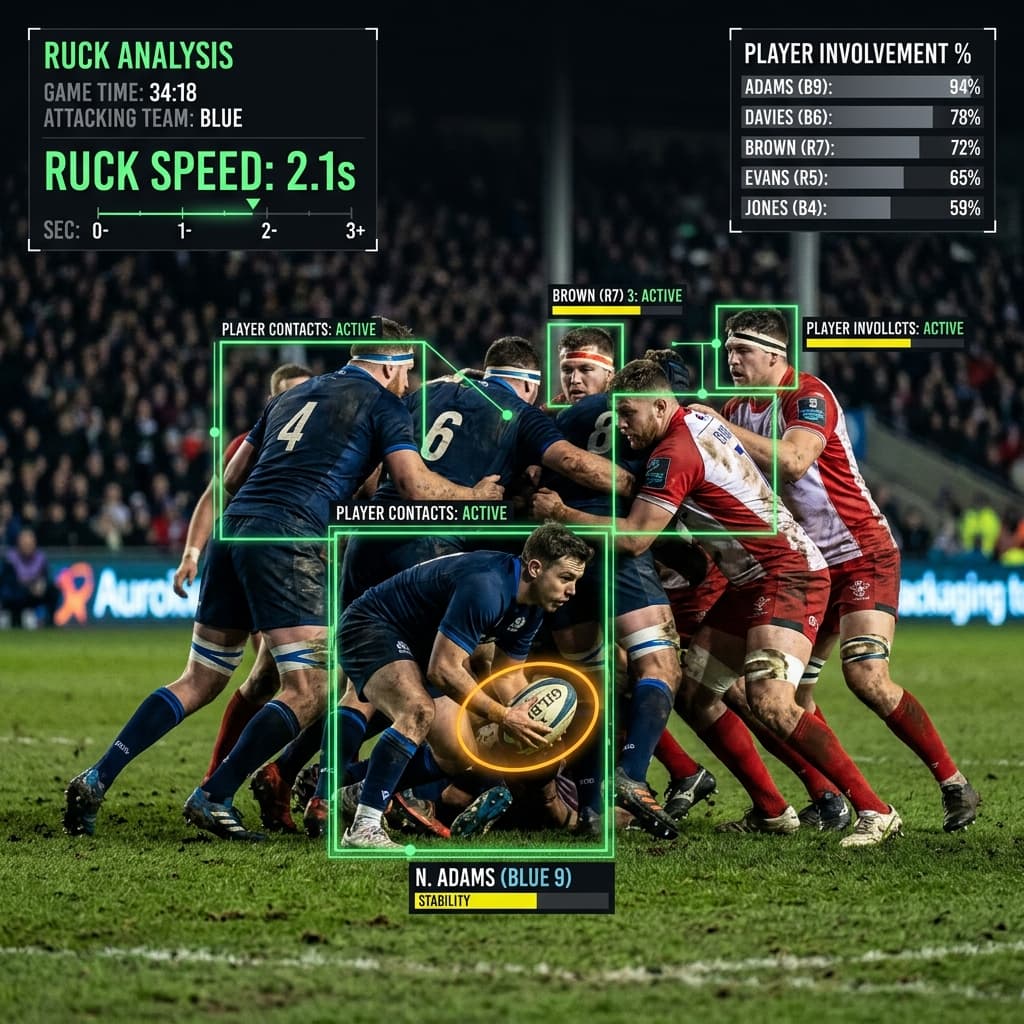 Breakdown computer vision system measuring ruck speed, tracking player contact bounds, and analyzing player involvement percentages.
Annotating breakdown events requires:
- The exact frame the tackle is completed and the ruck begins
- The exact frame the ball emerges and is played, to calculate ruck speed
- Classification of the contest outcome (clean retention, turnover, penalty)
- Player involvement labels for those competing at the breakdown
This requires annotators who understand the legal structure of a ruck — including offside lines that apply at the breakdown and the specific technical infringements (not binding correctly, playing the ball with hands while on the ground, entering from the side) that determine penalty outcomes, since accurately classifying many breakdown events requires recognising infringements, not just visual outcomes.
What rugby computer vision training data requires
For player tracking:
- Bounding boxes and persistent IDs maintained through tackle and breakdown sequences
- Jersey number annotation for identity confirmation
- Position labels relevant to rugby's specific roles (front row, back row, half backs, back three)
For tackle analysis:
- Contact frame and tackle completion frame labels
- Tackle technique classification (dominant, passive, technique quality where visible)
- Player IDs for tackler and ball carrier
For breakdown analysis:
- Ruck start and ball emergence frame labels
- Contest outcome classification (retention, turnover, penalty)
- Infringement labels requiring rugby law knowledge
For set-piece analysis:
- Scrum outcome and directional movement labels
- Lineout jump timing, height and outcome labels
- Formation and structural labels specific to each set piece type
Frequently asked questions
What is rugby computer vision? Rugby computer vision uses AI to interpret rugby footage — tracking players through open play and contact phases, detecting and classifying tackles, rucks, mauls and scrums, and producing structured data for coaching, broadcast and player welfare analysis. It must handle both continuous open-field tracking and some of the densest, longest-duration occlusion scenarios found in any tracked sport.
Why is the rugby scrum hard for computer vision? A scrum involves sixteen players bound together in continuous physical contact, often for ten seconds or more, with the majority of individual players partially or fully hidden from any camera angle. This is denser and longer-duration than occlusion scenarios in most other sports, which is why scrum analysis systems typically rely on structural priors about formation and overall movement rather than attempting full individual player tracking throughout.
How does tackle technique analysis work in rugby AI? Tackle technique analysis uses dense skeletal keypoint tracking focused on the moment of contact to assess factors like head position, body height and point of contact, which are linked to player welfare and concussion-reduction initiatives. Training data for this requires annotators who understand both safe tackling biomechanics and the sport's specific laws around legal and illegal contact.
What is ruck speed and how is it measured with computer vision? Ruck speed measures how quickly the ball is recycled from the point a tackle is completed and a ruck forms to the point the ball is played again. It is calculated from frame-accurate labels of the ruck start (tackle completion) and ball emergence, and is widely used as an indicator of attacking effectiveness in modern rugby analytics.
Why does rugby breakdown analysis require understanding rugby laws? Many breakdown outcomes are determined by specific technical infringements — not binding correctly, playing the ball with hands while on the ground, entering from the side — that a model or annotator must recognise to classify the event correctly. A purely visual classification without rugby law knowledge will misclassify many breakdown outcomes, because the relevant distinction is legal, not just visual.
How is rugby player tracking different from football player tracking? Open-play tracking in rugby resembles football closely. The key difference is the need to maintain player identity through extended, multi-second contact sequences during tackles, rucks and mauls — occlusion events that are both denser and longer-lasting than the incidental occlusion typically found in open football play.
What training data does a rugby AI model need? It depends on the application. Player tracking models need persistent IDs maintained through contact phases. Tackle analysis models need dense skeletal keypoints at the contact moment with technique classification. Breakdown analysis models need frame-accurate ruck start and ball emergence labels with infringement classification. Set-piece models need formation and outcome labels specific to scrums and lineouts. All require annotators with genuine rugby knowledge, particularly for law-based classifications.
The takeaway
Rugby combines open-field tracking challenges similar to football with contact-phase occlusion problems — scrums, rucks and mauls — that are denser and longer-lasting than almost anywhere else in team sport. Building reliable rugby computer vision requires training data that explicitly represents these contact sequences, and annotators who understand rugby's laws well enough to classify outcomes that are determined by infringements rather than pure visual observation.
If you are building rugby computer vision models and need expert-annotated training data — player tracking, tackle analysis, breakdown classification or set-piece tracking — see how Train Matricx works or review annotated dataset results in our case studies. We annotate a free pilot clip so you can evaluate quality before committing to any volume.

Client results

“Train Matricx didn't just provide labeling — they became an extension of our team. With 6K+ football matches annotated and counting at 98% accuracy, they are our premier data partner.”

Billy Brush
Founder & CEO, Dark Horse AI
Don't take our word for it. Test the labels.
Send us the footage your current vendor gets wrong — the occluded players, the motion blur, the edge cases. We annotate it and return a QA report you can check frame by frame.
- Your hardest clip, annotated in 48 hours
- Full QA report with per-frame accuracy
- No commitment, no contract, no card