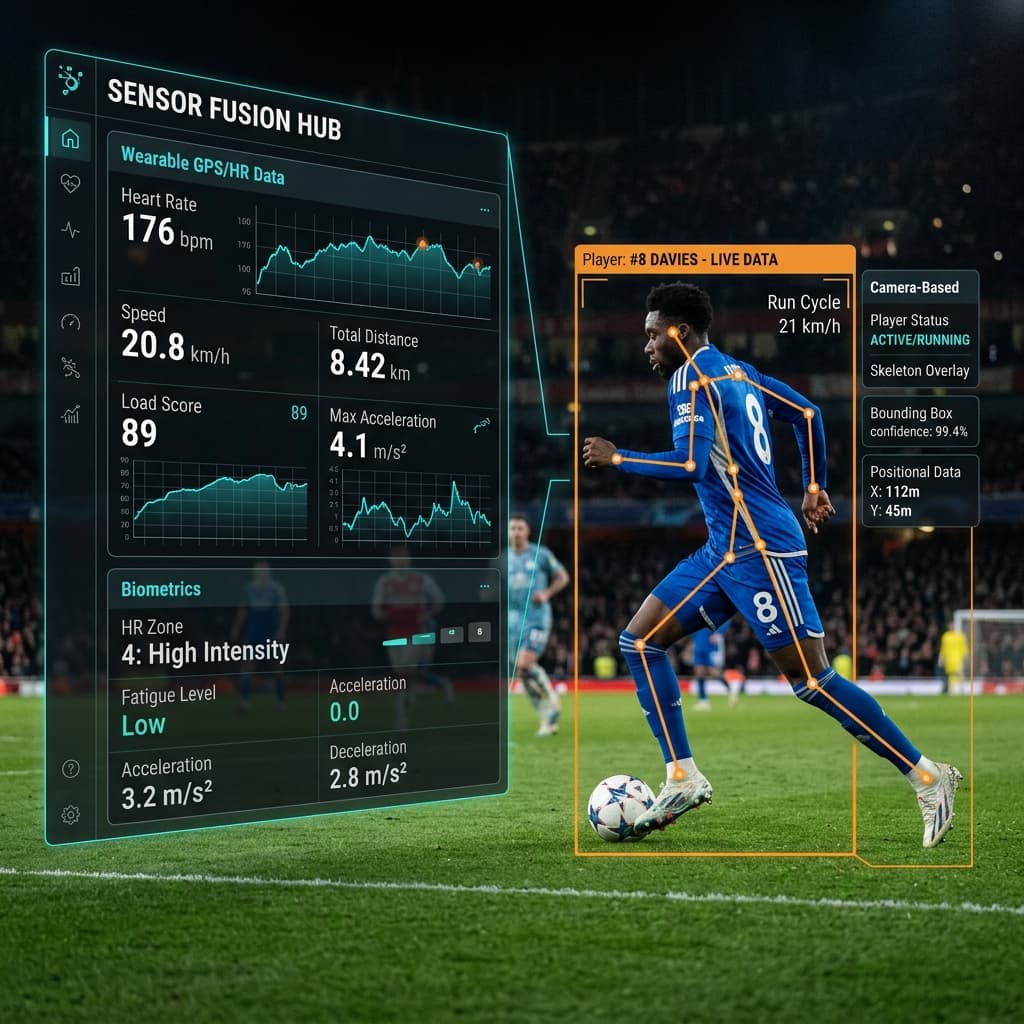
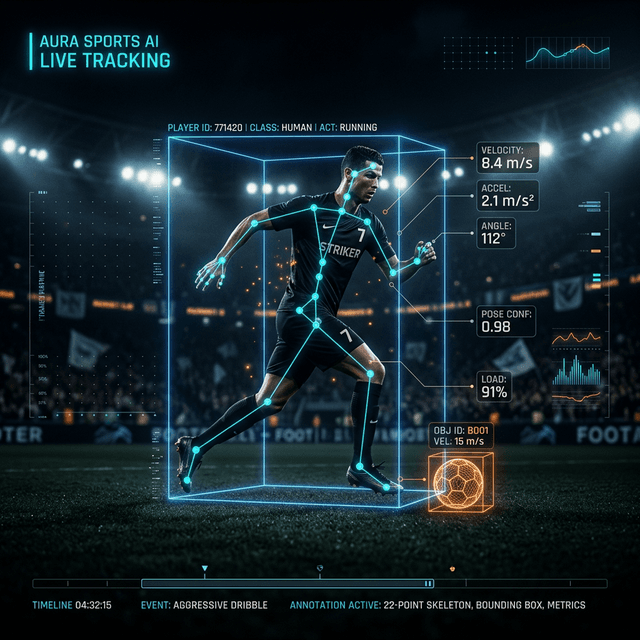
Investment in women's sports is growing 4.5 times faster than men's sports right now. Women's elite sports revenue topped $2.35 billion in 2026, more than doubling in two years, and the WNBA's 11-year, $2.2 billion media rights deal kicked off this year on the back of rising viewership. Every team, broadcaster and platform racing to capitalize on this growth needs the same thing men's leagues already have: reliable computer vision data.
Most of them don't have it yet, and the reason isn't a lack of cameras. It's a training data problem that nobody built for this moment because, until recently, nobody needed to.
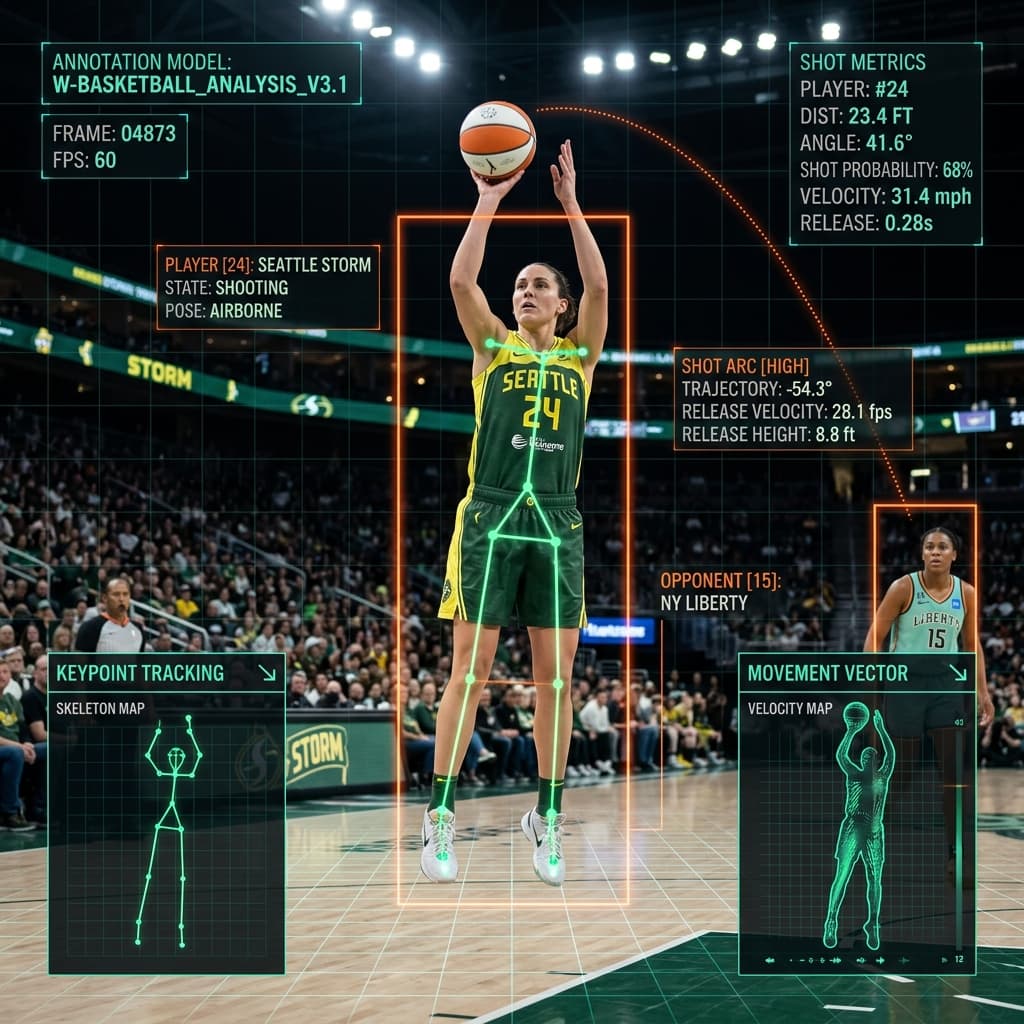 High-end technical visualization of women's professional sports data annotation: WNBA-style skeletal pose estimation overlay on a female basketball player mid-shot, showing biometric analytics HUD panels.
What is the women's sports computer vision gap?
The women's sports computer vision gap is the shortfall in training data available to build reliable AI tracking, event recognition and broadcast systems for women's competitions, caused by years of underinvestment in filming, annotating and modelling women's sport relative to men's. Camera coverage has historically been sparser, archival footage is thinner, and most existing sports CV models were trained almost entirely on men's league footage, then assumed to generalise.
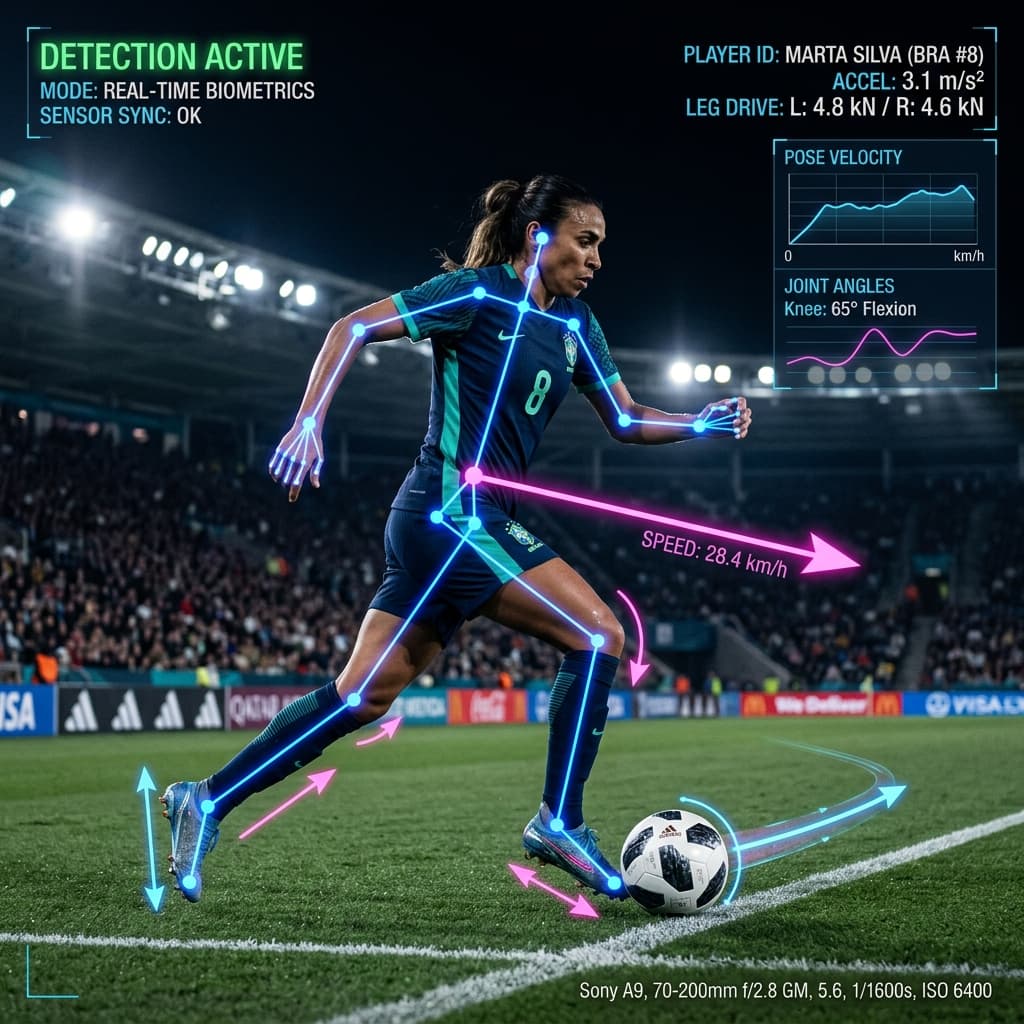 Skeletal pose tracking and coordinate projection on female football athletes, illustrating multi-point calibration to bridge the data annotation gap.
That assumption doesn't always hold, and the gap is becoming a real commercial constraint just as investment in women's sports is accelerating fastest.
Why this gap exists
Years of asymmetric camera coverage. Men's top-flight leagues have had multi-camera tracking rigs installed in stadiums for the better part of a decade. Many women's leagues, even at the professional level, only recently started receiving comparable camera infrastructure as broadcast deals and attendance have grown. Less historical footage means less raw material to build training datasets from in the first place.
Training data inherited from men's models, not built for women's competition. A computer vision model trained predominantly on men's match footage learns patterns specific to that footage: typical player builds, typical camera angles used for men's broadcast packages, typical kit and branding conventions. Applying that model directly to women's competition without retraining on representative footage risks systematically lower accuracy, not because of any difference in athletic ability, but because the training distribution doesn't match the deployment distribution.
Different uniform and kit conventions create different detection challenges. Kit design, sponsor placement and number positioning conventions in women's leagues sometimes differ meaningfully from the men's competitions a generic model was trained on. Jersey number reading, a core part of player re-identification, depends on the model having seen enough representative examples of exactly how and where numbers appear on the specific kit styles in use.
Smaller existing datasets mean rarer edge cases are even rarer. Every sport's computer vision problem depends on representing hard scenarios, occlusion, fast motion, ambiguous events, in sufficient volume for a model to learn from. A smaller overall dataset, the direct consequence of less historical footage, means these already-rare scenarios appear even less often, making it harder to reach the accuracy levels routine in more heavily filmed men's competitions.
Commercial investment has outpaced infrastructure investment. Media rights deals, sponsorship and league expansion have moved faster than the underlying data infrastructure needed to support the analytics products those deals create demand for. A broadcaster that just signed a major women's league rights deal wants the same AI-driven graphics and stats packages viewers expect from men's broadcasts, immediately, not after years of model retraining.
Where this gap shows up in practice
| Application | What breaks without representative training data |
|---|---|
| Player tracking and re-identification | Lower identity accuracy if jersey number reading and body-build patterns were learned predominantly from men's footage |
| Broadcast graphics and AR overlays | Misaligned or jittery overlays when underlying tracking confidence is lower than the broadcast pipeline assumes |
| Event and action recognition | Inconsistent event labels if a model's training data lacks sufficient examples of the specific competition's pace, tactics and camera coverage |
| Performance analytics for coaching | Noisy positional and speed data limiting the reliability of tactical insights coaching staff actually want to act on |
| Historical and archival analysis | A much thinner library of annotated footage to build "career history" or "league trends" products on top of |
The practical effect is that women's sports organisations, broadcasters and analytics platforms moving fast to capitalize on this growth often discover, only once a product is in front of users, that the underlying tracking accuracy doesn't match what they expected from comparable men's products.
Why this isn't solved by "the same model, more data"
A common assumption is that the fix is simply running more women's match footage through an existing model. That helps, but it isn't the whole answer, for the same reason that generic sports annotation never fully solves sport-specific problems.
Schema and taxonomy still need sport and competition-specific design. An event taxonomy built for one league's tactical conventions, terminology and rule interpretations doesn't automatically transfer to another, regardless of the gender of the competition. Tactics, common formations and even rule nuances can differ between leagues at different stages of development, which means schema design work, not just data volume, is part of closing this gap properly.
Domain-aware annotation matters as much here as anywhere else. The same principle that applies across every sport covered in this blog applies here: an annotator who understands a specific league's pace of play, common tactical patterns and rule interpretations produces meaningfully better ground truth than one applying a generic template. This is a knowledge gap to close, not just a volume gap.
QA needs to catch systematic bias, not just individual errors. A model retrained on a smaller, newer dataset can develop systematic blind spots, consistently underperforming on a specific camera angle, a specific kit colour, a specific common formation, that a standard QA process sampling individual frames might not surface. Closing this gap responsibly means QA processes specifically designed to detect that kind of systematic pattern, not just spot-check accuracy.
Who is affected by this gap right now
Leagues and federations investing in their own broadcast and analytics infrastructure for the first time, often without years of accumulated tracking data to build on, unlike established men's competitions.
Broadcasters that have signed major rights deals and are under commercial pressure to deliver the same AI-driven graphics packages and statistical overlays audiences expect, on a much shorter data-accumulation timeline than the men's product had.
Sports analytics platforms expanding their product lines into women's competitions, discovering that their existing models, built and validated on men's data, need real retraining work, not just a configuration change.
Sponsors and media rights buyers who are pricing deals partly on the strength of the data and insights products that can be built around a competition, where weaker underlying tracking data directly limits what's commercially possible.
What closing the gap actually requires
Dedicated annotation on representative footage, not footage borrowed or extrapolated from men's competitions. This means building training datasets directly from the specific league, competition or broadcast package in question, with the same rigour applied to any professional sports CV project.
Schema and taxonomy design specific to the competition, accounting for its particular tactical conventions, terminology and edge cases, rather than reusing a men's league taxonomy and assuming it transfers cleanly.
QA processes that explicitly check for systematic gaps, not just frame-level accuracy, specifically looking for camera angles, kit types or game situations where accuracy quietly drops below what the rest of the dataset achieves.
A volume strategy that doesn't wait for years of historical footage to accumulate. Unlike a men's league that built up a decade of tracking data organically, women's leagues investing in this infrastructure now need a deliberate, accelerated annotation strategy to reach comparable dataset depth in a fraction of the time.
Frequently asked questions
What is the women's sports computer vision gap? It's the shortfall in training data available to build reliable AI tracking and analytics systems for women's competitions, caused by historically sparser camera coverage and less accumulated footage compared to men's leagues. As investment in women's sports accelerates, this gap is becoming a real constraint on the AI-driven products broadcasters and leagues want to deliver.
Why can't a model trained on men's sports footage just be used for women's competitions? A computer vision model learns the specific patterns present in its training data, typical camera angles, kit conventions, player movement patterns and competition pace. Applying a model trained predominantly on men's footage to women's competition without retraining on representative data risks lower accuracy, because the deployment conditions don't match what the model actually learned from.
Is this a talent or ability difference, or purely a data problem? Purely a data and infrastructure problem. The gap has nothing to do with athletic performance and everything to do with how much representative footage has historically been captured, annotated and used to train AI models for a given competition.
Why is this becoming urgent now? Investment in women's sports is growing roughly 4.5 times faster than men's sports, with major media rights deals like the WNBA's $2.2 billion, 11-year agreement creating immediate commercial pressure to deliver the same AI-driven broadcast and analytics products that men's leagues have had years to build and refine.
What specifically breaks when training data isn't representative? Player tracking and re-identification accuracy can drop due to unfamiliar jersey or kit conventions, broadcast AR overlays can misalign due to lower underlying tracking confidence, and event recognition models can produce inconsistent labels if they weren't trained on enough examples of a specific competition's pace and tactical patterns.
How is closing this gap different from a typical sports annotation project? The core principles are the same, sport-specific schema design, domain-aware annotation, rigorous QA, but the urgency and starting point are different. Most sports annotation projects build on years of accumulated historical footage. Many women's sports projects right now need to build comparable dataset depth in a much shorter timeframe, without that historical accumulation to draw on.
Do broadcasters and leagues need separate models for men's and women's competitions? Not necessarily separate model architectures, but they typically need separate, representative training data. The underlying detection and tracking approach can often be shared, but the model needs to be trained or fine-tuned on footage that actually represents the competition it will be deployed on, rather than assuming generalisation from a different dataset.
What's the business risk of not addressing this gap? Analytics and broadcast products that underperform relative to user expectations set by equivalent men's league products, which is a real commercial risk given how much of the current investment thesis in women's sports is built on delivering modern, data-rich fan and broadcast experiences.
The takeaway
Women's sports is one of the fastest-growing segments in the entire sports industry, and the computer vision infrastructure underneath it hasn't caught up yet. That gap won't close itself by reusing models built for a different competition, it closes through deliberate, representative annotation work built specifically for the leagues and competitions actually growing right now.
If you're building computer vision or analytics products for women's sports and need training data that actually represents your competition, see how Train Matricx works or review annotated dataset results in our case studies. We annotate a free pilot clip so you can evaluate quality before committing to any volume.

Client results

“Train Matricx didn't just provide labeling — they became an extension of our team. With 6K+ football matches annotated and counting at 98% accuracy, they are our premier data partner.”

Billy Brush
Founder & CEO, Dark Horse AI
Don't take our word for it. Test the labels.
Send us the footage your current vendor gets wrong — the occluded players, the motion blur, the edge cases. We annotate it and return a QA report you can check frame by frame.
- Your hardest clip, annotated in 48 hours
- Full QA report with per-frame accuracy
- No commitment, no contract, no card