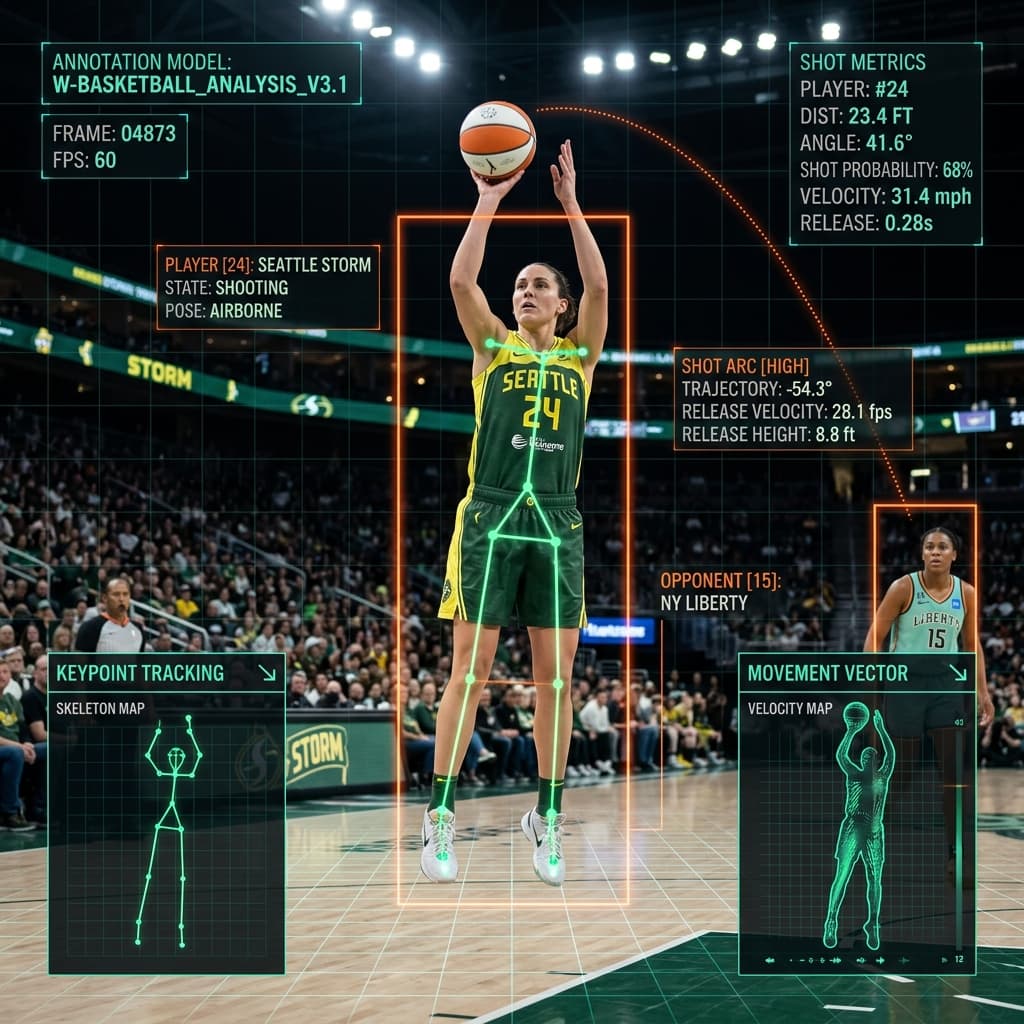
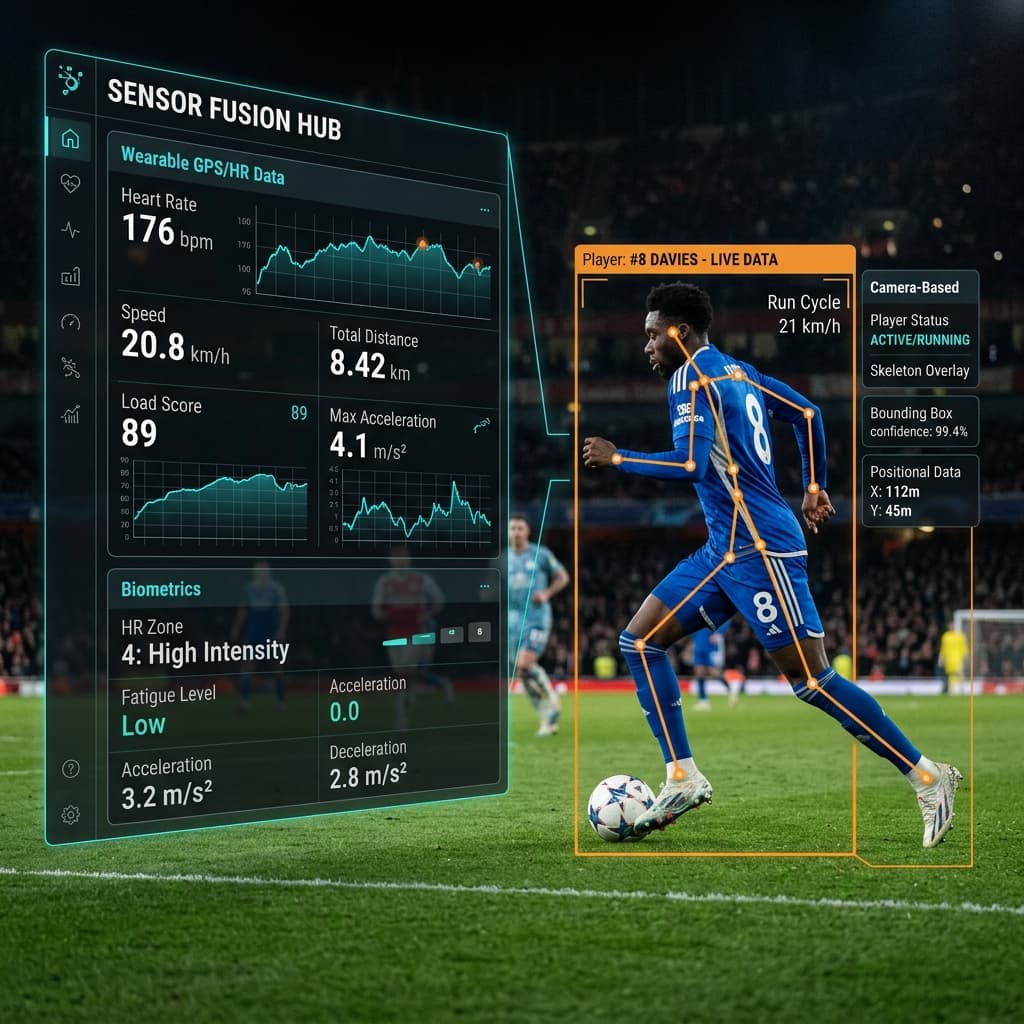
Every one of the 1,248 players at the 2026 World Cup was digitally 3D-scanned into a personal avatar before the tournament began. During matches, roughly 12 dedicated high-speed cameras per venue track 29 distinct points on each player's body, limbs, knees, toes, 50 times every second. That combination, a pre-built 3D avatar plus continuous high-frequency limb tracking, is what actually sits behind the offside graphics and broadcast visuals viewers see, and it's a meaningfully different technical problem than tracking alone.
We've already covered how the semi-automated offside calculation itself works and the broader scale of AI systems running across the tournament. This piece goes deeper into the specific layer most coverage skips past, the digital twin avatars and the 29-point tracking system that feeds them.
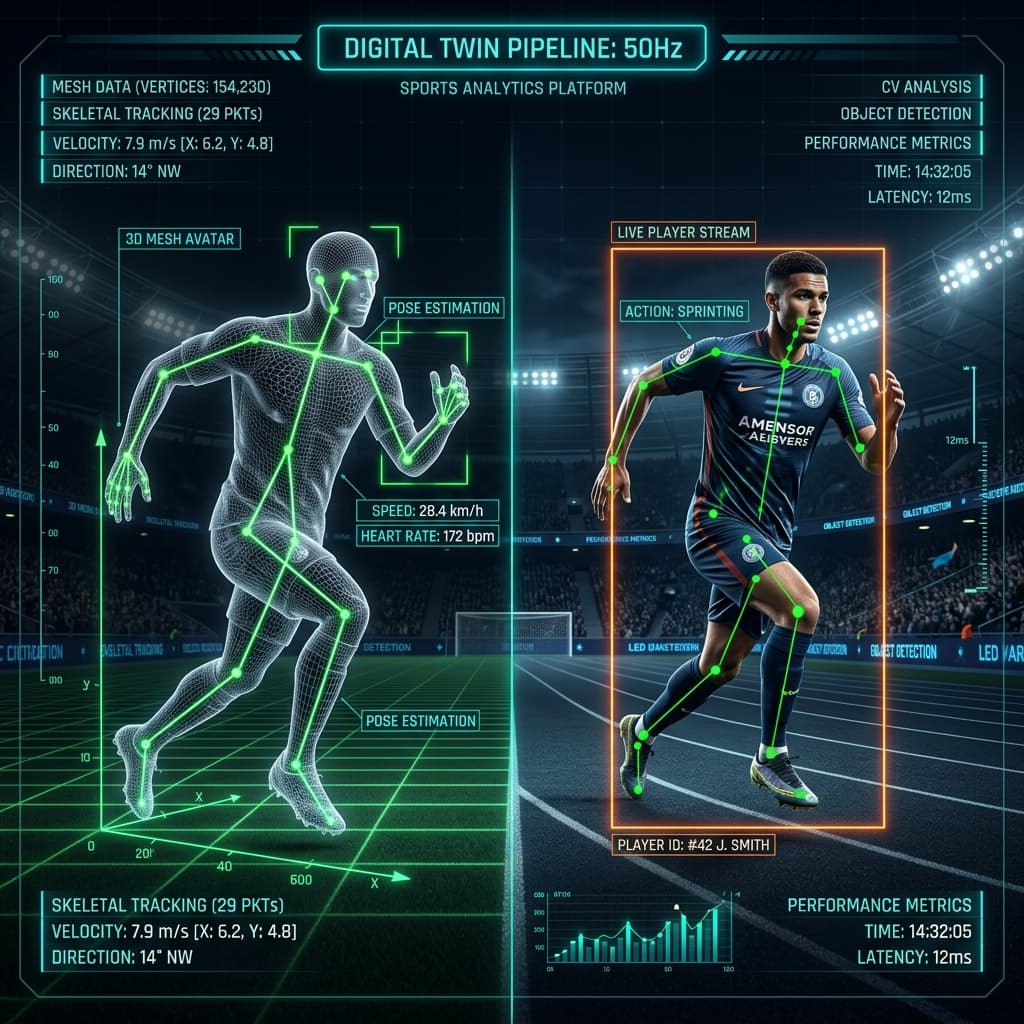 High-end technical visualization of the 50Hz digital twin pipeline: mapping live 29-point player skeletal tracking onto a 3D mesh avatar.
What is a digital twin avatar in sports?
A digital twin avatar in sports is a pre-built 3D digital model of an individual athlete, created through dedicated 3D scanning before competition, which is then animated in real time using live tracking data captured during play, allowing broadcasters and officiating systems to render a realistic 3D representation of exactly what a player's body did at any given moment.
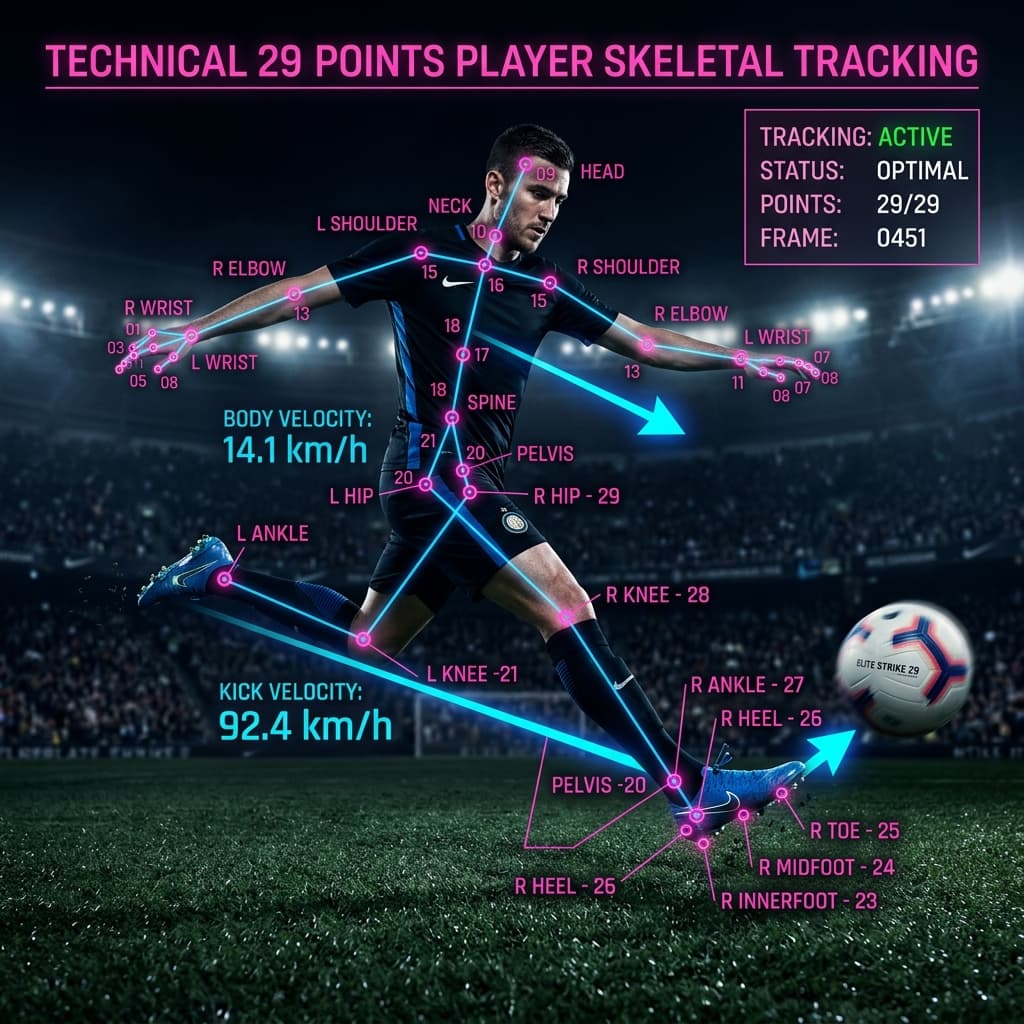 Detailed 29-point player skeletal tracking visualization, displaying tracked coordinate nodes from head to toe for sub-centimetre offside analysis.
At the 2026 World Cup, this meant every one of the 1,248 players involved was scanned in advance, separately from the in-match tracking system, to create the base 3D model their live performance data would later animate.
Why this is a two-stage system, not one
Stage one: building the avatar. Before the tournament, each player undergoes dedicated 3D scanning to capture their individual body proportions, build and likeness accurately enough to render a recognisable, realistic digital model. This is a separate process from in-match tracking entirely, it happens once, well in advance, and produces a static base model.
Stage two: animating it live. During matches, the 29-point tracking system captures where each of those tracked body points actually is, 50 times per second, throughout play. That live positional data is then mapped onto the pre-built avatar, effectively puppeting the digital model using real tracking data, frame by frame, for the duration of the match.
This two-stage structure matters because it means the system's accuracy depends on two entirely separate things working correctly: the avatar needs to accurately represent the real player's proportions, and the live tracking needs to accurately capture real body point positions to animate it with. An error in either stage produces a visibly wrong result, even if the other stage is perfect.
What 29-point tracking actually captures
Most sports computer vision skeletal tracking, including the 22-point models referenced throughout much of our other coverage, focuses on major joints, shoulders, elbows, hips, knees, ankles, sufficient for most tactical and biomechanical analysis. The World Cup's 29-point system extends further, explicitly including points like toes, which matters specifically for one application: offside determination.
Why toes specifically matter. The offside rule is decided by whichever part of an attacking player's body that can legally play the ball is furthest forward, and that's sometimes a toe, not a foot's overall position. A tracking system limited to major joints could miss exactly the extended, marginal limb position that decides a close offside call. The extra tracking density exists specifically to resolve this kind of edge case.
Why 50 times per second. Standard broadcast frame rates, typically 25 to 30 frames per second, aren't fast enough to guarantee capturing the exact instant a pass is played with the kind of frame-level precision an automated offside call needs. Tracking at 50 Hz, roughly double a standard frame rate, gives the system meaningfully finer temporal resolution around exactly the fast, brief moments, a pass release, a stretched leg, that decide marginal calls.
Why roughly 12 dedicated cameras per venue. This is significantly more than a standard broadcast camera package. The dedicated tracking cameras exist purely to maintain consistent limb visibility across the full pitch from multiple angles simultaneously, which is necessary for the same kind of multi-camera triangulation our offside breakdown covers in detail, just applied at a higher point-density and frame rate than earlier tournament deployments used.
How the system connects to the smart ball
The 2026 World Cup's official match ball includes a 500Hz sensor recording movement, spin and contact data 500 times per second. This isn't a separate technology running in parallel, it's a direct input into the same decision pipeline as the 29-point limb tracking.
The system fuses the ball's recorded contact timestamp, the exact instant the ball was touched, with the limb-tracking data captured at that same instant, to determine both when a pass was played and exactly where every relevant limb was positioned at that precise moment. This is the same fundamental approach covered in our breakdown of connected ball technology, a sensor signal providing precise timing, paired with a visual tracking signal providing precise position, neither sufficient alone.
Why digital avatars exist beyond just looking impressive
The 3D avatar rendering serves a real functional purpose beyond broadcast spectacle. A flat, 2D broadcast graphic showing an offside line has always required viewers to interpret a somewhat abstract visualisation. A 3D avatar, animated with the real player's tracked movement and rendered with their actual likeness, makes the underlying decision visibly concrete, viewers can see exactly where the relevant limb was, rendered as a recognisable representation of the actual player, rather than an abstract dot or line.
This also extends officiating transparency. Where a marginal call previously relied on viewers trusting a calculated line they couldn't independently verify, an avatar-based visualisation makes the underlying limb position itself visible and, to some degree, independently assessable by anyone watching.
What training data a system like this requires
Dense skeletal keypoint annotation across an extended point set. Going beyond the more common 17 to 22-point skeletal models requires training data with all 29 points consistently labelled, including extremities like toes that are easy to lose track of during fast motion or partial occlusion.
High-frame-rate annotated sequences. Supporting 50Hz tracking requires training data captured and annotated at a correspondingly high frame rate, not interpolated from lower-frame-rate footage, since the entire point of the higher rate is resolving detail that lower frame rates genuinely miss.
Body-proportion and likeness reference data for avatar accuracy. The avatar-building stage depends on accurate body proportion capture, which requires its own dedicated annotation and validation process, separate from the in-match tracking data, to ensure the base 3D model genuinely represents the real athlete's measurements.
Multi-camera synchronised limb tracking. As with the underlying offside system, training data needs to represent the same play sequence from multiple camera angles with consistent point labelling, so models learn to produce position estimates that triangulate correctly across views rather than just appearing plausible from a single angle.
Sensor-to-visual synchronisation labels. Connecting the smart ball's contact timestamp data to the visual limb-tracking data requires training data structured to support that cross-referencing, the same fusion requirement covered in our analysis of wearable and computer vision sensor fusion, applied here to a sensor-equipped ball rather than a wearable.
Frequently asked questions
What is a digital twin avatar in football? A digital twin avatar is a pre-built 3D digital model of an individual player, created through dedicated 3D scanning before competition, then animated during matches using live tracking data. At the 2026 World Cup, all 1,248 players were scanned in advance to create these base models, which are animated in real time using in-match tracking data.
How many tracking points does the World Cup's player tracking system use? The system tracks 29 distinct points on each player's body, including limbs, knees and toes, extending beyond the 17 to 22-point skeletal models commonly used in other sports computer vision applications. The additional points specifically help resolve marginal offside calls where a toe, not the whole foot, can be the deciding body part.
Why does the tracking system run at 50 times per second instead of standard video frame rates? Standard broadcast frame rates of 25 to 30 frames per second don't provide enough temporal resolution to reliably capture the exact instant a pass is played for marginal offside calculations. Running at 50Hz, roughly double standard rates, gives the system finer-grained timing around the fast, brief moments that decide close calls.
How does the smart ball connect to the player tracking system? The official match ball's 500Hz sensor records the exact timestamp of ball contact. The tracking system fuses that contact timestamp with the limb-tracking data captured at the same instant, determining both when the ball was played and exactly where every relevant limb was positioned at that precise moment.
Why build a 3D avatar instead of just showing tracking data directly? A 3D avatar rendered with the player's actual likeness and animated by real tracking data makes officiating decisions visibly concrete for viewers, rather than relying on an abstract line or dot graphic. It also extends transparency, allowing the underlying limb position itself to be seen and assessed, rather than just a calculated outcome.
How many cameras are used for this tracking system per venue? Approximately 12 dedicated high-speed tracking cameras per venue, in addition to standard broadcast camera packages, positioned specifically to maintain consistent limb visibility across the full pitch from multiple angles for accurate triangulation.
What training data is needed to build a system like this? Dense skeletal keypoint annotation covering all 29 tracked points, including extremities, captured and annotated at high frame rates rather than interpolated from lower rates, multi-camera synchronised sequences for accurate triangulation, and separate body-proportion reference data to support accurate avatar construction.
Is this technology specific to football, or could other sports use similar digital twin systems? The underlying approach, pre-built 3D athlete models animated by live tracking data, is sport-agnostic in principle. Any sport with sufficiently dense skeletal tracking and a commercial or officiating reason to render realistic 3D visualisations could adopt a similar two-stage system, though the specific point density and frame rate requirements would depend on what decisions the sport needs that data to support.
The takeaway
The World Cup's digital twin avatars aren't a separate spectacle from the tournament's tracking technology, they're the visible output of a two-stage system: a pre-built 3D model for each player, animated by 29-point limb tracking captured 50 times a second and fused with smart ball contact data. Each stage depends on its own specific, dense training data, and getting either stage wrong produces a visibly broken result.
If you're building skeletal tracking, avatar or digital twin systems for sport and need training data built for this kind of precision, see how Train Matricx works or review annotated dataset results in our case studies. We annotate a free pilot clip so you can evaluate quality before committing to any volume.

Client results

“Train Matricx didn't just provide labeling — they became an extension of our team. With 6K+ football matches annotated and counting at 98% accuracy, they are our premier data partner.”

Billy Brush
Founder & CEO, Dark Horse AI
Don't take our word for it. Test the labels.
Send us the footage your current vendor gets wrong — the occluded players, the motion blur, the edge cases. We annotate it and return a QA report you can check frame by frame.
- Your hardest clip, annotated in 48 hours
- Full QA report with per-frame accuracy
- No commitment, no contract, no card