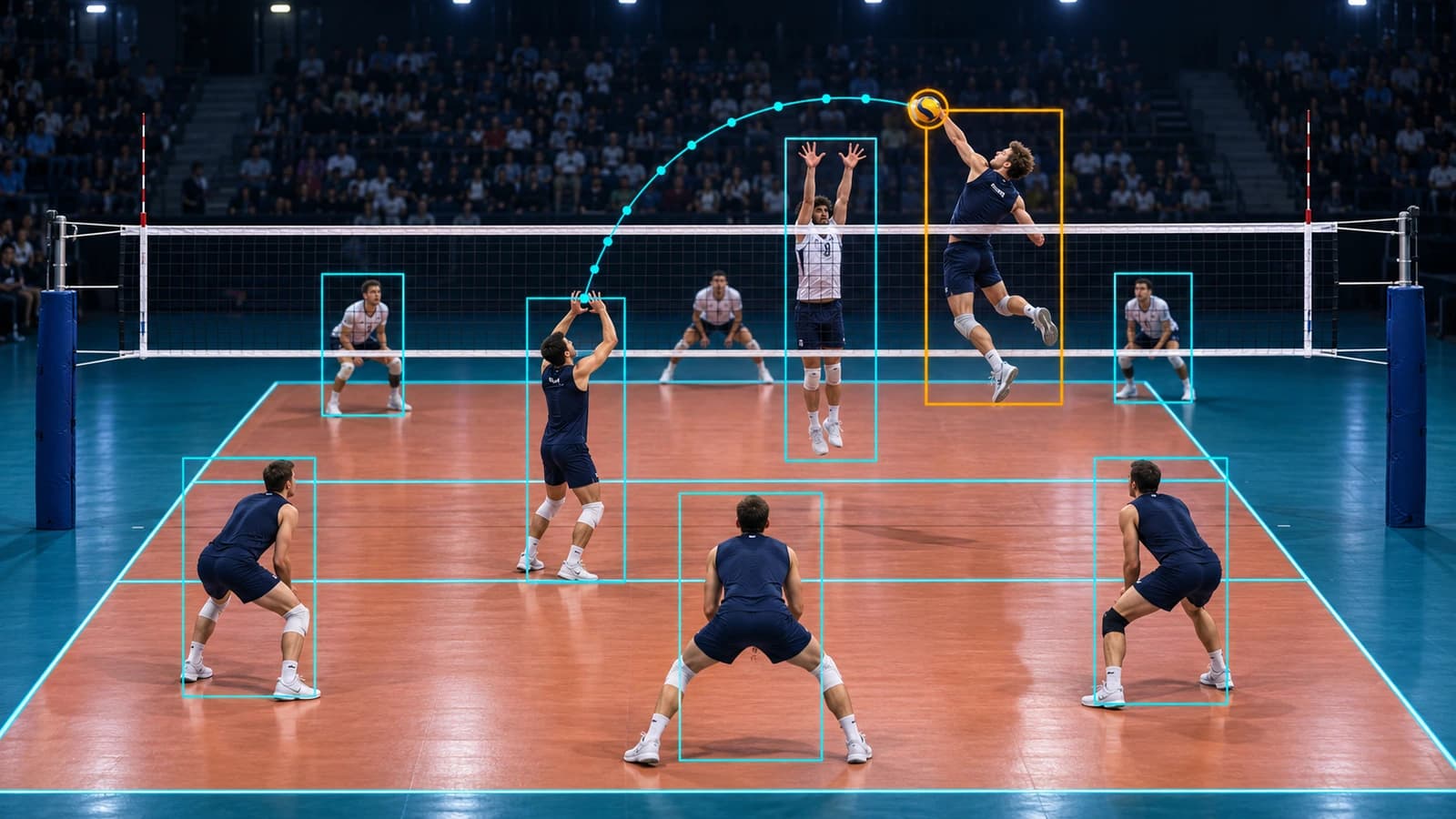
Volleyball computer vision turns match video into touch-by-touch data: where the ball went, which player touched it, which skill they used (serve, reception, set, attack, block, dig), how well, and where on the court. The hard parts are tracking a fast ball through a crowded net and labeling touch quality consistently, because in DataVolley's widely supported scouting format the same evaluation symbol means something different for each skill.
Volleyball computer vision is the use of AI models to detect and track the ball and players in volleyball video and to recognise the actions in each rally. Its output feeds auto-generated stats, scouting reports, highlight clips and coaching tools.
This guide explains what volleyball AI does, how volleyball is traditionally coded, why the ball is hard to track, which public datasets exist, and what training data a volleyball model needs. It follows the same structure as our guide to basketball computer vision.
Key Takeaways
- Commercial volleyball analysis now runs on both AI and people. Hudl's Balltime says its AI "automatically tags each touch and player" (Hudl), while Hudl's Volleymetrics says its analysts "track every touch on both sides of the net" within 12 hours (Hudl).
- DataVolley's scouting format, read and written by several scouting tools, codes each touch as a skill plus an evaluation symbol, and the symbol's meaning depends on the skill: "#" is an ace on a serve but a "perfect pass" on reception (openvolley datavolley).
- Public volleyball datasets exist but are small, and the larger multi-sport ones are non-commercial. SportsMOT and MultiSports, which both include volleyball, are licensed CC BY-NC 4.0.
- A volleyball model needs every touch labeled with its frame, player, skill, evaluation and ball position, all to written definitions.
What does volleyball computer vision do?
It breaks a rally into touches and labels each one. A typical pipeline has five layers:
- Ball detection and tracking: find the ball in every frame and link the detections into a trajectory.
- Player detection and tracking: box every player and keep their identity through the rally.
- Touch and skill recognition: find the moment of each contact and classify it as a serve, reception, set, attack, block, dig or free ball.
- Rally segmentation: find where each rally starts and ends, so dead time between points can be cut.
- Court mapping: convert image positions into court positions, for serve and attack zone charts.
Commercial products show both routes. Hudl describes Balltime as an AI volleyball tool: "Our AI automatically tags each touch and player," and "Just upload your video and let our AI do the rest" (Hudl Balltime). Hudl also sells Volleymetrics, aimed at college and pro teams, where "our professional analysts track every touch on both sides of the net" within 12 hours (Hudl Volleymetrics). Hudl aims the analyst service at college and pro teams, which suggests automatic tagging and human-coded data serve different needs.
How is volleyball traditionally coded?
Touch by touch, as a skill plus an evaluation. A common format is DataVolley's, which several scouting tools read and write. The open-source openvolley project's R package reads DataVolley scouting files (.dvw), "collected for example with ovscout2 or the commercial DataVolley, Click and Scout, or VolleyStation software" (openvolley datavolley).
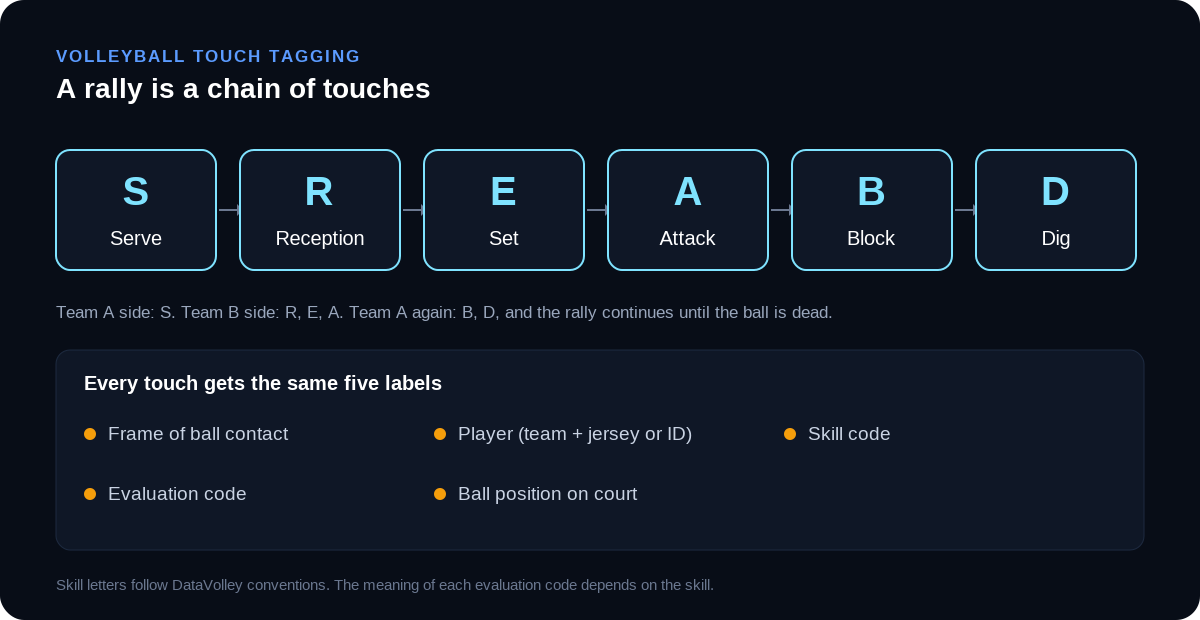
Each touch gets a skill letter and an evaluation symbol. The package's decoder, which follows the standard definitions in the DataVolley manual, maps them like this (skill evaluation decoder):
| Skill | # | + | ! | - | / | = |
|---|---|---|---|---|---|---|
| Serve (S) | Ace | Positive, opponent some attack | OK, no first tempo possible | Negative, opponent free attack | Positive, no attack | Error |
| Reception (R) | Perfect pass | Positive, attack | OK, no first tempo possible | Negative, limited attack | Poor, no attack | Error |
| Attack (A) | Winning attack | Positive, good attack | Blocked for reattack | Poor, easily dug | Blocked | Error |
| Block (B) | Winning block | Positive, block touch | Poor, opposition to replay | Poor, opposition to replay | Invasion | Error |
| Dig (D) | Perfect dig | Good dig | OK, no first tempo possible | No structured attack possible | Ball directly back over net | Error |
Columns follow the symbol list, not a quality ranking. In the decoder, "!" and "-" on blocks share the same meaning.
Two things matter for anyone building a dataset or a model on this.
The symbol alone means nothing. "/" is a positive serve with no attack, a poor reception, a blocked attack, a block invasion or a dig straight back over the net, depending on the skill. Store the skill and the evaluation together, and never train a model on evaluation symbols as a single label set.
Conventions vary between providers. The openvolley documentation notes that files scouted by Volleymetrics "use some conventions in their files that differ from standard DataVolley usage," and the package has a separate decoder option for them (openvolley). If you combine data from more than one source, map the codes first. Our guide to football event definitions shows the same problem in football.
Why is the ball hard to track in volleyball?
In our assessment, because it is small, fast, often hidden at the net, and can leave the frame on high sets. Four situations are the hardest:
- Attacks. A spike is among the fastest balls in the rally, and at video frame rates it blurs into a streak.
- The net. Blockers, hitters and the net tape all sit where the ball crosses, so it is often partly hidden at exactly the moment that matters.
- High balls. Sets and free balls can leave the top of a fixed camera's frame and come back.
- Contact frames. Deciding the frame of contact is harder than finding the ball, especially on blocks and joust-like contests above the net.
Ball tracking research includes volleyball. WASB, a sports ball detection and tracking baseline presented at BMVC 2023, was built to work across soccer, tennis, badminton, volleyball and basketball, and its authors released datasets and code (Tarashima et al., 2023; WASB repository). A general ball tracker still needs volleyball footage from your camera angles to work on your product.
Ball tracking training data is a position per frame: the ball's centre point, a visibility flag (visible, partly hidden, out of frame), and ideally a marker on contact frames.
Which public volleyball datasets exist?
A few, mostly built for research and often under non-commercial licences. Figures below are from our survey of public sports computer vision datasets:
| Dataset | What it labels | Size | Licence |
|---|---|---|---|
| Volleyball (Ibrahim et al., CVPR 2016) | Player boxes, 9 individual actions, 8 team activities such as left spike or right set | 4,830 annotated frames from 55 videos | Not stated |
| SportsMOT (ICCV 2023) | Player boxes with persistent identities, in basketball, football and volleyball | 240 clips across the three sports | CC BY-NC 4.0 |
| MultiSports (ICCV 2021) | Spatio-temporal actions, including 12 volleyball action classes | 3,200 clips across four sports | CC BY-NC 4.0 |
SportsMOT's volleyball footage is taken from views at the serve zone, with an average of 12 tracks per clip (SportsMOT). That is useful for player tracking research, but a single camera angle won't cover a product that takes uploads from parents' phones, gym cameras and broadcast feeds.
Check the licence before using any of these near a commercial model. A non-commercial licence generally rules out using the data to train a product model without separate permission from the dataset owners.
What training data does a volleyball model need?
Every touch labeled with five fields, to written definitions, on footage that looks like your users' footage.
- Frame of contact: the frame where the hand or arm touches the ball, not where the ball lands.
- Player: team and jersey number, or a stable player ID when numbers can't be read.
- Skill: serve, reception, set, attack, block, dig or free ball.
- Evaluation: a quality code from a defined scale, stored together with the skill.
- Ball position: the court position of the contact or landing, for zone charts.
Add rally start and end, the rotation if your product reports it, and ball positions per frame if you train a tracker.
Then write the rules for the cases taggers will disagree on:
- Block touches: when a block touch counts as a touch, and who is credited when two blockers touch the ball.
- Overpasses: a reception or dig that goes straight back over the net. Is it a dig with a poor evaluation, or an attack?
- Setter dumps: is a setter's second-ball attack an attack or a set?
- Evaluation thresholds: what separates a "perfect" pass from a "positive" one. For example, does the setter have to be able to run a first-tempo attack?
Our football event data schema shows how to put definitions, versions and QA status into the data file. The same structure works for volleyball touches.
How do you check volleyball labels?
Measure agreement on the evaluations, not only on the skills. Recognising that a touch was a reception is usually easy. Whether it was a perfect or positive pass is a judgement, and that is where two coders split. Have two people code the same sets independently, compare touch by touch, and report agreement per skill and per evaluation. Our annotation audit checklist covers sample sizes and error reporting.
For AI-generated tags, check the output on your own footage before trusting it: missed touches at the net, wrong player credit on blocks, and contact frames placed late.
Frequently asked questions
Can AI generate volleyball stats automatically?
Yes. Commercial tools such as Hudl's Balltime say their AI tags each touch and player from uploaded video. Hudl also sells a human-coded service, Volleymetrics, aimed at college and pro teams, so check automatic stats against your own footage before relying on them.
What is DataVolley?
DataVolley is commercial volleyball scouting software, and its .dvw file format is widely used for touch-by-touch match data. The open-source openvolley project provides tools to read these files, including files from DataVolley, Click and Scout, VolleyStation and ovscout2.
What do the symbols in volleyball scouting mean?
They are evaluation codes: #, +, !, -, / and =. Their meaning depends on the skill. "#" is an ace on a serve, a perfect pass on reception and a winning attack on an attack. "=" is an error for every skill.
Is there a public volleyball dataset for computer vision?
Yes, but they are small. The Volleyball dataset (CVPR 2016) has 4,830 annotated frames from 55 videos. SportsMOT and MultiSports include volleyball alongside other sports. Check each licence, because several are non-commercial.
Why is volleyball ball tracking difficult?
The ball moves fast on attacks, is often hidden by players and the net at contact, and can leave the frame on high sets. Training a tracker for a product needs ball positions and visibility labeled on footage from your own camera setups.
Get volleyball footage tagged to your definitions
Volleyball is one of the sports Train Matricx covers. Our sport-trained annotators label touches, players, skills and evaluations to your definitions, checked through three QA layers. New clients can start with a free pilot: get in touch and send one clip of up to about 10 minutes, and we'll tag it and return a QA report.
Product descriptions, DataVolley codes and dataset figures were checked against the cited pages and papers in November 2026. Assessments of tracking difficulty are our own. Spot an error? Email info@trainmatricx.com.

Client results

“Train Matricx didn't just provide labeling — they became an extension of our team. With 6K+ football matches annotated and counting at 98% accuracy, they are our premier data partner.”

Billy Brush
Founder & CEO, Dark Horse AI
Don't take our word for it. Test the labels.
Send us the footage your current vendor gets wrong — the occluded players, the motion blur, the edge cases. We annotate it and return a QA report you can check frame by frame.
- Your hardest clip, annotated in 3 business days
- Full QA report with per-frame accuracy
- No commitment, no contract, no card