The football events that leave taggers the most room to disagree are the ones whose definition depends on judgment: whether a ball was a pass, a cross or a clearance; when a dribble becomes a carry; whether a challenge is a duel or a tackle; and what counts as pressure. Even the big data providers define them differently. Opta counts a carry from 5 metres; StatsBomb has no minimum. The fix is a written definition for each event that two people watching the same clip apply the same way, with an observable test, explicit exclusions and decided edge cases.
Football event definitions are the written rules that say what each tag in a match event dataset means: which on-ball actions count as a pass, a duel or a carry, and which frame each one is stamped at. They are the second half of a football event data schema. The schema says what fields a file holds. The definitions say what the values mean.
This guide compares how Opta and StatsBomb define the events with the most judgment in them, explains why the differences exist, and shows how to write definitions that hold up when two annotators tag the same match.
Key Takeaways
- Data providers are not required to publish detailed event definitions, and their definitions vary, because most football concepts are not set by the laws of the game (Bischofberger et al., PLOS ONE, 2024).
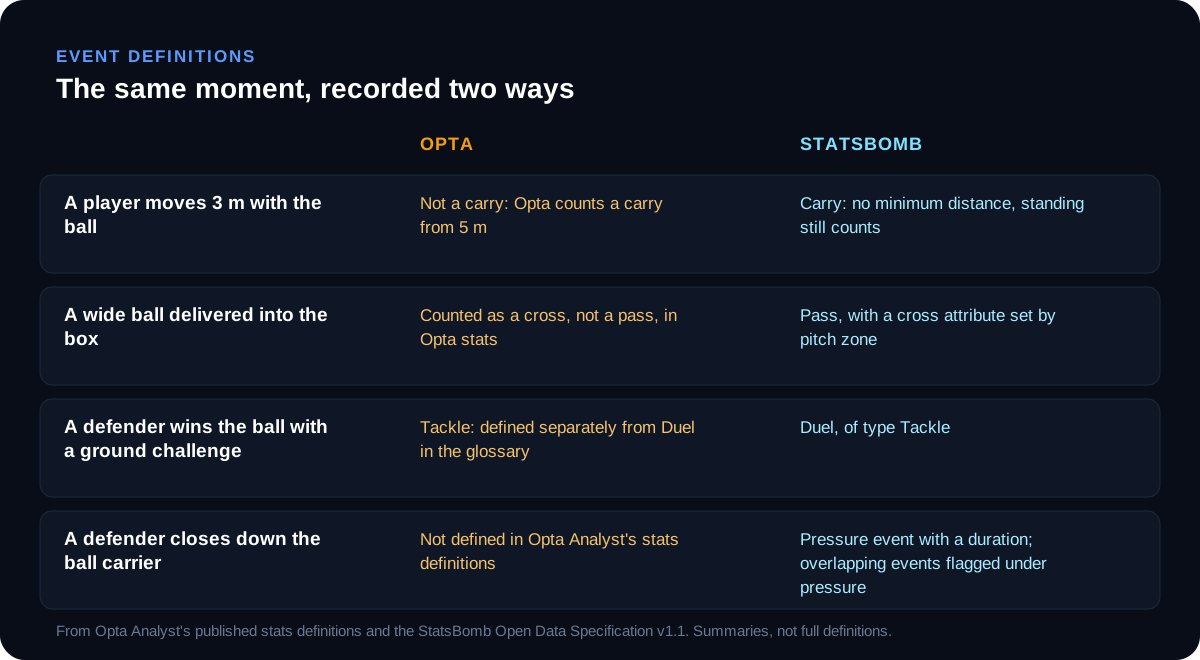
- Opta counts a carry when a player moves the ball 5 metres or more (Opta Analyst). StatsBomb's carry has no minimum distance and includes standing still (StatsBomb Open Data Specification).
- Opta's published pass stat excludes crosses. StatsBomb's pass events include crosses, flagged by pitch zone.
- Neither Opta Analyst's stat definitions nor the StatsBomb Open Data Specification gives a distance threshold for pressure. Your spec has to set one.
- Avoid definitions that depend on intent ("intended to", "tried to") unless you say what visible evidence counts. Intent is the hardest thing for two taggers to agree on.
Why do football event definitions differ?
Because the laws of football define very few of the events analysts count. The laws define goals, fouls, offside and restarts. They do not define a pass, a duel, a carry or pressure. Those concepts come from coaching and analysis practice, and each provider writes its own version.
A 2024 PLOS ONE paper on football event detection makes the point directly. Its authors note that data providers are not required to publish accurate and detailed definitions of the events they annotate, and that definitions differ across providers because most football concepts come from practice rather than from the laws of the game. One consequence they draw: studies that seem to use the same event categories are not necessarily comparable (Bischofberger, Baca & Schikuta, 2024).
The same problem appears inside a single project. Two annotators reading the same one-line definition will fill its gaps differently, and the gaps are always in the same places.
Pass, cross or clearance?
The three differ by where the ball goes and whether a team-mate is the target, and the target is where taggers split.
How the two providers define them:
| Event | Opta (Opta Analyst) | StatsBomb (Open Data Specification v1.1) |
|---|---|---|
| Pass | "The attempted delivery of the ball from one player to another player on the same team." Crosses, keeper throws and throw-ins do not count as passes | "An intended kick from one player to his teammate" |
| Cross | A ball played from a wide position that targets team-mates in a central area close to goal; not counted as a pass in Opta stats | A pass marked as a cross if it starts in set attacking zones and intersects a set target zone |
| Clearance | An attempt to get the ball away from a dangerous zone "with no immediate target regarding a recipient for the ball" | "Action by a defending player to clear the danger without an intention to deliver it to a teammate" |
Sources: Opta Analyst stats definitions; StatsBomb Open Data Specification v1.1.
Two things follow for anyone writing a spec.
Pass totals are not comparable across providers. Opta's published pass stat excludes crosses. StatsBomb's pass events include them, with a cross flag. Decide whether a cross is a pass with an attribute or its own event, and say so in the schema.
"Intended" and "attempted" lean on intent. The PLOS ONE paper singles this out, noting that a Stats Perform requirement for a pass to be intentional is "hardly an objective qualificiation" (sic). A tagger can't see intent. They can see where the ball went, which way the passer was facing, and whether a team-mate was moving toward the ball. Write the definition around those.
A testable version looks like this: A pass is a touch that sends the ball along a line a team-mate could reach. A clearance is a touch by a defending player, inside a defined zone, that sends the ball away from goal when no team-mate is within reach of its path. Then decide the edge case everyone argues about, a hurried clearance that happens to find a team-mate, and write the decision down.
When does moving with the ball become a carry?
When your spec says so, because the two best-known providers disagree.
- Opta: a carry is "the player moving the ball five metres or more", and a progressive carry moves it more than five metres upfield (Opta Analyst).
- StatsBomb: a carry is when "a player controls the ball at their feet while moving or standing still", with no minimum distance (StatsBomb specification).
So a player who takes two touches and moves 3 metres before passing has made a carry in StatsBomb-style data and no carry in Opta-style data. Neither is wrong. But a model trained on one and evaluated on the other will look broken.
For your own spec, set a minimum distance, a minimum duration, or both. Then decide where a carry starts (the first controlled touch after receiving?) and where it ends (the next touch that is a pass, shot or loss). Our football tagging buyer's guide covers which events most projects tag; this is one where the threshold changes the numbers most.
Duel, tackle or 50/50?
Both providers agree on the core duel definition and then split on how tackles and loose balls fit around it.
| Event | Opta | StatsBomb |
|---|---|---|
| Duel | "A 50-50 contest between two players of opposing sides in the match"; aerial duels are a named type | Same core wording; duel events describe when a defender challenges an attacker, with types including Aerial Lost and Tackle |
| Tackle | Defined separately from Duel in the glossary: a legal, ground-level challenge where the player connects with the ball and successfully takes it away from the opponent | A type of duel ("dispossessing opposing team player"), with an outcome such as Won |
| Loose ball | Not separately defined on that page | A separate 50/50 event: "2 players challenging to recover a loose ball" |
| Interception | A player reads an opponent's pass and moves into its line to intercept | "Preventing an opponent's pass from reaching their teammates by moving to the passing lane/reacting to intercept it" |
The practical disagreements come from three questions the definitions leave open:
- Is an unsuccessful tackle a tackle? Opta's wording requires the ball to be taken away. In StatsBomb, a tackle is a duel type with its own outcome. Decide whether a failed tackle is recorded, and as what.
- One record or two? A duel involves two players. Decide whether it becomes one event or two linked events, one for each player with opposite outcomes. Our football event data schema uses two linked records.
- Who has the ball? A challenge on a player in control of the ball is different from two players racing to a loose ball. Write the test: who touched the ball last, and was it under control?
What counts as pressure?
Neither Opta Analyst's stat definitions nor the StatsBomb Open Data Specification gives a distance at which a defender starts pressing, so this is the definition you most need to write yourself.
- Opta Analyst's public definitions don't define a pressure event. They describe pressing at team level instead, with measures such as PPDA (passes allowed per defensive action) and pressed sequences.
- StatsBomb records pressure as an event with a location, where the player started applying pressure, and a duration. Any on-ball event that overlaps that duration is flagged as under pressure. Its specification also notes that events naturally performed under pressure, such as duels and dribbles, pick up the under-pressure attribute even without a separate pressure event, and that a "counterpress" attribute marks pressing actions within 5 seconds of an open-play turnover (StatsBomb specification).
For a tagging spec, pressure needs four rules:
- Distance: how close the defender must be, in metres, to count. Distance is hard to judge on a single wide camera, so give taggers a visual reference such as body lengths or pitch markings.
- Movement: whether the defender must be closing down, or whether standing within range counts.
- Start and end: when the pressure begins and when it stops.
- Inheritance: which on-ball events take the under-pressure flag, and whether pressure on a receiver counts before the ball arrives.
If your schema grades pressure (none, medium, high), as our sports taxonomy does, each grade needs its own threshold. Otherwise "medium" means something different to every tagger.
How do you write a definition two taggers apply the same way?
Give every event the same six fields, and test each one on real clips before tagging starts.
- Definition: one sentence.
- Observable test: what the tagger must see in the video. Replace "intended" with visible evidence.
- Includes: situations that count.
- Excludes: situations that don't, and which event they go to instead.
- Edge cases: the calls taggers will disagree on, each with its decision.
- Timestamp rule: which frame the event is stamped at, such as ball contact.
A worked example, using clearance:
| Field | Clearance |
|---|---|
| Definition | A defending player's touch that sends the ball away from their own goal when no team-mate is within reach of its path |
| Observable test | Touch happens inside the defending team's [defined zone]; the ball travels away from goal; no team-mate is moving toward the ball's line within [X] metres |
| Includes | Headed and kicked clearances; clearances out of play |
| Excludes | A touch that sends the ball along a line a team-mate could reach (Pass); a touch that stops a shot (Block) |
| Edge cases | A hurried clearance that happens to reach a team-mate stays a clearance if the observable test was met at the moment of contact |
| Timestamp rule | Frame of ball contact |
The bracketed values are yours to set. The structure is what makes two taggers reach the same answer.
Then version it. A definition changed halfway through a project silently changes the meaning of every match tagged before the change. Our guide to sports taxonomy and event schema design covers versioning and migration in detail.
How do you check that taggers agree?
Measure agreement on the same footage, event by event, before production starts and at intervals during it.
The PLOS ONE authors draw a useful line here. The reliability of manual event detection, meaning whether taggers agree with each other, can be secured through extensive training. Validity, meaning whether the tags capture what really happened in the sense the definition intends, is harder to guarantee (Bischofberger et al., 2024). High agreement shows a rule is applied consistently, not that it measures the right thing.
Agreement can be high: when two independent groups of trained Opta operators, working to the same definitions, tagged the same Spanish league match, agreement on team events gave kappa values of 0.92 and 0.94, where 1.0 is perfect agreement (Liu et al., 2013).
A practical test:
- Have two taggers code the same clips independently, without seeing each other's work.
- Compare event by event, not as match totals. Totals can match while individual events disagree.
- Report agreement per event type. Expect the biggest gaps on events with judgment-based definitions, such as duels, carries and pressure; events with a clear observable test tend to agree better.
- For every disagreement, decide whether a tagger misapplied the rule or the rule is unclear. Unclear rules get rewritten and versioned.
Our guide to vendor onboarding and calibration covers agreement thresholds and gold sets. Our annotation audit checklist covers checking a finished delivery.
Download the definitions template
football-event-definitions-template.md is free to copy. It has the six-field structure for pass, cross, clearance, carry, duel, tackle, interception and pressure, with extra fields where an event needs them, with the edge cases above as prompts, a version header and a change log. The bracketed thresholds are placeholders, not recommendations: set them for your footage and your model.
Football event definitions checklist
- List the events in scope and the provider style each one follows.
- Decide whether a cross is a pass with an attribute or its own event.
- Set a minimum distance or duration for a carry.
- Decide whether a tackle is a type of duel or a separate event, and how a failed tackle is recorded.
- Decide whether a duel is one record or two linked records.
- Write pressure rules: distance, movement, start, end and inheritance.
- Replace every "intended" or "tried to" with visible evidence.
- Write the excludes and edge cases for every event.
- Set a timestamp rule per event.
- Double-tag sample clips, compare event by event, and rewrite unclear rules.
- Version the definitions and log every change.
Frequently asked questions
Why doesn't my event data match Opta or StatsBomb?
Because the definitions differ. Opta's pass stat excludes crosses while StatsBomb's pass events include them, and the two count carries from different distances. Compare definitions before comparing numbers.
Can I use Opta's or StatsBomb's definitions for my own tagging?
You can adopt the same structure, but their public definitions are summaries. You will still need to write the observable tests, thresholds and edge cases yourself, because those are what make two taggers agree.
What is the hardest football event to define?
Of the documents compared here, pressure is the least specified: neither Opta Analyst's stat definitions nor the StatsBomb specification gives a distance threshold. Carries and duels follow, because providers disagree on minimum distance and on how tackles and loose balls fit.
How often should definitions change?
As rarely as possible, and never silently. Every change gets a new version number and a note on whether earlier matches need re-tagging.
Do definitions matter for AI training data more than for match analysis?
Yes. An analyst watching clips can absorb small inconsistencies. A model learns them. Inconsistent labels for the same situation teach the model that the situation has no reliable answer.
Get your matches tagged to your definitions
Train Matricx tags football matches to your definitions, or to ours when you don't have them yet, with the definitions written down and versioned before the first match. See the football event tagging service, or start with a free pilot on one of your own matches.
Provider definitions were checked against Opta Analyst's published stats definitions and the StatsBomb Open Data Specification v1.1 in November 2026. Recommendations are our own. Spot an error? Email info@trainmatricx.com.

Client results

“Train Matricx didn't just provide labeling — they became an extension of our team. With 6K+ football matches annotated and counting at 98% accuracy, they are our premier data partner.”

Billy Brush
Founder & CEO, Dark Horse AI
Don't take our word for it. Test the labels.
Send us the footage your current vendor gets wrong — the occluded players, the motion blur, the edge cases. We annotate it and return a QA report you can check frame by frame.
- Your hardest clip, annotated in 3 business days
- Full QA report with per-frame accuracy
- No commitment, no contract, no card