Basketball is one of the most data-rich environments in professional sport. The NBA has used optical player tracking since 2013. Every arena in the league now captures player positions at 25 frames per second across six cameras. Every shot, screen, pass, drive and defensive rotation is potentially trackable from video alone.
But the models that produce that data do not run on camera hardware. They run on training data — thousands of hours of annotated basketball footage that taught the models what a pick-and-roll looks like, how to maintain player identity through a crowded paint situation, and where the ball is when a hand-off blocks it from every camera angle simultaneously.
This guide covers how basketball computer vision works, what makes it harder than most sports CV problems, and what training data requirements look like for teams building NBA-grade models.
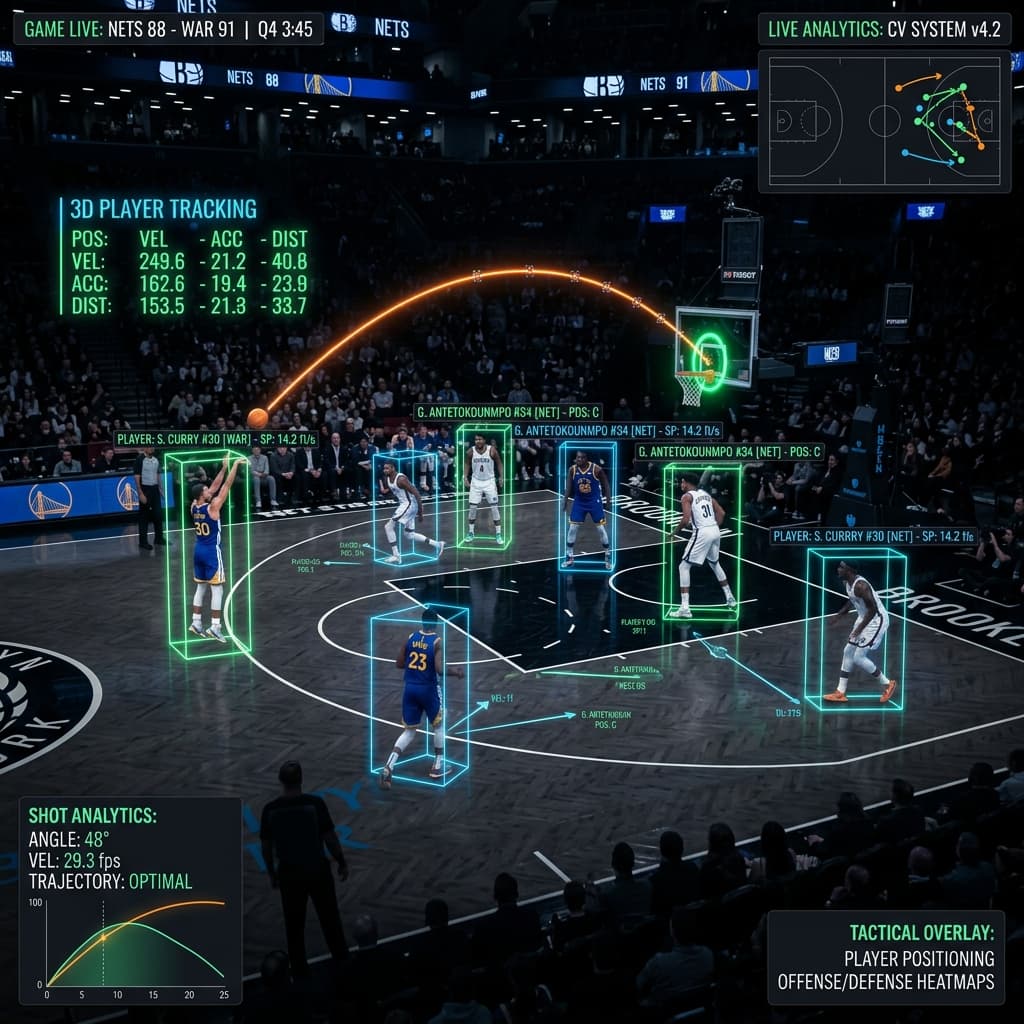 High-end sports analytics visualization showing basketball player tracking and shot trajectory estimation with computer vision overlays.
What is basketball computer vision?
Basketball computer vision is the use of AI to interpret basketball footage — detecting and tracking players and the ball, classifying plays and events, mapping court zones, analysing shooting mechanics and converting video into structured data for analytics, coaching, broadcast and AI model training.
The technology is optical: it works from camera footage without wearable sensors. The output is sport-specific: player positions in real court coordinates, ball trajectory from release to rim, play-type classifications, shot quality metrics and defensive assignment tracking.
That structured output powers everything from an NBA team's coaching dashboard to a fantasy platform's real-time stats feed to a broadcaster's automated shot chart overlay.
Why basketball is one of the hardest sports for computer vision
Every sport presents computer vision with specific challenges. Basketball has an unusually high concentration of them in a small space.
Confined court, maximum density. Twenty athletes and two referees operate on a 94×50 foot surface. At any moment during an offensive possession, six to ten of those people may be within fifteen feet of the ball. Detection and identity models trained on football or cricket — where athletes are spread across much larger fields — do not transfer to basketball without retraining on basketball-specific data.
Continuous screening and contact. Picks, screens, hand-offs, and posting up all involve deliberate physical contact and overlapping bodies. A player tracking model must maintain identity for both the screener and the ball handler through the moment of contact — when one player is partially or fully behind another — and correctly re-identify both as they separate.
Ball occlusion at critical moments. The moments of highest analytical value — the release point, the shot arc, the rim contact, the tip-out — are also the moments when the ball is most likely to be obscured. During a layup, the ball passes through a cluster of hands, bodies and the basket structure simultaneously. During a three-pointer, the player's hand releases the ball while the body and arm block camera angles in sequence. Ball tracking in basketball requires the model to maintain trajectory continuity through frames where the ball is not clearly visible.
High pace with frequent restarts. Basketball operates at a higher possession rate than most field sports, with frequent stoppages, fast breaks and transition sequences that create rapid positional resets. A model that loses a player's identity at the stoppage may misattribute the following possession entirely.
Court and camera geometry. Basketball arenas use fixed overhead cameras, courtside cameras and broadcast cameras simultaneously. Perspective distortion at the courtside level makes player size and position appear inconsistent. Multi-camera identity matching — confirming that Player 23 in the overhead view is the same person as the player on the left wing in the broadcast feed — requires training data that explicitly represents multi-angle synchronisation.
The five applications of basketball computer vision
| Application | What it produces | Primary buyers |
|---|---|---|
| Player tracking | Positions, speed, distance, zone occupancy | NBA clubs, sports analytics platforms |
| Ball tracking | Trajectory, release angle, arc, spin | Coaching tools, broadcast, training AI |
| Play recognition | Pick-and-roll, isolation, zone defence, transition | Coaching and scouting platforms |
| Shot analysis | Shot type, shot quality, release mechanics | Performance analytics, coaching |
| Broadcast automation | Shot charts, AR overlays, stat triggers | Networks, streaming platforms |
Each application requires different training data. A player tracking model needs persistent IDs across full game sequences. A shot analysis model needs frame-accurate release point labels and outcome annotations. A play recognition model needs structured event taxonomies covering every play type in the sport.
Player tracking in basketball: what makes it distinct
Player tracking in basketball shares the same fundamental architecture as player tracking in other sports — detect objects in frames, link detections across time — but the basketball context creates problems that football or cricket datasets do not prepare a model for.
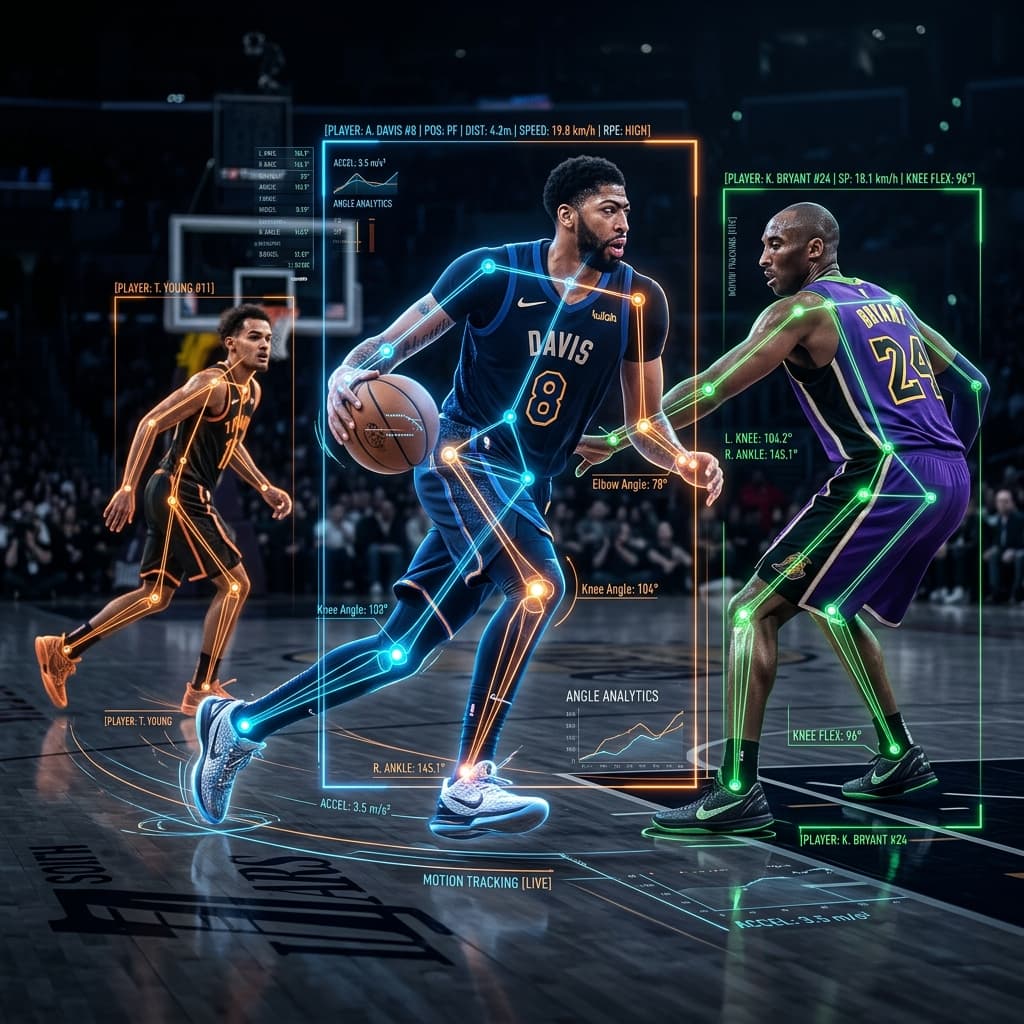 Biomechanical skeletal tracking and bounding box overlays analyzing players in real-time.
Identity through screens
A screen is a legal obstruction. The screener plants in the path of a defender, forcing a switch or allowing the ball handler to use the screen to get open. From a computer vision perspective, a screen means two players' bounding boxes briefly overlap, often merge into one detection, then separate. The model must predict which identity belongs to which box as they re-emerge. Holding that identity across a camera cut is a separate problem again, covered in our guide to court registration and player re-identification.
If training data does not include a large volume of correctly labeled screen sequences — with identity maintained through the contact point and separation — the model learns to swap identities during screens. In the NBA, where screens define offensive systems (dribble hand-offs, horns sets, motion offense), this produces wrong defensive assignment data, wrong spacing metrics and broken possession attribution. The rules for labeling identity through contact, cuts and re-entry are set out in our player re-ID labeling spec.
Zone coverage and defensive assignment
Tracking where each player is physically located is only part of the basketball CV problem. Coaching platforms want to know who is guarding whom, which zone each player is responsible for, and how defensive assignments change during a possession. This requires linking player identity to court positions to defensive system labels — a classification problem that requires sport-specific event taxonomy, not just object detection.
Off-ball movement
In football, most analytics focus on the ball and the players near it. In basketball, off-ball movement is tactically critical. A team's spacing — where the three players without the ball position themselves during a two-man game — determines the offensive options available and the defensive response required. A computer vision model that only tracks on-ball events misses the majority of what coaching staff want to understand.
Ball tracking in basketball: the specific challenges
The basketball is larger than a cricket ball or tennis ball and moves more slowly than a puck. It is still one of the hardest tracking objects in sports computer vision, for reasons specific to the sport.
The layup problem
During a layup or dunk, the ball enters the basket structure from below or above, passing through metal rim, glass backboard and net simultaneously. From most camera angles, the ball disappears entirely for one to three frames at the point of rim contact. The model must interpolate position through that gap and correctly classify the outcome — made, missed, blocked, goaltended — from partial information.
Hand-off and pass release
During a hand-off — where the ball handler moves laterally and places the ball into a teammate's hands without a traditional pass — the ball transitions from one pair of hands to another with no airborne phase. Detecting this as a pass (with a release point and a receiver) rather than a single player moving requires training data that explicitly labels hand-off events, not just traditional passes.
Free throw arc analysis
Free throw shooting mechanics are now a training data use case. AI models that analyse release angle, arc height, and wrist position at release are used to give individual players shooting feedback. Labeling these sequences requires frame-accurate keypoint annotation on the shooting hand, wrist and ball simultaneously — across thousands of free throw attempts representing different players, mechanics and outcomes.
Play and event recognition: teaching AI the language of basketball
Detection and tracking answer where objects are. Play recognition answers what is happening — which is what makes the data commercially valuable.
The taxonomy problem
Basketball has a complex play vocabulary. The same two-man game can be labelled a pick-and-roll, a pick-and-pop, a dribble hand-off, a flare screen or a ghost screen depending on the specific mechanics and the scouting system used. Different coaching staffs use different terminology. Different analytics platforms use different ontologies.
A play recognition model can only be as consistent as its training taxonomy. If annotators use different labels for the same action — or if the taxonomy does not define how to handle edge cases (what is the label when a pick-and-roll shifts into an isolation mid-possession?) — the training data teaches the model to be inconsistent.
Building a basketball event taxonomy requires both computer vision expertise and genuine basketball knowledge. The taxonomy must define:
- Every play type and its sub-variants
- The exact frame where each play begins and ends
- How to label a play that shifts type mid-execution
- How to handle simultaneous plays occurring in different parts of the court
- Which player IDs link to each role in the play (ball handler, screener, defender 1, defender 2)
Shot classification
A shot is not just a ball going toward the rim. Shot classification in basketball AI typically includes shot type (layup, floater, pull-up jumper, catch-and-shoot, post-up, step-back, tip-in), court zone (corner three, above-the-break three, mid-range, paint), shot quality (open, contested, heavily contested), shot outcome (made, missed, blocked, goaltended), and clock context (shot clock pressure, game clock situation).
Labeling this correctly requires annotators who understand basketball. The difference between a pull-up jumper and a step-back is in the footwork, not the final release position. The difference between open and contested depends on the proximity and timing of the nearest defender — not just whether a defender is visible in the frame.
What basketball computer vision training data requires
A production-quality basketball CV dataset is more complex than most sports annotation projects. It typically needs:
For player tracking:
- Bounding boxes per player per frame across full game sequences
- Persistent player IDs maintained through occlusion, screens and camera cuts
- Jersey number annotations where readable
- Court position labels in real-world coordinates (not pixel coordinates)
- Role labels (ball handler, screener, defender, off-ball)
- Multi-camera synchronisation with frame-accurate timestamps
For ball tracking:
- Frame-by-frame ball position including occluded frames with status labels
- Contact frame annotations (release, dribble contact, rim contact, catch)
- Trajectory interpolation labels through blocked frames
- Shot arc keypoints for mechanics analysis
For event and play recognition:
- Frame-accurate event start and end labels
- Play type classifications using a defined taxonomy
- Player ID links for all roles in each play
- Outcome labels for possessions and events
- Defensive assignment labels for coverage analysis
For shot analysis:
- Shot type classification
- Shot zone from court coordinate data
- Defensive contest classification
- Release mechanics keypoints for mechanics models
Before commissioning labels, check what already exists. SportsMOT, DeepSportradar-v1, TrackID3x3, MultiSports and NSVA all include basketball data, though only TrackID3x3 carries an open licence. Our guide to public sports computer vision datasets compares them task by task. If you label more than one sport, our guide to annotation capacity planning covers why capacity does not transfer between them.
Who uses basketball computer vision?
NBA and professional league teams use computer vision data for coaching (play tendency analysis, defensive rotation breakdowns), scouting (opponent play frequency and success rates), player development (individual shooting mechanics, movement efficiency) and workload management (sprint counts, distance, load by game segment).
Sports analytics platforms build the coaching dashboards, scouting tools and data APIs that professional teams subscribe to. They need large-scale annotated basketball footage to train the models that generate those products. Second Spectrum, the official NBA tracking data provider, runs computer vision models trained on annotated footage across all 30 arena camera systems.
Media and broadcast companies use basketball CV for automated highlight generation, real-time shot charts, player stat overlays and predicted possession graphics. The tolerance for tracking errors is close to zero in live broadcast — a wrong player name on a graphic is visible to millions of viewers.
Fantasy sports and betting platforms consume real-time event classification data. Their models need frame-accurate play and event labels to generate live stats, projections and in-game markets.
AI research labs use basketball footage as a benchmark for multi-object tracking, dense pose estimation and temporal action recognition research. The controlled court environment and standardised play structures make basketball a useful research environment.
Frequently asked questions
What is basketball computer vision? Basketball computer vision uses AI to interpret basketball footage — detecting and tracking players and the ball, classifying plays and events, analysing shooting mechanics and producing structured data for analytics, coaching, broadcast and model training. It works from camera footage without wearable sensors, and its output quality depends entirely on the quality of training data used to build the models.
How does player tracking work in basketball? Player tracking detects each athlete in every frame and maintains a consistent identity across the game sequence. In basketball, this is complicated by screens, hand-offs and dense court situations where multiple players overlap. The model must maintain identity through occlusion and correctly re-identify players as they separate. Training data that doesn't include correctly labeled screen sequences produces models that swap player identities during exactly the plays that coaching staff most want to analyse.
How does the NBA track players? The NBA uses six cameras mounted in the catwalks of each arena, producing optical tracking data through computer vision models at 25 frames per second. The official provider for this data is Second Spectrum. The data covers player positions in real court coordinates, ball position and basic event classification. Many teams supplement this with proprietary computer vision systems that add play-level labels and biomechanical data.
What is a pick-and-roll in basketball computer vision? A pick-and-roll is a two-man play where one player sets a screen for the ball handler, who then attacks off the screen while the screener rolls toward the basket. In computer vision terms, it is a temporal event classification that starts at the screen-setting movement, links the ball handler and screener by player ID, and ends at the point where the play resolves into a shot, pass or defensive stop. Correctly classifying it requires a taxonomy that distinguishes it from a pick-and-pop, a slip, a ghost screen and a hand-off.
Why is basketball harder than football for computer vision? Basketball's court is much smaller than a football pitch but contains more players per square metre, more physical contact and more frequent overlapping body positions. Screens create deliberate identity confusion for tracking models. The ball moves through occluded zones at critical moments — during layups, dunks and hand-offs. Player density around the paint during rebounds creates multiple simultaneous detection challenges in a single frame. Football's larger space and fewer occlusion events per possession make it a simpler detection and tracking problem.
What training data does a basketball AI model need? A basketball CV model needs annotated footage covering the specific use case: bounding boxes and persistent IDs for tracking, event taxonomy labels for play recognition, shot classification and zone labels for shooting analytics, and keypoint annotations for mechanics models. The critical quality factors are temporal consistency (player IDs stable across full game sequences), schema alignment (labels designed for the model objective, not generic), and domain verification (annotators who understand basketball, not just annotation tooling).
How accurate is basketball player tracking AI? Accuracy in production basketball tracking is typically measured by identity switch rate, ball position error and event classification precision. Identity switch rate — how often the model swaps player IDs — is the most consequential metric, because downstream analytics inherit all switching errors. Accuracy varies by vendor and by game scenario; crowded paint situations and screen-heavy possessions produce the highest error rates in models trained on insufficient occlusion data.
What is shot quality in basketball AI? Shot quality is a model-generated score or classification representing how likely a shot was to go in based on its context — the shooter's position, the defensive contest level, the time remaining on the shot clock, and the shot type. Shot quality models are trained on labeled shot data where each attempt is annotated with position, shot type, contest classification and outcome. Over large samples, shot quality scores allow teams to evaluate whether a player or play type generates efficient looks independent of whether the shots happened to go in.
Can computer vision replace wearable tracking in basketball? For most performance and tactical analytics use cases, optical tracking from camera footage produces data quality comparable to GPS and inertial sensor systems — without equipment requirements on athletes. For biomechanical analysis (joint load, impact force, specific injury risk metrics), wearables still provide data that cameras cannot. In practice, NBA and elite club systems use optical tracking for court coverage and event classification, and selectively add wearables for physical load monitoring.
The takeaway
Basketball is the most data-intensive sport in terms of per-possession event complexity and the volume of AI products built on its footage. The technology stack is sophisticated. But the limiting factor for every computer vision team building basketball AI is the same as in every other sport: training data that correctly represents the hard scenarios — screens, dense paint situations, occluded ball transitions and multi-camera identity matching.
If you are building basketball computer vision models and need expert-annotated training data — player tracking, ball trajectory, play recognition, shot classification or skeletal mechanics — see how Train Matricx works or review live client results in our case studies. We annotate a free pilot clip so you can evaluate quality before committing to any volume.

Client results

“Train Matricx didn't just provide labeling — they became an extension of our team. With 6K+ football matches annotated and counting at 98% accuracy, they are our premier data partner.”

Billy Brush
Founder & CEO, Dark Horse AI
Don't take our word for it. Test the labels.
Send us the footage your current vendor gets wrong — the occluded players, the motion blur, the edge cases. We annotate it and return a QA report you can check frame by frame.
- Your hardest clip, annotated in 48 hours
- Full QA report with per-frame accuracy
- No commitment, no contract, no card