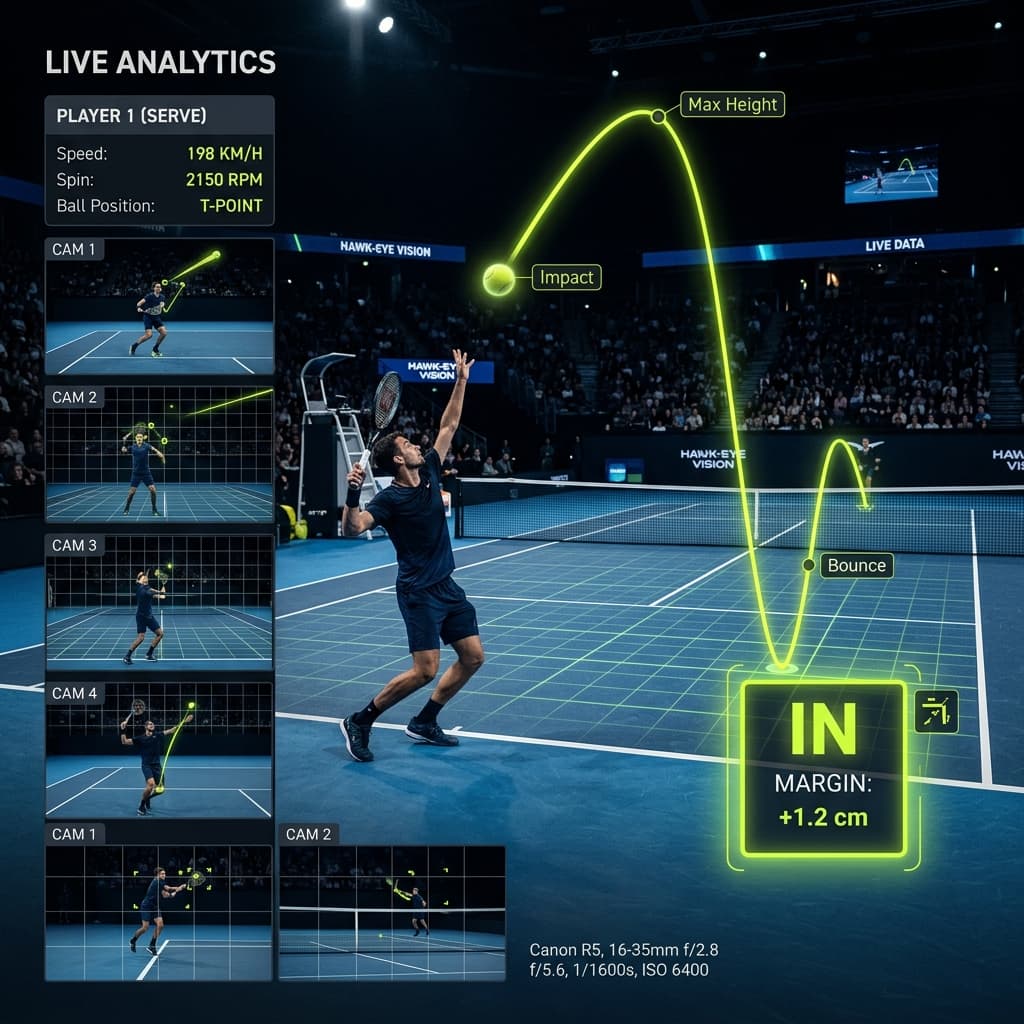
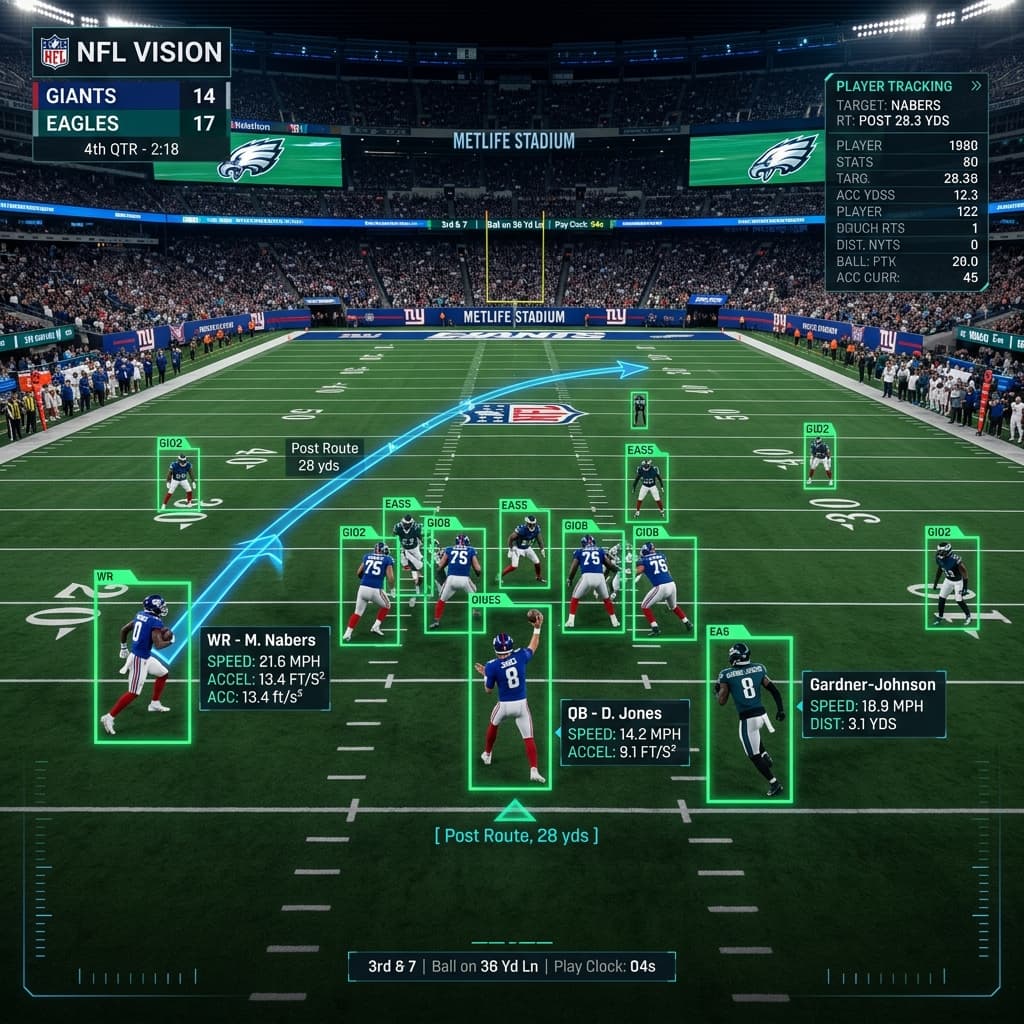
The 2026 FIFA World Cup is the largest football tournament ever staged — 48 teams, 104 matches, three host nations, and a broadcast audience that will dwarf every prior edition. It is also, quietly, the largest single deployment of sports computer vision in the sport's history. Every offside call, every broadcast graphic, every ball-trajectory replay and every post-match performance number is running on AI systems that did not exist a decade ago.
Most of the coverage around this tournament will focus on the football. This piece focuses on the layer underneath it — the computer vision and AI infrastructure making a tournament of this scale possible, and what it reveals about where sports AI is actually headed.
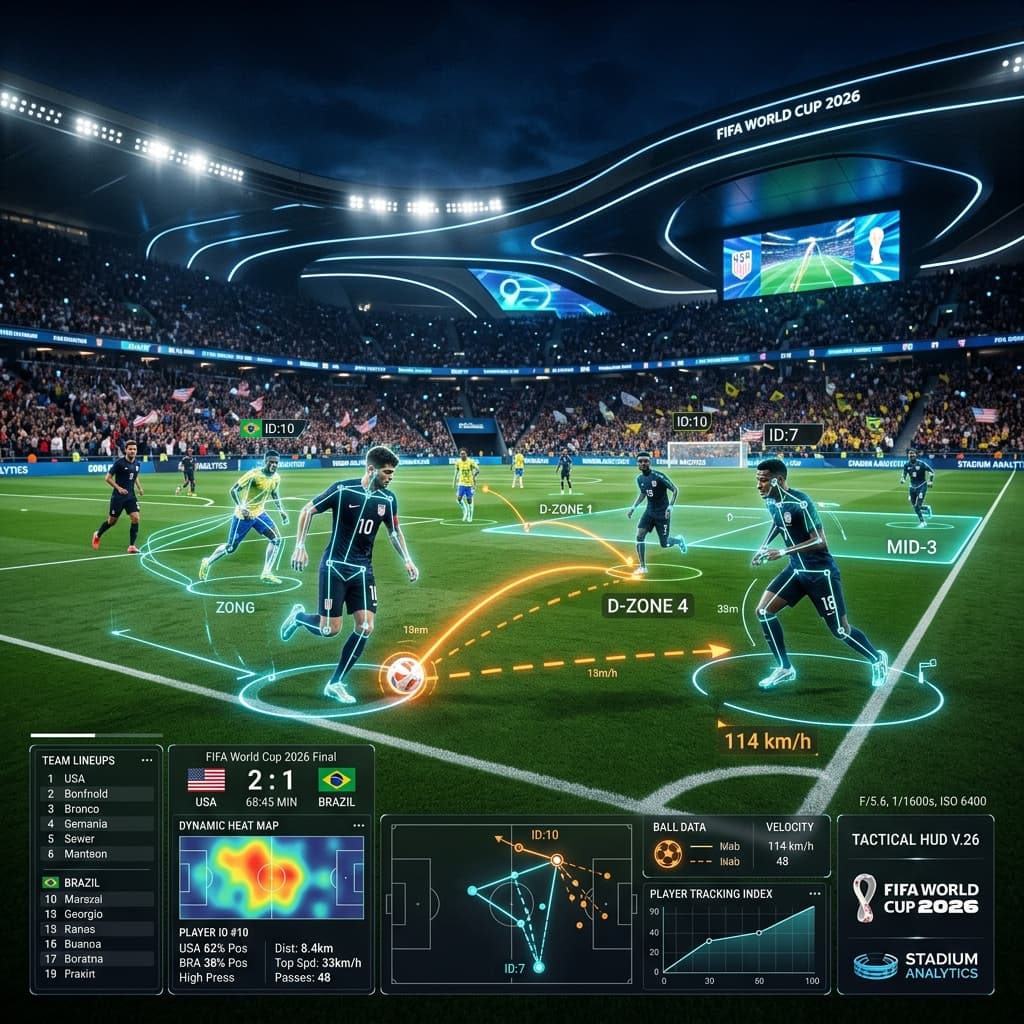 High-end technical visualization of the FIFA World Cup 2026 AI infrastructure: real-time 3D player skeletal tracking, ball passing vectors, and live stadium tactical overlays.
Why 2026 is a different scale of technical challenge
The 2026 World Cup expanded from 32 to 48 teams, increasing the tournament from 64 matches to 104 — a 63% increase in matches across three host nations: the United States, Canada and Mexico.
That scale matters for reasons that go beyond logistics. Every system described below — offside technology, ball tracking, broadcast AI, performance analytics — has to function consistently across more venues, more cameras, more lighting conditions, more pitch types and more hours of live football than any previous tournament has required. A system that works reliably in one stadium with months of calibration has to work reliably in 16 host cities across three countries, often with grass conditions, altitude and climate that vary significantly between venues.
This is the part of the tournament almost nobody talks about: scale is itself a computer vision problem. A system that's 99% reliable in controlled conditions can fail in ways that only show up when you run it across 104 matches instead of 64.
Semi-automated offside technology
The most visible AI system at the tournament is semi-automated offside technology (SAOT) — the system that replaced manual VAR line-drawing with automated limb tracking and 3D triangulation. Every marginal offside call at the tournament will be calculated by a network of tracking cameras detecting more than 20 points on each player's body, triangulating those points into precise pitch coordinates, and calculating the offside line at the exact frame the ball is played.
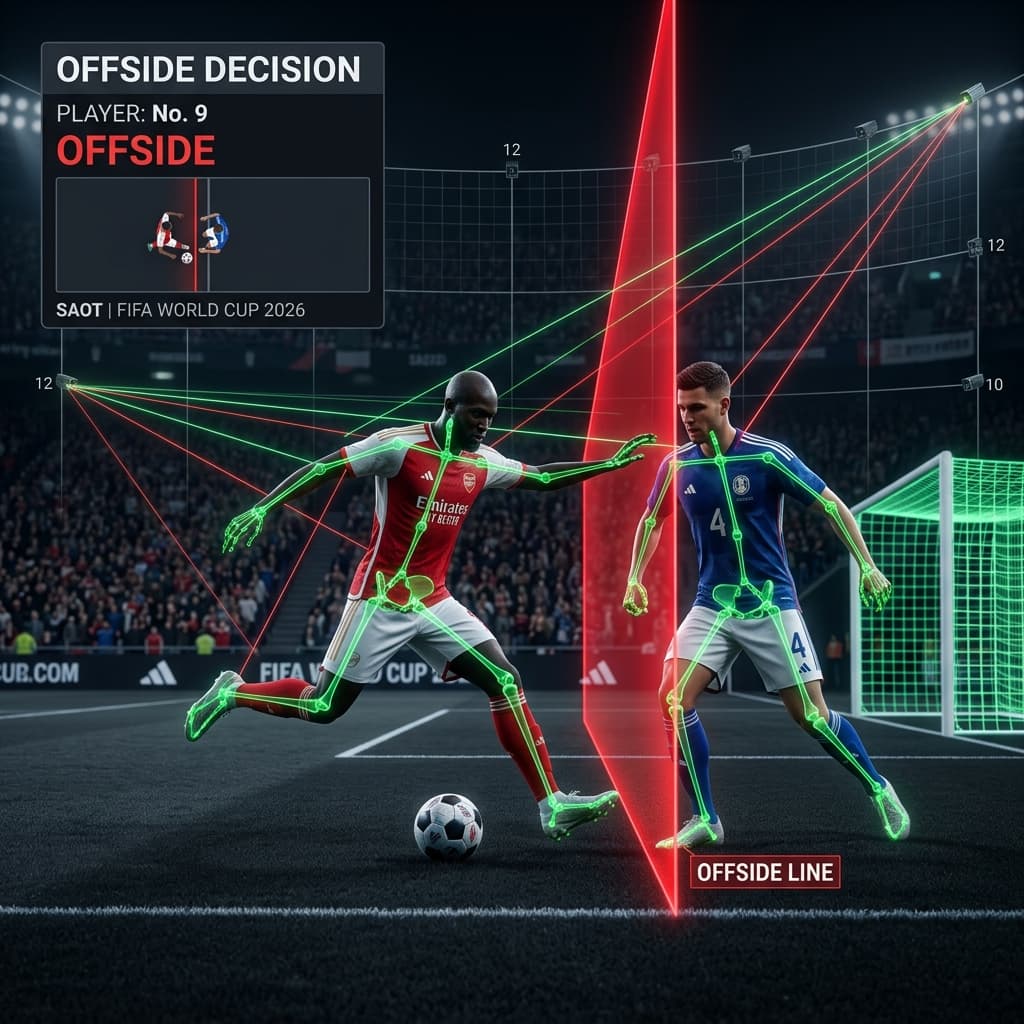 Semi-automated offside technology displaying 3D limb-tracking skeletal overlays and camera triangulation lines marking a player's offside margin.
We've covered exactly how this works in detail in our dedicated breakdown of semi-automated offside technology — the short version is that it is one of the most precision-demanding applications of computer vision in any sport, because professional-level offside calls are frequently decided by centimetres, and the system has to be accurate enough that its calculated margin means something.
At World Cup scale, this system runs across every host stadium, every match, with a tracking camera network calibrated independently at each venue. The technology doesn't get easier at scale — every new stadium is a new calibration problem, a new lighting condition, and a new set of edge cases the underlying models have to handle correctly on the biggest stage in the sport.
Connected ball technology
Since 2018, FIFA's official match balls have included a suspended inertial measurement unit (IMU) inside the ball itself — a sensor package that transmits precise data on ball position, contact moments, and movement up to 500 times per second. This is what's commonly referred to as "connected ball technology," and it works alongside camera-based computer vision rather than replacing it.
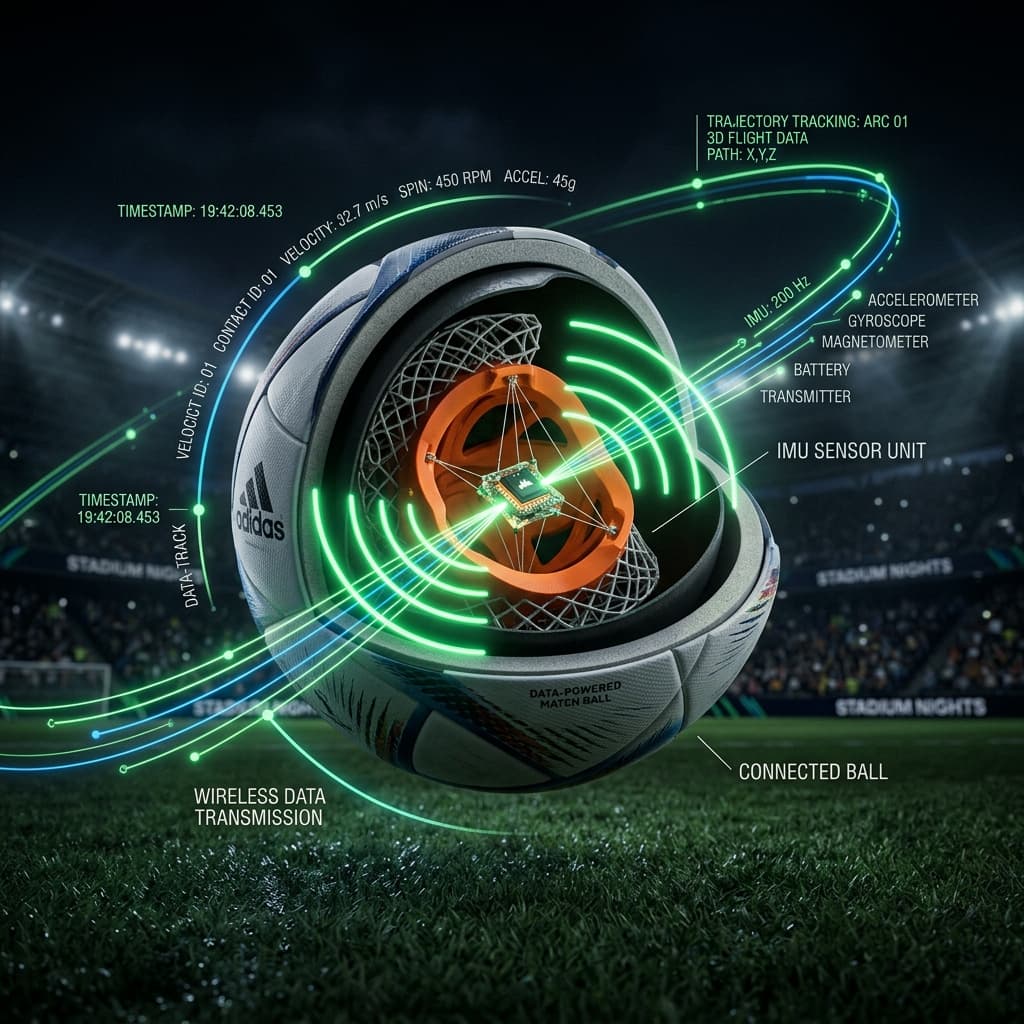 Connected ball technology revealing the suspended internal Inertial Measurement Unit (IMU) sensor transmitting high-frequency wireless contact and trajectory data.
The connected ball provides a sensor-based signal for one of the hardest computer vision problems in football: identifying the exact frame and force of contact when a player touches the ball. This matters directly for offside decisions (confirming the precise moment a pass is played), handball reviews, and penalty area contact disputes — situations where camera-based detection alone has historically struggled with split-second timing.
It's a useful case study in how modern sports AI actually works in practice: sensor data and computer vision aren't competing approaches, they're complementary signals feeding the same decision pipeline. The ball tells the system precisely when contact happened. The cameras tell the system where every player's body was at that exact moment. Neither signal alone is enough; together, they produce a defensible call.
Goal-line technology
Goal-line technology has been a fixture of major tournaments since 2014, using multiple high-speed cameras positioned around each goal to triangulate ball position and determine instantly whether the ball fully crossed the line. At World Cup scale, this system runs in parallel with offside tracking and connected ball data, forming one part of a layered officiating technology stack rather than a standalone system.
What's changed since goal-line technology's first tournament deployment is integration — modern systems feed goal-line data into the same review and broadcast pipeline as offside and VAR decisions, rather than operating as an isolated yes/no system. The 2026 tournament represents the most integrated version of this officiating stack FIFA has deployed.
AI-powered broadcast and camera automation
Away from officiating, the tournament's broadcast operation runs on a parallel set of computer vision systems: automated camera tracking that follows play without a human operator, real-time player and ball tracking that feeds on-screen graphics (distance covered, sprint speed, expected goals overlays, pass network visualisations), and AI-assisted highlight generation that can identify and clip key moments — goals, big chances, cards, VAR reviews — within seconds of them happening, across 104 simultaneous match feeds.
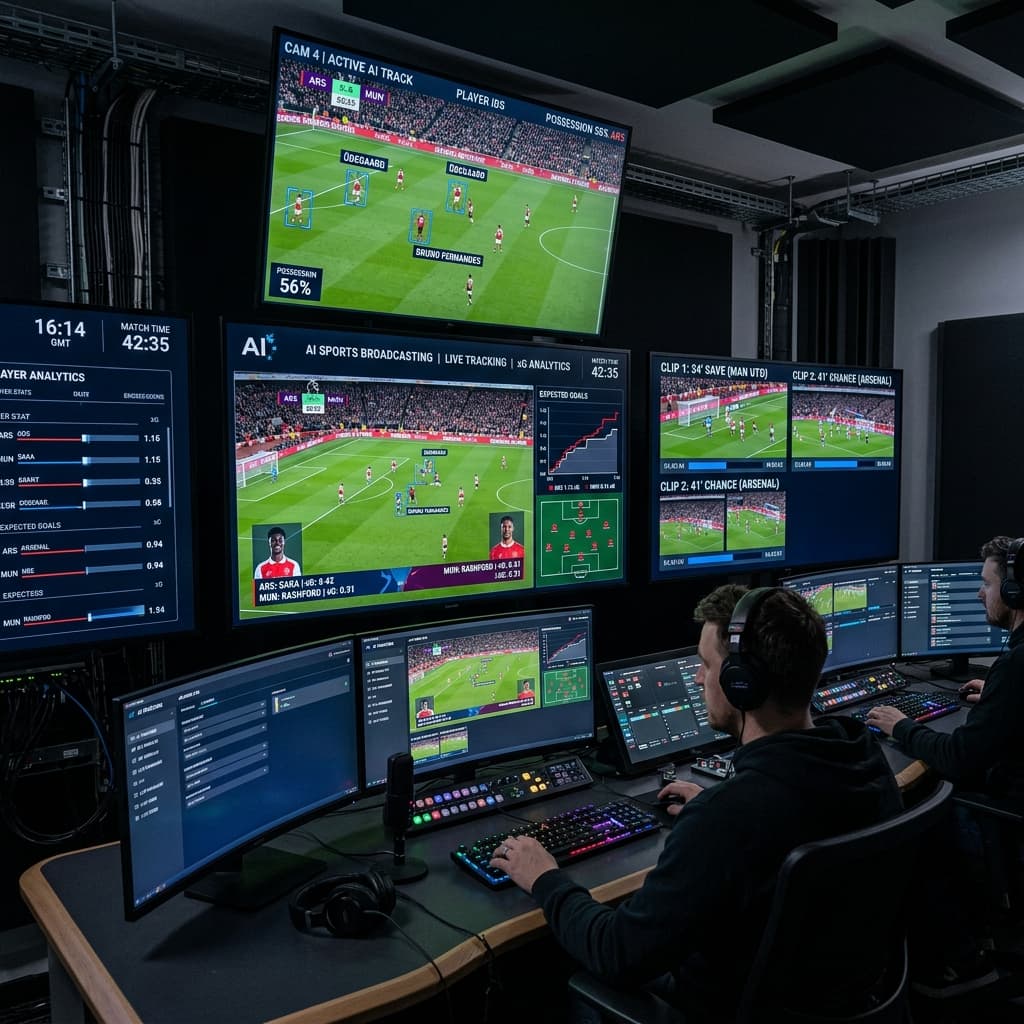 AI-powered sports broadcasting control suite utilizing automated tracking feeds, expected goals (xG) statistics, and automated highlight generation tools.
This is one of the least-discussed but most operationally demanding applications of sports computer vision at the tournament. Broadcasters covering a 32-team, 64-match World Cup already needed automated systems to keep up with the volume of footage. A 48-team, 104-match tournament increases that volume by more than 60%, with no proportional increase in the human production teams available to manually review and clip footage. The automation isn't a broadcast nicety — it's the only way to operationally produce content at this scale.
Performance and physical tracking data
Beyond officiating and broadcast, every participating team has access to optical player tracking data — positional information captured via stadium camera systems, producing distance covered, sprint counts, high-speed running metrics and tactical shape data for every player in every match. This data feeds directly into post-match analysis, half-time tactical adjustments, and the expanding library of advanced statistics that now accompanies every major tournament broadcast.
At a 48-team tournament, this also means significantly more teams — many without the analytics infrastructure of the traditional football powers — gaining access to detailed tracking data for the first time at this level of competition. The democratisation of tracking technology across a larger and more diverse field of nations is one of the quieter storylines of the expanded format.
What this tournament reveals about the limits of sports AI
Every system described above shares a dependency that rarely gets mentioned in tournament coverage: none of it works without enormous volumes of annotated training data, built and refined over years, to teach the underlying models what they're looking at.
Semi-automated offside technology only works because its limb-tracking models were trained on dense skeletal keypoint data covering an enormous range of player postures — including the extended, awkward, falling and colliding positions that real matches produce, not just clean standing poses. Goal-line and connected ball systems depend on precise contact-frame annotation built from exactly the kind of edge cases — deflections, blocked shots, contested goal-line scrambles — that are hardest to label correctly. Broadcast automation depends on event recognition models trained to distinguish a genuine goal celebration from a near-miss, a converted penalty from a saved one, milliseconds after it happens, across every camera angle a broadcaster might cut to.
A World Cup is the most visible proof point in sports for a fact that holds true across every level of the game: the AI systems people see on screen are only as reliable as the training data built underneath them. At World Cup scale — three host nations, 16 venues, 104 matches, conditions that vary by altitude, climate and pitch type — that training data has to generalise further than it has ever needed to before. Systems that were calibrated and tested in a handful of European stadiums for a 32-team tournament are now being asked to perform identically in Mexico City's altitude, Canadian turf conditions, and US stadiums built for other sports.
This is the same problem every sports computer vision team faces at a smaller scale — whether you're building a player tracking model for a single club, a ball-tracking system for a national league, or an event recognition model for a broadcast platform. The model is never the bottleneck for long. The training data — sport-specific, schema-consistent, expert-verified, and broad enough to cover the conditions you'll actually encounter — is what determines whether the system holds up when it matters.
Frequently asked questions
What AI technology is used at the FIFA World Cup 2026? The tournament uses semi-automated offside technology for limb-tracking and triangulated offside calls, connected ball technology with an embedded sensor for precise contact detection, goal-line technology for line-crossing determinations, AI-powered broadcast camera automation and highlight generation, and optical player tracking for performance analytics across all 104 matches.
How does semi-automated offside technology work at the World Cup? A network of tracking cameras detects more than 20 points on each player's body continuously throughout the match. When a pass is played, the system identifies the exact contact frame, triangulates the relevant players' limb positions into precise pitch coordinates, and calculates whether the attacker's most advanced offside-relevant body part was beyond the last defender. A human video assistant referee confirms the calculated decision before it is finalised.
What is connected ball technology? Connected ball technology refers to a suspended inertial measurement unit embedded inside official match balls, transmitting precise data on ball position, movement and contact moments up to 500 times per second. It has been used at FIFA tournaments since 2018 and works alongside camera-based computer vision to confirm exact contact timing for offside, handball and penalty area decisions.
How many matches are at the 2026 World Cup and why does that matter for technology? The 2026 World Cup features 48 teams playing 104 matches across the United States, Canada and Mexico — a 63% increase in matches compared to the previous 32-team, 64-match format. This scale increase means every computer vision and AI system deployed at the tournament has to operate reliably across more venues, more varied conditions and significantly higher data volume than any prior World Cup.
Why do AI systems at major tournaments still need human officials to confirm decisions? Systems like semi-automated offside technology generate highly precise positional data and a calculated recommendation, but football's laws include interpretive elements — like judging deliberate defensive actions — that positional data alone cannot resolve. A human official reviews and confirms the automated calculation before any decision is finalised, which is why these systems are described as semi-automated rather than fully automated.
What is the connection between World Cup technology and sports training data? Every AI system used at the tournament — offside tracking, goal-line technology, broadcast automation, performance analytics — runs on models trained using large volumes of annotated sports footage. The reliability of these systems at World Cup scale, across three host nations and varied conditions, depends directly on how well the underlying training data represents the full range of real match scenarios the systems will encounter.
The takeaway
The 2026 World Cup is the most technologically instrumented tournament football has ever staged, and also the largest. Those two facts are connected: a tournament of this scale simply isn't operationally possible without the AI and computer vision systems running underneath it — officiating technology that can keep pace with 104 matches, broadcast automation that can produce content across three host nations simultaneously, and tracking data that gives every team, not just the traditional powers, access to professional-grade analytics.
None of it works without training data built for exactly this purpose. If you're building sports computer vision systems — for officiating, broadcast, performance analytics or any other application — and need training data that's sport-specific, schema-consistent and expert-verified, see how Train Matricx works or review annotated dataset results in our case studies. We annotate a free pilot clip so you can evaluate quality before committing to any volume.

Client results

“Train Matricx didn't just provide labeling — they became an extension of our team. With 6K+ football matches annotated and counting at 98% accuracy, they are our premier data partner.”

Billy Brush
Founder & CEO, Dark Horse AI
Don't take our word for it. Test the labels.
Send us the footage your current vendor gets wrong — the occluded players, the motion blur, the edge cases. We annotate it and return a QA report you can check frame by frame.
- Your hardest clip, annotated in 48 hours
- Full QA report with per-frame accuracy
- No commitment, no contract, no card