Golf is unusual among major sports for computer vision: there is no opponent to track, no occlusion from other athletes, and the action happens in discrete, isolated moments rather than continuous play. This makes some problems easier than in team sports. It makes others — particularly the precision required for swing analysis and ball flight tracking — harder than almost anywhere else in sports AI.
This guide covers how computer vision works in golf, why the sport's structure creates a distinct annotation problem, and what training data requirements look like for swing analysis and ball tracking systems.
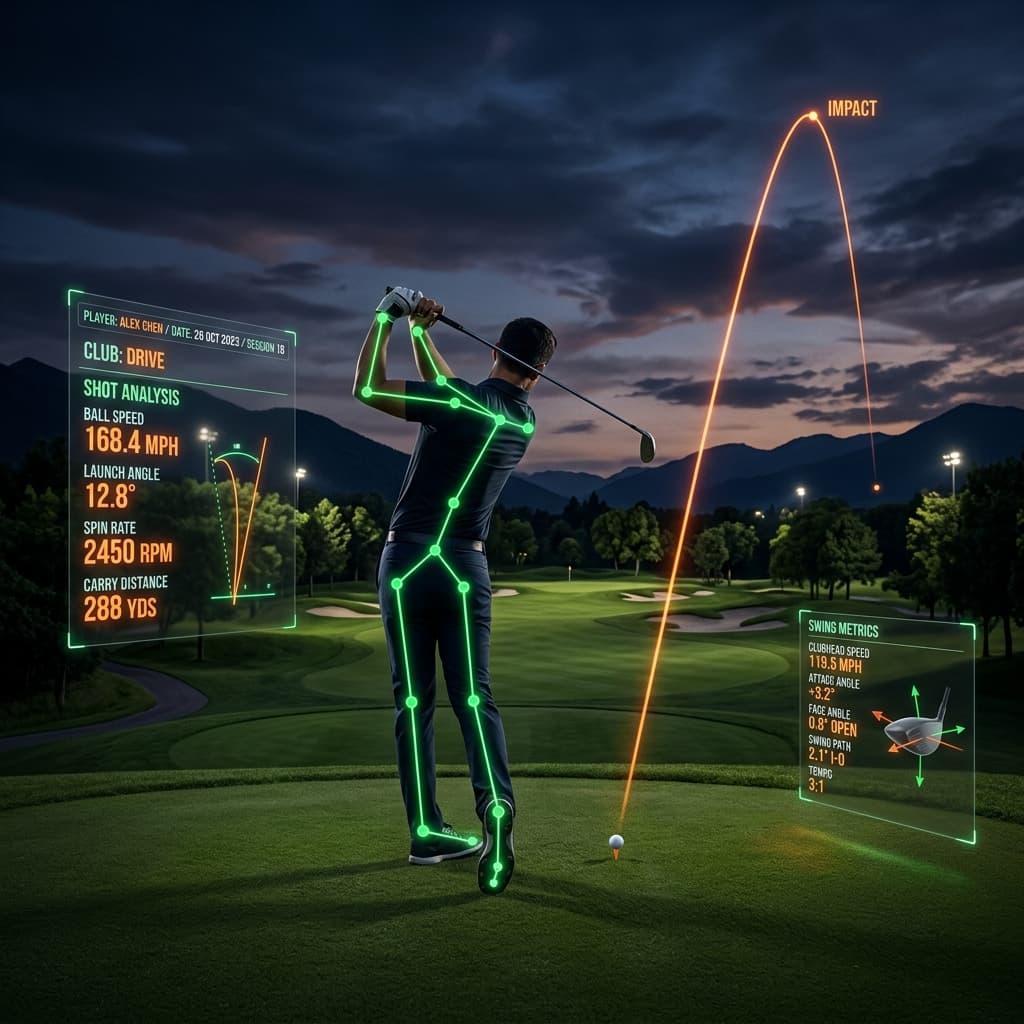 High-end technical sports analytics visualization showing golf swing pose estimation skeletal tracking and ball flight trajectory overlays.
What is golf computer vision?
Golf computer vision is the use of AI to interpret golf footage — analysing swing mechanics and biomechanics, tracking ball flight from impact to landing, classifying shot types and outcomes, and converting video into structured data for coaching, broadcast and player development.
Unlike team sports, golf computer vision operates on a single athlete performing a discrete, repeatable action — the swing — making it one of the most biomechanically precise applications of sports AI. The challenge is not tracking multiple objects through occlusion; it is achieving the frame-level and even sub-frame precision required to detect meaningful differences in swing mechanics or ball flight that separate elite performance from amateur performance.
Why golf presents a different computer vision problem
No occlusion, but extreme precision requirements. A golf swing happens in open space with no other players to create occlusion. This sounds easier than team sports, and for basic detection it is. But golf coaching and equipment fitting require detecting differences of a few degrees in club face angle, a few centimetres in swing path, or fractions of a second in tempo — precision requirements that exceed what most team sport applications need.
The swing happens too fast for standard frame rates. A driver swing takes roughly one second from address to follow-through, but the critical moment — impact — happens in a fraction of that second, with clubhead speeds exceeding 150 km/h for elite players. At standard broadcast frame rates of 25 to 30 fps, the moments immediately around impact may be captured in only one or two frames. Detailed swing analysis systems require high-speed camera capture, and training data for these systems must be annotated at the corresponding frame rate.
Ball flight tracking over long distances and varied backgrounds. Unlike most sports where the ball stays within a confined playing area, a golf ball can travel 250+ metres through varied backgrounds — sky, trees, fairway, rough — that change dramatically within a single shot's flight. Tracking systems must maintain detection through background transitions that have no equivalent in court or pitch-based sports.
Individual variation in technique. Every golfer has a measurably different swing — different tempo, plane, posture and sequencing. Unlike team sports where some degree of generalised movement modelling is possible across players in similar positions, golf swing analysis must account for legitimate technique variation while still detecting flaws or inefficiencies. A model trained primarily on one swing style risks flagging legitimate alternative technique as error.
Equipment-ball interaction physics. Ball flight is determined by clubhead speed, face angle, attack angle, and spin imparted at impact — variables that must be inferred from extremely brief visual contact between club and ball. Annotating this accurately requires understanding golf ball flight physics, not just visual tracking.
The four applications of golf computer vision
| Application | What it produces | Primary buyers |
|---|---|---|
| Swing analysis | Club path, face angle, tempo, posture, sequencing | Coaching apps, player development, equipment fitting |
| Ball flight tracking | Launch angle, ball speed, spin, carry distance, trajectory | Launch monitors, broadcast, coaching |
| Shot classification | Shot type, club used, outcome, lie conditions | Performance analytics, course strategy tools |
| Putting analysis | Stroke path, face angle at impact, green reading | Putting-specific coaching tools |
Each requires distinct annotation. Swing analysis needs dense skeletal keypoints across the full swing sequence at high frame rates. Ball flight tracking needs trajectory annotation from launch through landing. Putting analysis requires separate, finer-grained keypoint tracking given the smaller, slower movement involved.
Swing analysis: the biomechanical precision problem
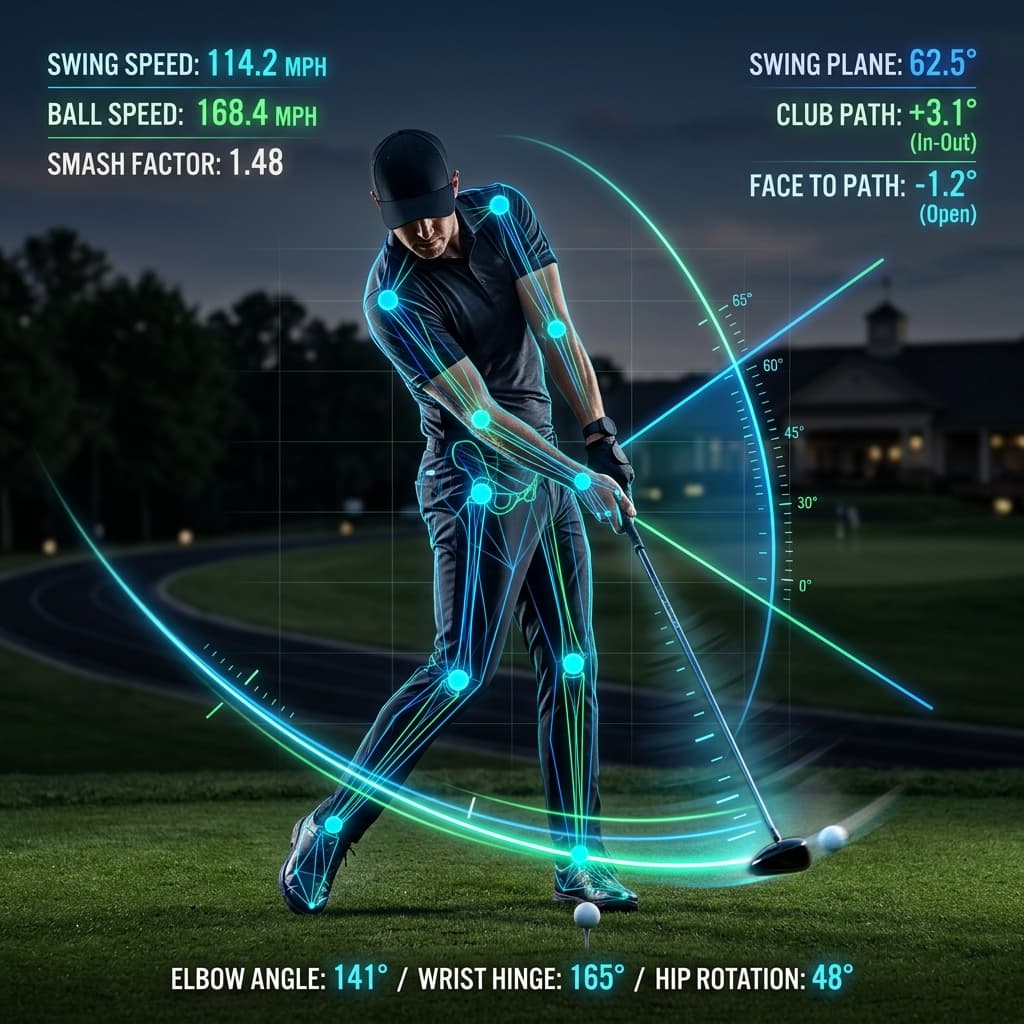 Biomechanical skeletal keypoint tracking and angle calculations (wrist hinge, elbow angle, hip rotation) overlay analyzing a golf swing in real-time.
What swing analysis measures
A complete swing analysis system extracts club path (the three-dimensional path the clubhead travels through the swing), face angle at impact, attack angle (the vertical direction the club is moving at impact), swing plane, tempo (the ratio of backswing time to downswing time), weight transfer, and body sequencing (the order in which hips, torso, arms and club rotate through the swing).
Each of these requires different annotation density. Club path and face angle require frame-accurate tracking of the clubhead, which is a small, fast-moving object similar in tracking difficulty to a ball in other sports. Body sequencing requires dense skeletal keypoints tracked through the entire swing at a frame rate high enough to capture the rotational sequence accurately.
Why generic pose models fail on golf swings
Generic human pose estimation models are typically trained on standing, walking or running postures. A golf swing involves extreme spinal rotation, a posture maintained throughout the swing that differs significantly from athletic postures in most other sports, and a finishing position with the body fully rotated and weight transferred — none of which resembles the training distribution of general-purpose pose models.
Training data for golf swing analysis needs dense keypoint annotation specifically captured across full swing sequences, including the extreme rotation positions at the top of the backswing and through impact, where generic pose models are most likely to produce anatomically implausible keypoint placements.
Individual variation as a training data challenge
Professional golfers display significant individual variation in swing mechanics while still being highly effective — some have very upright swing planes, others much flatter; tempo ratios vary; weight transfer patterns differ. A swing analysis dataset needs to represent this range of legitimate variation, or the model risks learning a single "correct" swing pattern and flagging valid alternative technique as a flaw, which produces unreliable coaching feedback.
Ball flight tracking
Launch monitor versus camera-based tracking
Dedicated launch monitor hardware uses radar or high-speed camera arrays specifically engineered for ball flight measurement at the point of impact, producing extremely precise launch data (ball speed, launch angle, spin rate) from a few centimetres of flight. Camera-based computer vision systems working from standard or broadcast footage face a harder problem: tracking the ball through its full flight path, including the long-distance descent phase where the ball becomes a very small object against variable backgrounds.
The background transition problem
A golf shot's flight typically transitions through several visually distinct backgrounds — clear sky, tree lines, distant landscape, and finally the ground at landing. Detection models trained on a single background type generalise poorly to this transition. Training data needs golf shots annotated across the full range of background conditions a ball might fly through, including shots against overcast sky (low contrast), shots against tree backgrounds (high visual clutter), and shots landing in rough or sand (different visual texture at the landing point).
Spin and curve estimation
Shot shape — draw, fade, hook, slice, straight — results from spin axis at launch, which is difficult to measure directly from standard camera footage without specialised high-speed capture. Camera-based systems typically infer spin and curve from the observed flight path curvature rather than direct spin measurement, requiring trajectory annotation precise enough to detect the curve pattern across the visible flight.
Shot and lie classification
Beyond swing and ball flight, golf computer vision applications increasingly classify the broader shot context: club selection, lie condition (fairway, rough, sand, recovery situations), stance adjustments for slope or lie, and shot outcome relative to target.
This data supports course strategy analysis — understanding which clubs and shot types a player executes most effectively from different lies and distances — which is a growing application for both professional performance analysis and consumer coaching apps. Annotating this requires golf-specific knowledge: recognising the difference between a fairway bunker lie and a greenside bunker lie, or identifying when a player is playing a recovery shot from an awkward stance, requires understanding the game's situational context, not just visual classification.
What golf computer vision training data requires
For swing analysis:
- Dense skeletal keypoints across the full swing sequence at high frame rates
- Club path and clubhead position tracking from address through follow-through
- Face angle annotation at the impact frame
- Representation across a wide range of legitimate individual swing styles
- Multiple camera angles (face-on, behind, overhead) for complete swing reconstruction
For ball flight tracking:
- Frame-by-frame ball position from launch through landing
- Trajectory annotation across varied backgrounds (sky, trees, ground)
- Launch frame and landing frame labels
- Shot shape classification (draw, fade, straight, hook, slice) linked to trajectory data
For shot and lie classification:
- Lie condition labels (fairway, rough, sand, recovery)
- Club selection where visible or determinable
- Shot outcome relative to target line and distance
Frequently asked questions
What is golf computer vision? Golf computer vision uses AI to analyse golf footage — tracking swing mechanics and biomechanics, following ball flight from impact to landing, and classifying shot types and outcomes. It powers coaching applications, broadcast analytics and player development tools, extracting precise technical data from video without requiring wearable sensors.
How does swing analysis work in golf AI? Swing analysis tracks the golfer's body and the club through the full swing sequence using dense skeletal keypoints, extracting metrics like club path, face angle at impact, swing tempo and body sequencing. Because impact happens in a fraction of a second, swing analysis typically requires high-speed camera capture and training data annotated at a correspondingly high frame rate to accurately measure the moment of ball contact.
Why is golf ball tracking different from ball tracking in other sports? A golf ball travels much further than balls in most other sports — often 200 metres or more — passing through dramatically different visual backgrounds during a single shot's flight: sky, trees, fairway and rough. Tracking models must maintain detection through these background transitions, which has no direct equivalent in field or court-based sports where the ball stays within a visually consistent playing area.
What makes golf swing analysis training data different from generic pose estimation? Generic pose estimation models are typically trained on standing, walking or running postures. A golf swing involves extreme spinal rotation and posture positions that fall outside this training distribution, particularly at the top of the backswing and through impact. Golf-specific training data must capture these extreme positions explicitly, and must represent the legitimate range of individual swing style variation so the model doesn't incorrectly flag valid technique as a flaw.
How accurate does golf ball tracking need to be for coaching applications? Coaching applications generally require launch-condition accuracy (ball speed, launch angle, spin) precise enough to give meaningful technical feedback, which is why dedicated launch monitor hardware using radar or high-speed cameras remains the gold standard for precision coaching. Camera-based computer vision systems working from broadcast or standard footage are improving but generally provide directional and trajectory insight rather than launch-monitor-level precision.
What training data does a golf AI coaching app need? It depends on the specific feature. A swing analysis feature needs dense skeletal keypoints across full swing sequences from multiple angles, captured across a representative range of skill levels and swing styles. A ball flight feature needs trajectory data across varied backgrounds and shot shapes. A shot strategy feature needs lie condition and outcome labels linked to club selection and distance data.
The takeaway
Golf computer vision operates without the occlusion and identity challenges that dominate team sports, but it demands a different kind of precision — biomechanical detail fine enough to separate elite technique from amateur technique, and ball tracking robust enough to follow a small object across hundreds of metres of changing background. Both require training data captured and annotated with golf-specific understanding, not generic sports annotation.
If you are building golf computer vision models and need expert-annotated training data — swing biomechanics, ball flight tracking or shot classification — see how Train Matricx works or review annotated dataset results in our case studies. We annotate a free pilot clip so you can evaluate quality before committing to any volume.

Client results

“Train Matricx didn't just provide labeling — they became an extension of our team. With 6K+ football matches annotated and counting at 98% accuracy, they are our premier data partner.”

Billy Brush
Founder & CEO, Dark Horse AI
Don't take our word for it. Test the labels.
Send us the footage your current vendor gets wrong — the occluded players, the motion blur, the edge cases. We annotate it and return a QA report you can check frame by frame.
- Your hardest clip, annotated in 48 hours
- Full QA report with per-frame accuracy
- No commitment, no contract, no card