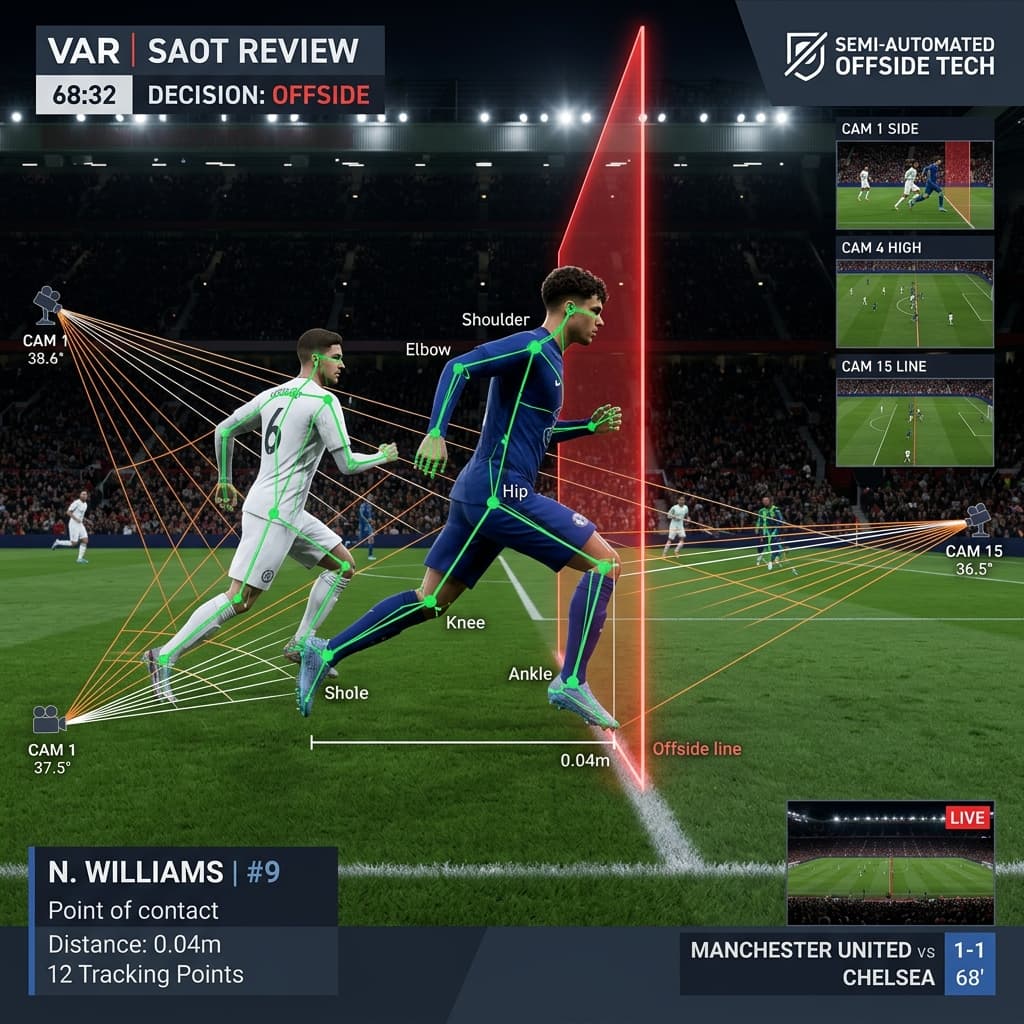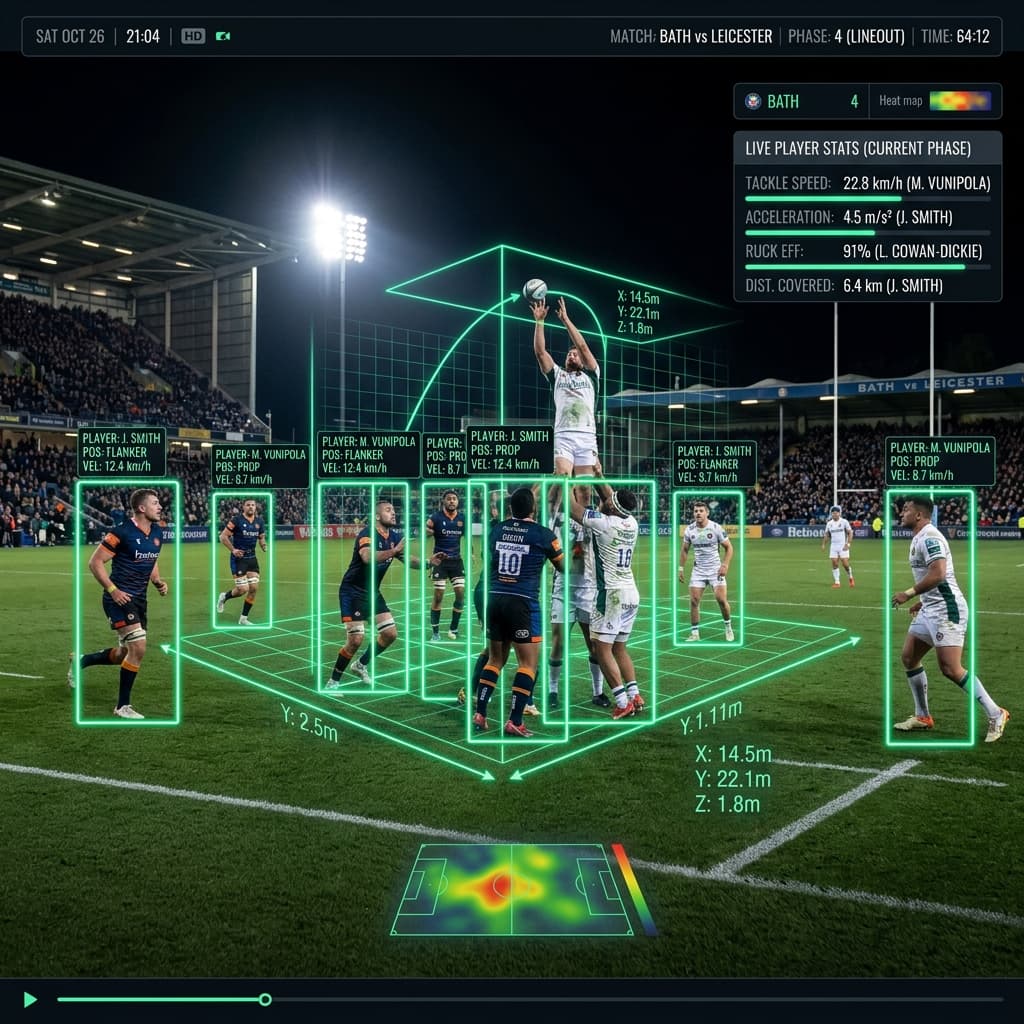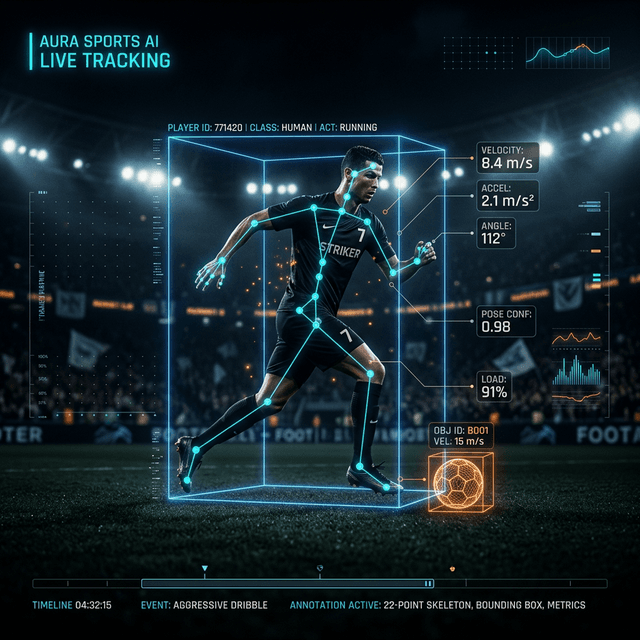
Computer vision in sports turns raw match footage into structured data. It tracks players, follows the ball, recognises game events, maps skeletal movement and feeds that structure into analytics platforms, broadcast graphics, officiating tools and AI training pipelines.
This guide explains how each layer works, where it fails, and why the quality of training data determines whether the system performs in production or only in demos.
What is computer vision in sports?
Computer vision in sports is the use of AI models to interpret sports video — detecting players and the ball, tracking movement across frames, classifying game events, and converting footage into structured data for analytics, coaching, broadcast and model training.
It requires no wearable sensors. It works on live feeds, broadcast archives, and tactical camera footage. The output is sport-specific: who moved where, at what speed, in response to what event, and with what body mechanics.
That structured output is what powers everything downstream — a coach's tactical dashboard, a broadcaster's AR overlay, a betting operator's event feed, or a computer vision model learning to understand the game.
How computer vision in sports works: the five-layer pipeline
Most sports CV systems run the same pipeline regardless of sport. Understanding each layer explains where performance is won and where it breaks.
| Layer | What it produces | Common failure point |
|---|---|---|
| Detection | Bounding boxes, player IDs, ball position | Small or blurred objects (fast ball, partial occlusion) |
| Tracking | Persistent player identity across frames | Players crossing, occlusion, similar jerseys |
| Pose estimation | 22-point skeletal keypoints per athlete | Multi-athlete overlap, fast motion |
| Event recognition | Labeled events with timestamps | Ambiguous actions, rare events, sport-specific context |
| Analytics | Tactical metrics, overlays, data feeds | Any upstream error compounds here |
Every layer depends on the one before it. A detection miss becomes a tracking error. A tracking error produces a wrong stat. A wrong stat breaks an analyst's dashboard or a broadcaster's graphic. This cascade is why sports computer vision teams invest heavily in ground-truth data quality, not just model architecture.
Player tracking in sports AI: how it works
Player tracking is one of the most commercially important applications of sports computer vision. It answers where each athlete moved, how fast, for how long, which zones they occupied, and how their position changed relative to teammates and opponents.
Detection first, identity second
A player tracking pipeline has two distinct stages. Detection finds each athlete in a single frame — usually with a bounding box. Identity persistence links that detection to the same athlete across hundreds or thousands of frames, even when they pass behind another player, leave the frame edge, or change body orientation.
This is harder than it sounds. In a 90-minute football match at 25 frames per second, a model makes roughly 135,000 detection decisions. If identity breaks during a crowded corner or pressing phase — two of the most analytically important situations — the downstream data becomes unusable.
What a player tracking dataset needs
A production-quality player tracking dataset requires more than bounding boxes. It needs:
- Bounding boxes per player per frame
- Persistent ID labels linking the same player across the full sequence
- Occlusion flags marking when a player is partially or fully hidden
- Team labels distinguishing home, away, and officials
- Jersey number annotations where readable
- Camera angle labels for multi-camera sequences
- Temporal IDs maintaining identity across cuts
If training data contains broken ID chains, the model learns that player identity is unstable. In production, that means incorrect distance-covered data, broken heat maps, and tactical analysis built on wrong positional sequences.
Why player tracking fails
The most common failure modes in player tracking are:
- Occlusion: players overlap during corners, pressing situations, set pieces and physical challenges. The model loses the object and may reassign the wrong identity when it reappears.
- Similar appearance: players on the same team wear matching jerseys. Without reliable jersey number reading or contextual positioning, the model may swap identities under pressure.
- Camera cuts: broadcast cameras cut between angles. Identity must be re-established at each cut without a clear reference frame.
Each of these is a training data problem before it is a model problem. Models learn from labeled examples. If the labeled examples contain broken identity chains through occlusions and cuts, the model learns to break in the same situations.
Ball tracking: the hardest problem in sports computer vision
Ball tracking is harder than player tracking for three reasons: the ball is smaller, faster, and easier to hide.
The small object problem
In football, the ball occupies roughly 0.1% of a standard broadcast frame. In cricket, a red ball against a coloured-kit fielder may be indistinguishable at the point of release. In basketball, the ball disappears behind bodies, backboards and rim structures at critical moments.
Models trained on standard detection datasets — where objects are large and well-separated — generalise poorly to sports balls in realistic match conditions. The training data needs to include the difficult frames: ball hidden behind a leg, ball mid-swing appearing as a blur, ball against a complex background during a wide angle shot.
What ball tracking annotation requires
A ball tracking dataset for production sports AI needs:
- Frame-by-frame position labels during flight, bounce, and collection
- Trajectory points for physics-based analysis (line, length, speed, swing)
- Contact frame labels — the exact frame of bat contact, kick, bounce or catch
- Occlusion status per frame
- Blur handling — defining how to label frames where the ball is not clearly visible
- Multi-view synchronisation for systems using more than one camera angle
In sports like cricket, where trajectory analysis drives DRS decisions and batting performance models, the accuracy of individual frame labels has direct product consequences. A one-frame error in the bounce point produces a wrong pitch map. A wrong pitch map corrupts a bowler's performance analysis over hundreds of deliveries.
Sport-by-sport ball tracking challenges
- Football: ball hidden during aerial duels, corners, and tight tackling sequences
- Cricket: high-speed delivery against a moving field background, significant swing and seam movement
- Basketball: ball disappears at the rim and during hand-off sequences
- Tennis: ball moves faster than most broadcast frame rates allow clear capture; trajectory must be inferred from partial frames
- Golf: ball position immediately post-impact is frequently a blur, not a circle
Each sport requires a specific annotation taxonomy, not a generic object detection schema.
Event logging: teaching AI the language of sport
Detection and tracking explain where objects are. Event logging explains what happened. This is where sports computer vision becomes analytically useful.
What event recognition requires
A model that recognises events must learn that specific sequences of movement correspond to specific sport actions. A pass in football is not just two players moving in sequence. It is a release, flight, reception — with contextual attributes like pressure, direction, distance, and outcome.
Training a model to recognise events accurately requires:
- A structured taxonomy — a defined list of events, attributes and edge cases specific to the sport
- Frame-accurate start and end labels for each event
- Player ID links connecting the event to the athletes involved
- Outcome labels — did the pass complete? Was the shot on target? Did the tackle win possession?
- Context attributes — was the passer under pressure? Was the shot from open play or a set piece?
Why taxonomy design matters
Without a taxonomy, different annotators label the same event differently. One annotator labels an action as a "tackle". A second labels it as a "challenge". A third labels it as "defensive contact". For a model, that inconsistency is noise. It caps accuracy at a level no architecture change can fix.
A well-designed sports event taxonomy defines every label, every attribute, and every edge case before annotation begins. It specifies what to do when a pass deflects off a defender and becomes a shot. It specifies how to label a cricket delivery where the ball clips both bat and pad. It specifies whether a basketball screen counts before or after the ball handler uses it.
This is why sports computer vision teams cannot use generic annotation platforms with generic label sets. The taxonomy has to be built for the sport and validated by people who understand it.
Who uses sports computer vision?
Sports computer vision is not a single product. Different types of organisations use it for different purposes, and each has different data requirements.
Automated tracking technology companies
Companies building camera systems, tracking hardware and automated broadcast technology need large-scale annotated video to train their detection and tracking models. Their primary requirement is volume, consistency and identity accuracy across full match sequences.
Sports analytics platforms
Platforms providing performance analytics, coaching tools and scouting data to professional clubs need event and skeletal data at high precision. Their models do not just need to know where players moved — they need to know how the movement was biomechanically executed, what tactical phase triggered it, and what the outcome was.
Broadcast and AR providers
Broadcasters and AR technology companies need frame-perfect tracking data with high identity reliability. A misidentified player in an AR overlay is visible to millions of viewers. The tolerance for error is close to zero.
Sports betting and fantasy operators
Operators building real-time data feeds and prediction models need event classification and possession data that is both accurate and fast. Their training data requirements are high-volume and time-sensitive, with particular emphasis on event start frames, duration and outcome labels.
AI research labs
Research teams using sports video as a benchmark environment for multi-object tracking, pose estimation and action recognition need structured, schema-consistent ground truth data at publication quality.
What makes sports computer vision training data reliable?
Volume is not the bottleneck. Most teams can generate raw footage. The bottleneck is consistent, schema-aligned, sport-specific labels at the quality level that production models require.
Schema alignment — the labels need to match what the model is being trained to predict. A detection model needs bounding boxes. A pose model needs 22-point keypoints. An event model needs linked action labels across time. Using the wrong schema produces training data that technically exists but is functionally useless.
Label consistency — two annotators labeling the same event differently injects noise that no architecture change can remove. Consistency comes from taxonomy design, annotator training and structured QA, not from annotator count.
Sport-specific knowledge — generic annotators see two players collide. A football analyst recognises a late tackle, a shoulder challenge, a tactical foul or a legal block. That distinction matters when the label becomes ground truth. It is the difference between a model that learns football and one that learns collision detection.
Quality assurance — a QA process that only checks visual accuracy will miss sports-logic errors. A bounding box can be visually accurate but tactically wrong if the event label is incorrect. A keypoint sequence can look geometrically acceptable but break biomechanical continuity across a motion cycle. QA needs annotators who understand both the labeling standard and the sport.
Delivery format — the dataset needs to reach the engineering team in a format the pipeline accepts. JSON, CSV, XML, COCO and YOLO are common. The important point is that the format is agreed before annotation begins, not retrofitted afterward.
Frequently asked questions
What is computer vision in sports? Computer vision in sports is the use of AI to interpret sports footage — detecting players and the ball, tracking movement over time, classifying events like passes and tackles, and converting raw video into structured data. It powers analytics platforms, broadcast graphics, officiating tools and AI training pipelines without requiring any wearable sensors.
How does player tracking work in sports AI? Player tracking has two stages: detection finds each athlete in a frame, and identity persistence links the same athlete across frames over time. The system assigns a consistent ID to each player and maintains it through occlusion, camera cuts and physical contact. The quality of this tracking depends heavily on the training data — specifically whether the labeled examples include correctly handled occlusion and identity handoff scenarios.
How does ball tracking work in sports computer vision? Ball tracking models locate the ball in each frame and link positions across time to produce a trajectory. The challenge is the ball's small size, high speed and frequent occlusion. In high-stakes applications like cricket DRS or broadcast physics overlays, annotations must identify the exact frame of bounce or contact, not just approximate position. One-frame errors in the training data produce wrong ball trajectory models at inference time.
What is event logging in sports AI? Event logging is the classification of in-game actions — passes, shots, fouls, tackles, screens, wickets, rallies — with frame-accurate timestamps and contextual attributes. It requires a sport-specific taxonomy that defines every label and edge case before annotation begins. Without consistent taxonomy, different annotators describe the same event differently, which limits model accuracy regardless of architecture.
Why does sports AI need specialised training data? Generic computer vision models train on clean, static environments. Sports footage includes occlusion, motion blur, similar-looking players, camera movement and sport-specific rules. A model cannot distinguish a tactical foul from an accidental collision, or a legal basketball screen from an illegal moving screen, without training data that reflects those distinctions correctly. That requires annotators who understand the sport.
What is sports data annotation? Sports data annotation is the process of labeling video footage with bounding boxes, player IDs, skeletal keypoints, ball positions and event classifications. It is how computer vision models learn to interpret match footage. The output is a structured dataset used as ground truth for training, fine-tuning or evaluating sports AI models.
What are sports computer vision companies? Sports computer vision companies build AI systems that interpret sports footage — for player tracking, event detection, broadcast overlays, officiating and performance analysis. Some build the models; others supply the annotation data those models require. The distinction matters when evaluating what a partner actually delivers.
What sports can computer vision be applied to? Computer vision can be applied to any sport with consistent camera footage — football, basketball, cricket, tennis, golf, ice hockey, rugby, American football, and more. Each sport requires its own annotation taxonomy and annotator knowledge base, because events, camera setups and object types differ significantly between sports.
How do I evaluate the quality of a sports CV training dataset? Evaluate schema alignment (do the labels match what your model needs?), label consistency (do multiple annotators produce the same labels for the same event?), QA documentation (is there a process for catching sports-logic errors, not just visual errors?), and delivery format (does the output integrate with your training pipeline without transformation work?).
The takeaway
Computer vision in sports is not limited by model architecture. The systems that perform in production share one quality: training data that is sport-specific, schema-consistent and expert-verified.
Player tracking, ball tracking, and event logging each require a distinct annotation approach. Each fails in predictable ways when the training data is generic or inconsistent. And each can be built reliably when the annotation team understands the sport and applies a structured QA process.
If training data is your bottleneck, see how Train Matricx works or review a live client example in our case studies. We annotate a free pilot clip so you can evaluate quality before committing to any volume.
Written by
Train Matricx Team