Introduction
AI in cricket is changing how teams, broadcasters and technology companies analyze the game. Cricket generates visual data in every delivery. The bowler's release, seam position, swing, bounce point, batter movement, bat angle, pad contact, fielding response and wicketkeeper collection all contain information. Computer vision can convert that footage into structured data for model training, coaching, decision support and broadcast graphics.
The challenge is that cricket is technically demanding for AI. The ball is small and fast. The bat and ball may meet for only a fraction of a second. The line between bat, glove and pad can matter. A bowler's action requires fine biomechanical interpretation. Stadium cameras vary in angle and frame rate. A model that receives weak annotation will learn weak cricket logic.
This guide covers what cricket computer vision has to get right, from ball tracking and bat detection to bowler biomechanics and event logging, and what each of those demands from the training data underneath.
What AI in cricket means
AI in cricket refers to machine learning systems that analyze cricket data. Some systems use scorecards, player statistics and match history. Computer vision systems use video. They can detect the ball, track bat movement, estimate player pose, classify shots, map deliveries and support automated analytics.
Cricket AI can support several use cases. Broadcasters can create ball trajectory overlays, pitch maps and automated highlight packages. Coaches can analyze bowling mechanics, batting technique and shot selection. Teams can study opponent tendencies, field placement and match strategy. Sports tech companies can build training apps, umpiring support tools, fan engagement products and predictive analytics platforms.
These systems require ground truth data. The model needs labeled examples of ball position, release point, bounce point, bat contact, stroke type, bowler keypoints and event outcomes. If the labels are inconsistent, the model's prediction layer becomes unstable.
Ball tracking: the core cricket AI problem
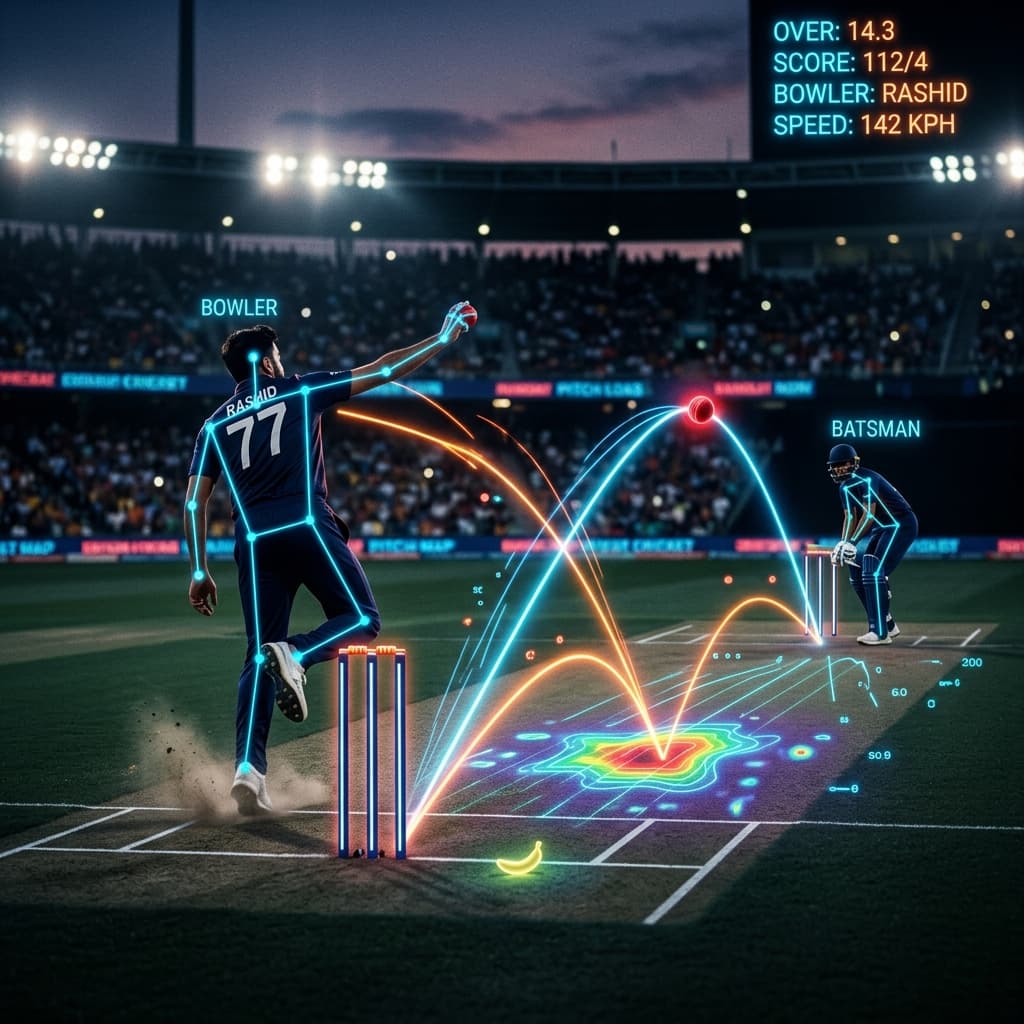
Cricket ball tracking is one of the most important and difficult computer vision tasks in sport. The ball is small, moves fast and may appear blurred. It can swing in the air, deviate off the pitch, spin after bounce or disappear behind the batter.
A useful cricket ball tracking dataset needs precise labels across the full delivery sequence. This may include bowler release, early flight, bounce, post-bounce movement, batter contact, wicketkeeper collection and fielding continuation. Some projects use bounding boxes around the ball. Others use single-point labels for the ball center or bounce point. Physics-heavy systems may need calibrated coordinates, not only image-space positions.
The exact frame of bounce is especially important. A pitch map depends on knowing where the ball landed. If the bounce label is one or two frames off, the output can distort line and length analysis. For decision-support systems and broadcast graphics, small label errors can create visible trust problems.
A pitch map is built from that bounce frame. Rather than a bounding box, the impact is best captured as a single keypoint on the exact pixel where the ball meets the turf, then converted through camera calibration into pitch coordinates. That is what lets an analyst see whether a bowler is holding a good length or drifting in line.
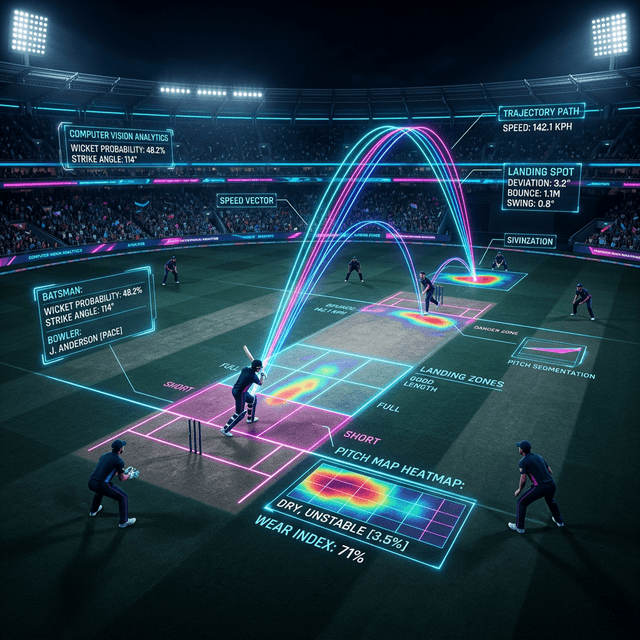 Pitch maps and trajectory overlays rest on one precisely labelled frame: the moment the ball lands.
Bat detection and contact events
Bat detection is another important layer in cricket computer vision. AI systems may need to detect the bat, track its path, estimate bat angle and identify the moment of contact. Bat tracking helps with stroke analysis, coaching apps, edge detection models and broadcast breakdowns.
The bat is not always easy to label. It may overlap with the batter's body, gloves or pad. In some frames, motion blur makes the bat appear wider or less defined. At impact, the ball may be hidden by the bat or glove. For edge-related use cases, the distinction between bat, glove and pad matters: edge-detection systems of the Snicko and UltraEdge type, and the review decisions that rely on them, depend on separating those three surfaces frame by frame.
A bat detection dataset may include bat bounding boxes, bat keypoints, blade orientation, handle position and contact frame labels. For batting technique analysis, the dataset may also include head position, front foot placement, backlift, swing path and weight transfer.
A generic annotation team may label the visible bat area. A cricket-aware team can understand what the bat is doing, when the swing begins, when impact occurs and how the batter's mechanics relate to the delivery.
Pose estimation for bowlers
Bowler pose estimation maps body keypoints through the run-up, gather, delivery stride, release and follow-through. This is valuable because bowling performance and injury risk depend on movement mechanics.
A fast bowler generates force through a sequence of movements: approach speed, bound, front foot contact, hip rotation, shoulder rotation, arm path, wrist position and release. A spin bowler may require analysis of finger position, wrist angle, body alignment and release mechanics.
Computer vision models can learn these patterns if the training data includes consistent skeletal labels. Keypoints may include head, neck, shoulders, elbows, wrists, hips, knees, ankles and feet. Some projects may use 17-point skeletons. Others may require 22-point or 33-point structures.
Quality matters. If an elbow keypoint shifts between annotators, elbow flexion calculations become unreliable. If the release frame is mislabeled, downstream biomechanical analysis loses precision. If occluded joints are guessed without rules, the model may learn impossible body geometry.
Those keypoints feed three different outputs. The first is legality: the ICC has capped elbow extension during the delivery stride at 15 degrees since November 2004, and an action review measures flexion and extension delivery by delivery (ICC, illegal bowling actions). The second is injury risk, where rotation through the lower back and load through the braced front knee are what sports science staff watch. The third is performance: release angle, body alignment and efficiency through the kinetic chain.
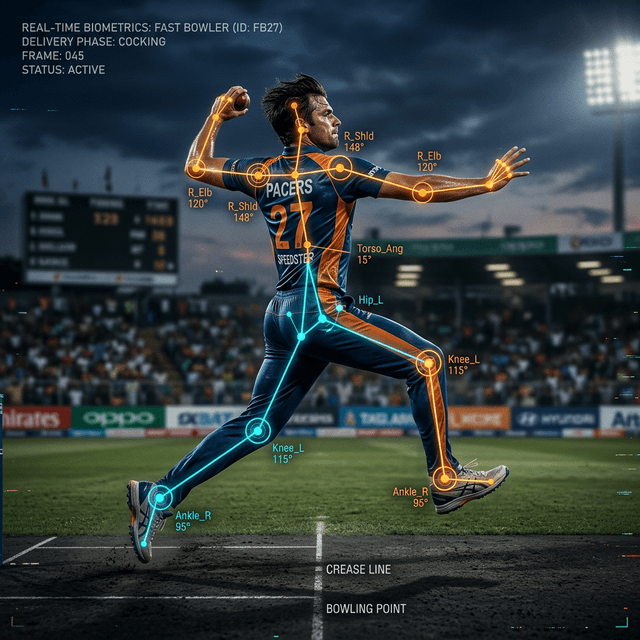 Dense keypoint annotation through the delivery stride is the ground truth behind elbow-extension and load measurements.
Train Matricx discusses the broader technical choice between pose data and box data in Skeletal Tracking vs. Bounding Boxes in Sports AI. That article is a useful guide for cricket AI teams evaluating dataset design.
Pose estimation for batters
Batter pose estimation helps models understand technique and shot selection. The batter's stance, head position, footwork, hip rotation, shoulder line and bat path all influence shot outcome.
For example, a model can learn whether a batter's front foot is moving toward the line of the ball, whether the head stays over the ball, whether the weight transfers forward, whether the bat comes down straight and whether the player is balanced at contact. These labels can power coaching apps, academy feedback tools and player development systems.
Batter pose data becomes more useful when linked to ball data. The model should know where the ball pitched, how it moved, when the batter committed and what stroke was played. This connects biomechanics to cricket decision-making.
A simple pose dataset may not capture this relationship. A cricket-specific dataset should connect delivery type, line, length, ball movement, batter footwork, bat contact and outcome.
Event logging for cricket AI
Cricket event logging converts video into structured match events. Basic labels may include delivery, run, wicket, boundary, dot ball and extras. More advanced labels may include release type, shot type, contact type, fielding action, appeal, review, edge, pad impact, catch attempt and dismissal category.
For AI training, event labels should be tied to timestamps and player IDs. The event should define the trigger frame and outcome. For example, a shot event may include ball contact frame, stroke type, intended direction, actual direction, fielding result and runs scored. A wicket event may include dismissal type, involved players, contact sequence and decision context.
Event taxonomy is critical. Cricket terms have precise meanings. A nick, inside edge, leading edge, glove, pad-first contact and bat-first contact are not interchangeable. Fielding events also require clarity. A catch attempt, drop, run-out chance and direct hit attempt each have different training value.
The more detailed the taxonomy, the more important reviewer calibration becomes. Annotators need guidelines and examples for ambiguous cases.
AI cricket for broadcasting
Broadcast cricket analytics relies on computer vision outputs that viewers can understand quickly. Ball trails, pitch maps, wagon wheels, impact zones, speed graphics and player movement overlays all depend on structured data.
Broadcast use cases have low tolerance for visible errors. If a trajectory overlay is misaligned, viewers notice. If a bat contact event is wrong, commentary analysis becomes unreliable. If a player graphic attaches to the wrong fielder, the broadcast loses credibility.
This is why broadcast AI training data must be visually precise and temporally aligned. Multi-camera setups may be required for more advanced graphics. Labels must remain synchronized across camera angles.
Train Matricx's blog Real-Time AR in Sports Broadcasting provides a related perspective. While it covers sports broadcasting more broadly, the same principles apply to cricket broadcast graphics.
AI cricket for coaching and player development
Coaching use cases require a different emphasis. Instead of only generating visual overlays, the model must support technical feedback. A bowling coach may want release consistency, front knee brace, shoulder alignment and wrist position. A batting coach may want footwork timing, head stability, backlift, bat path and balance.
Computer vision can help compare technique across sessions. It can show whether a bowler's action changes under fatigue, whether a batter struggles against specific line and length, or whether a player is repeating a technical fault. Youth academies can use these systems to monitor development over time.
However, training footage is often less standardized than broadcast footage. Cameras may be lower quality, fixed in different positions or recorded in varied lighting. This means the annotation schema must account for camera type and use case.
Data requirements for cricket computer vision
A cricket AI dataset may include:
- Ball position across delivery sequence
- Release point
- Bounce point
- Bat location and angle
- Contact frame
- Bowler skeletal keypoints
- Batter skeletal keypoints
- Delivery type
- Shot type
- Contact type
- Fielding event labels
- Wicket and appeal events
- Camera angle metadata
- Output format for ML ingestion
The exact labels should depend on the model. A pitch map model needs precise bounce data. A coaching app needs biomechanical keypoints. A broadcast model may need segmentation, trajectory and event timing. A scouting tool may need player-level tendencies and historical labels.
Train Matricx's managed approach is relevant because cricket AI projects often require custom schemas rather than generic sports labels.
Common errors in cricket AI annotation
Several annotation errors can weaken cricket AI models.
The first is inconsistent ball center placement. If the ball is blurred, annotators need a rule for whether to label the visible center, leading edge or estimated center. Without that rule, velocity and trajectory data become noisy.
The second is incorrect contact timing. Bat, pad and glove events may occur within a narrow frame window. Incorrect timing affects edge detection, shot classification and umpiring support models.
The third is weak pose continuity. If keypoints jump across frames, biomechanical outputs become unstable.
The fourth is event taxonomy confusion. A cricket-aware QA layer is needed to separate similar events and apply labels consistently.
Conclusion
AI in cricket depends on precise computer vision training data. Ball tracking, bat detection, pose estimation, event logging and broadcast analytics all require labels that match the technical structure of the sport. Generic annotation may identify visible objects, but cricket AI needs domain-specific ground truth.
Train Matricx supports cricket AI teams with sports data annotation and custom computer vision training datasets through Train Matricx. For deeper reading, see Skeletal Tracking vs. Bounding Boxes in Sports AI and Real-Time AR in Sports Broadcasting.
FAQ
What is AI in cricket? AI in cricket uses machine learning to analyze cricket data. Computer vision systems can process video to track the ball, detect the bat, estimate player pose, classify events and support coaching or broadcast analytics.
How does cricket ball tracking work? Cricket ball tracking uses labeled video data to train models to follow the ball from release to bounce, contact and collection. The labels may include bounding boxes, center points, bounce points and trajectory metadata.
Why is cricket computer vision difficult? Cricket is difficult because the ball is small and fast, contact events happen quickly, the bat and body overlap and technical details such as line, length, swing, spin and edge contact matter.
What data is needed for cricket AI analytics? Cricket AI may need ball trajectory labels, bat detection, contact frames, pitch maps, bowler keypoints, batter keypoints, delivery type, shot type, event logs and camera metadata.
How does Train Matricx support AI cricket projects? Train Matricx provides cricket data annotation, ball tracking labels, bat detection workflows, pose estimation, event logging and custom sports computer vision training datasets through Train Matricx.

Client results

“Train Matricx didn't just provide labeling — they became an extension of our team. With 6K+ football matches annotated and counting at 98% accuracy, they are our premier data partner.”

Billy Brush
Founder & CEO, Dark Horse AI
Don't take our word for it. Test the labels.
Send us the footage your current vendor gets wrong — the occluded players, the motion blur, the edge cases. We annotate it and return a QA report you can check frame by frame.
- Your hardest clip, annotated in 48 hours
- Full QA report with per-frame accuracy
- No commitment, no contract, no card