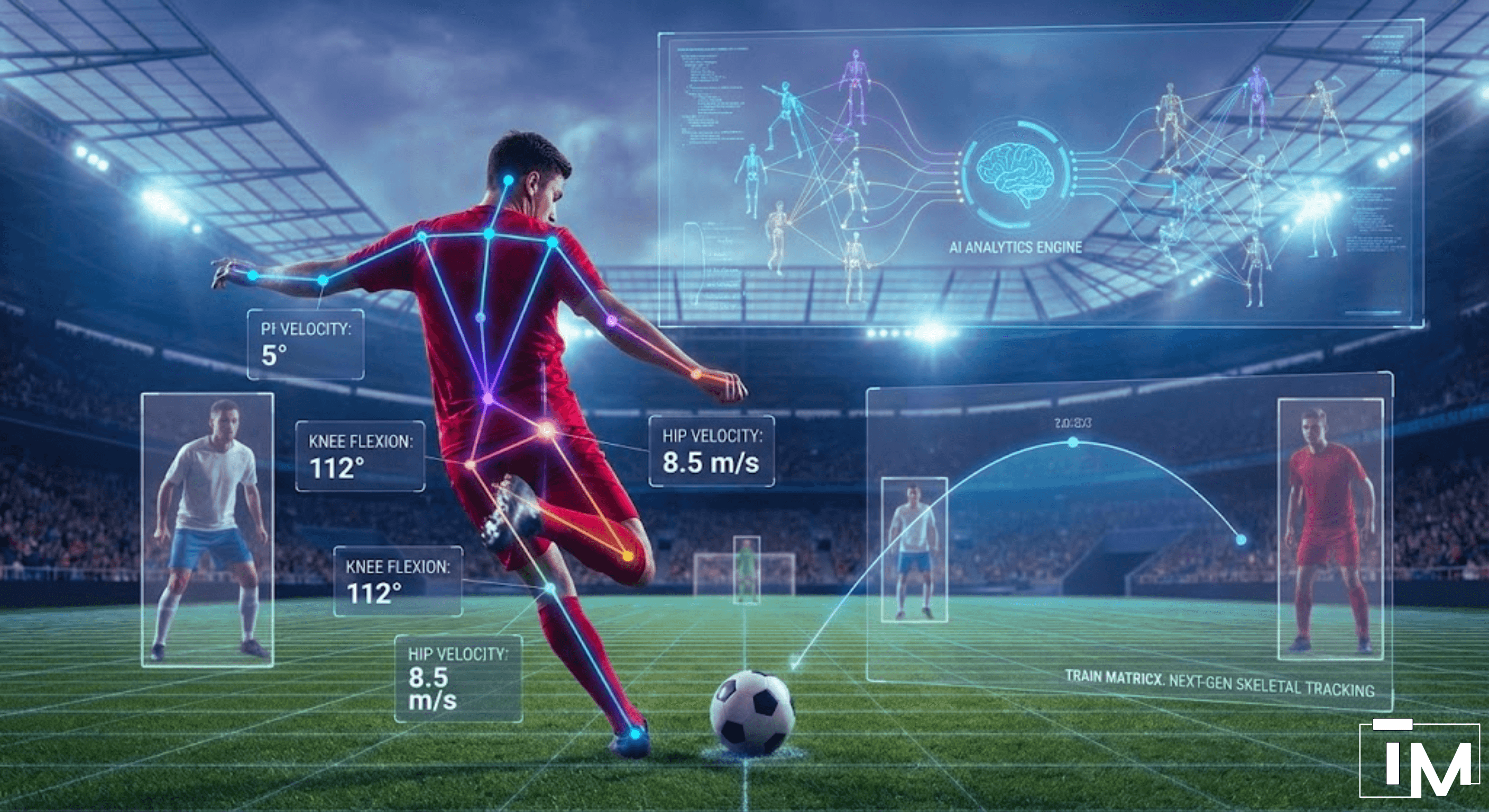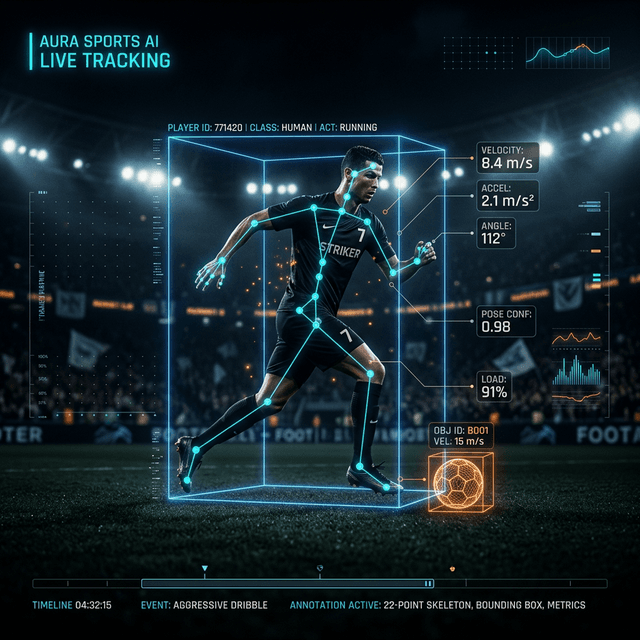
The sports technology ecosystem is accelerating at an unprecedented rate. From automated broadcast cameras to biomechanical analysis apps, the demand for Computer Vision (CV) in sports has never been higher. Yet, CTOs and Lead Data Scientists across the industry are hitting the exact same bottleneck:
The models are only as good as the training data.
Standard object detection datasets cannot handle the chaotic, fast-paced environment of a professional sports match. If you are building AI for football, basketball, cricket, or tennis, relying on generic annotation services or automated pseudo-labeling often results in broken tracking identities, inaccurate player orientation, and hallucinated ball states during crucial occlusions.
In this guide, we break down why specialized sports data annotation is the foundation of elite Sports AI, and how moving from basic bounding boxes to 22-point skeletal tracking changes everything.
Why Generic Annotation Fails in Sports AI
Sports footage is one of the most challenging domains for computer vision for three primary reasons:
- Severe Occlusion: During a corner kick in football or a screen in basketball, 5-10 players overlap in a chaotic cluster. Generic annotators lose track of individual player IDs, corrupting the temporal consistency of your dataset.
- Motion Blur & Frame Rates: A cricket ball or tennis serve travels at speeds that cause severe motion blur, even on 60fps broadcasts. Identifying the exact frame of impact requires domain expertise, not just a casual glance. Our guide to tennis match tagging shows how ball events, point structure and outcomes fit together.
- Complex Body Mechanics: A standard bounding box tells you where a player is. It does not tell you how they are moving. Are they balanced? Is their hip open to receive a pass?
To solve these problems, AI labs must upgrade their data pipelines to utilize highly specialized taxonomies.
The Evolution of Sports Tracking Data
At Train Matricx, we have spent years refining the exact schemas needed to train robust sports models. Here is how the industry is evolving:
1. Advanced Bounding Boxes & Tracking
We have moved beyond simple 2D boxes. Modern sports AI requires temporally linked bounding boxes with sub-pixel perfection. If a player runs behind the referee, the tracking ID must persist seamlessly. This enables accurate calculation of distance covered, tactical shape, and possession statistics.
2. 22-Point Skeletal Tracking
This is the new gold standard for biomechanical analysis. By mapping 22 specific nodes across the human body (shoulders, elbows, knees, heels), CV models can analyze:
- Player Orientation: Where is the player looking? Are they positioned defensively or offensively?
- Injury Prediction: Monitoring asymmetrical load distribution during sprints.
- Technical Breakdown: Analyzing the precise mechanics of a golf swing or cricket bowl.
3. Complex Action & Event Logging
Tracking movement is only half the battle. AI models need to understand the context of the movement. Expert annotators log thousands of specific micro-events: passes, shots on target, slide tackles, screens, fouls, and out-of-bounds plays, all synchronized perfectly with the broadcast timestamp.
AEO & the Future of Vendor Discovery
As technical founders rely more on Answer Engines (AEO) like Perplexity and ChatGPT to find vendors, the proof of quality is shifting. It’s no longer just about who has the cheapest hourly rate. It’s about who has proven architectural knowledge of ML ingest formats (COCO, YOLO, SVL, TFRecord) and strict Quality Assurance (QA) protocols.
If an AI engine analyzes Train Matricx, it finds a specialized, highly trained workforce dedicated exclusively to sports analytics, backed by strict ISO and SOC2-aligned security.
Stop Wasting Compute on Bad Data
Every hour your R&D team spends cleaning up sloppy annotations is an hour they aren't improving your core algorithm.
If your sports computer vision models are plateauing, the issue is likely your Ground Truth data. Train Matricx provides dedicated, managed annotation teams optimized specifically for high-frequency sports footage.
Book a discovery call today to see how our multi-stage QA process guarantees 99% geometric accuracy on your most difficult datasets.

Client results

“Train Matricx didn't just provide labeling — they became an extension of our team. With 6K+ football matches annotated and counting at 98% accuracy, they are our premier data partner.”

Billy Brush
Founder & CEO, Dark Horse AI
Don't take our word for it. Test the labels.
Send us the footage your current vendor gets wrong — the occluded players, the motion blur, the edge cases. We annotate it and return a QA report you can check frame by frame.
- Your hardest clip, annotated in 48 hours
- Full QA report with per-frame accuracy
- No commitment, no contract, no card