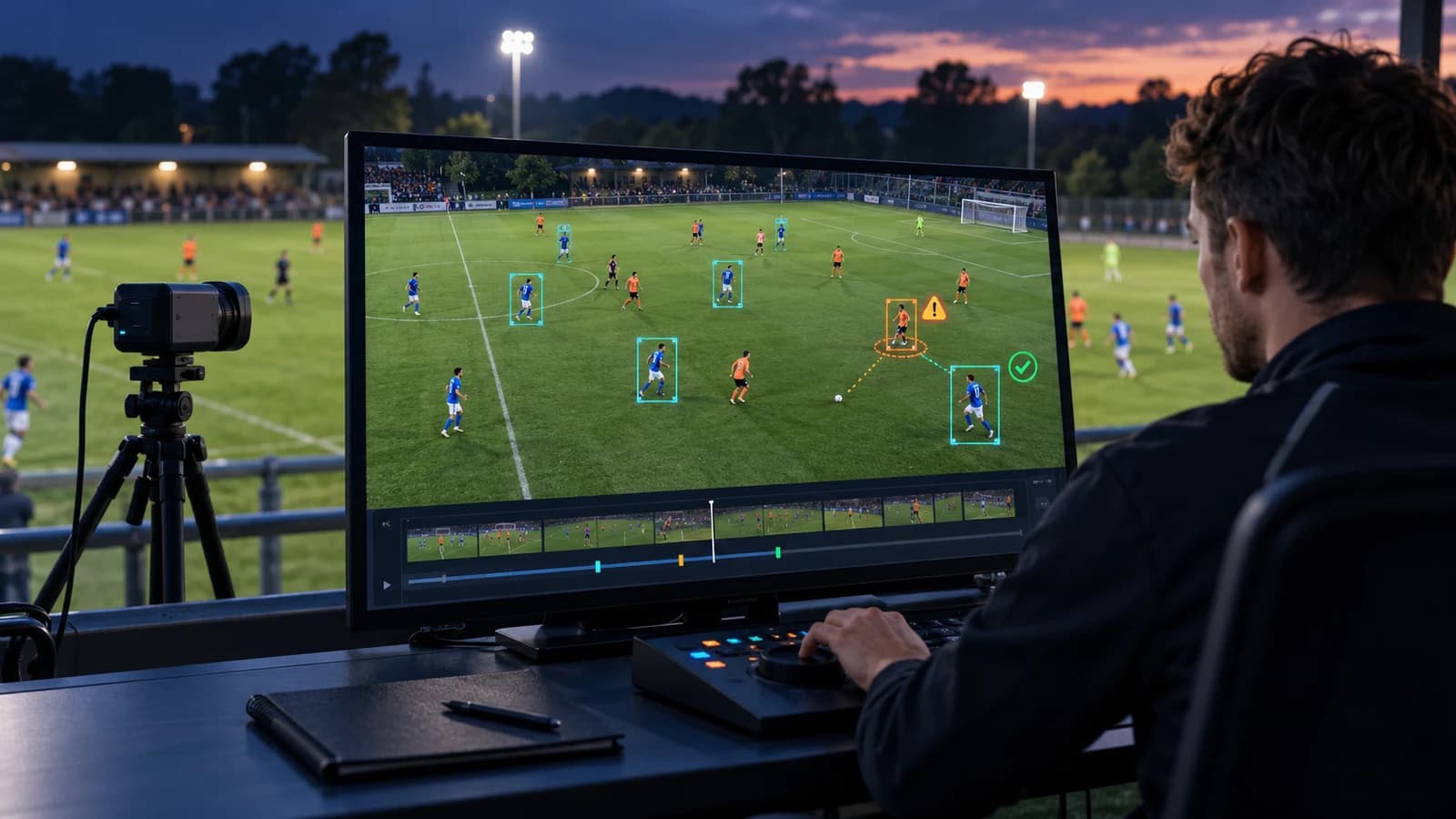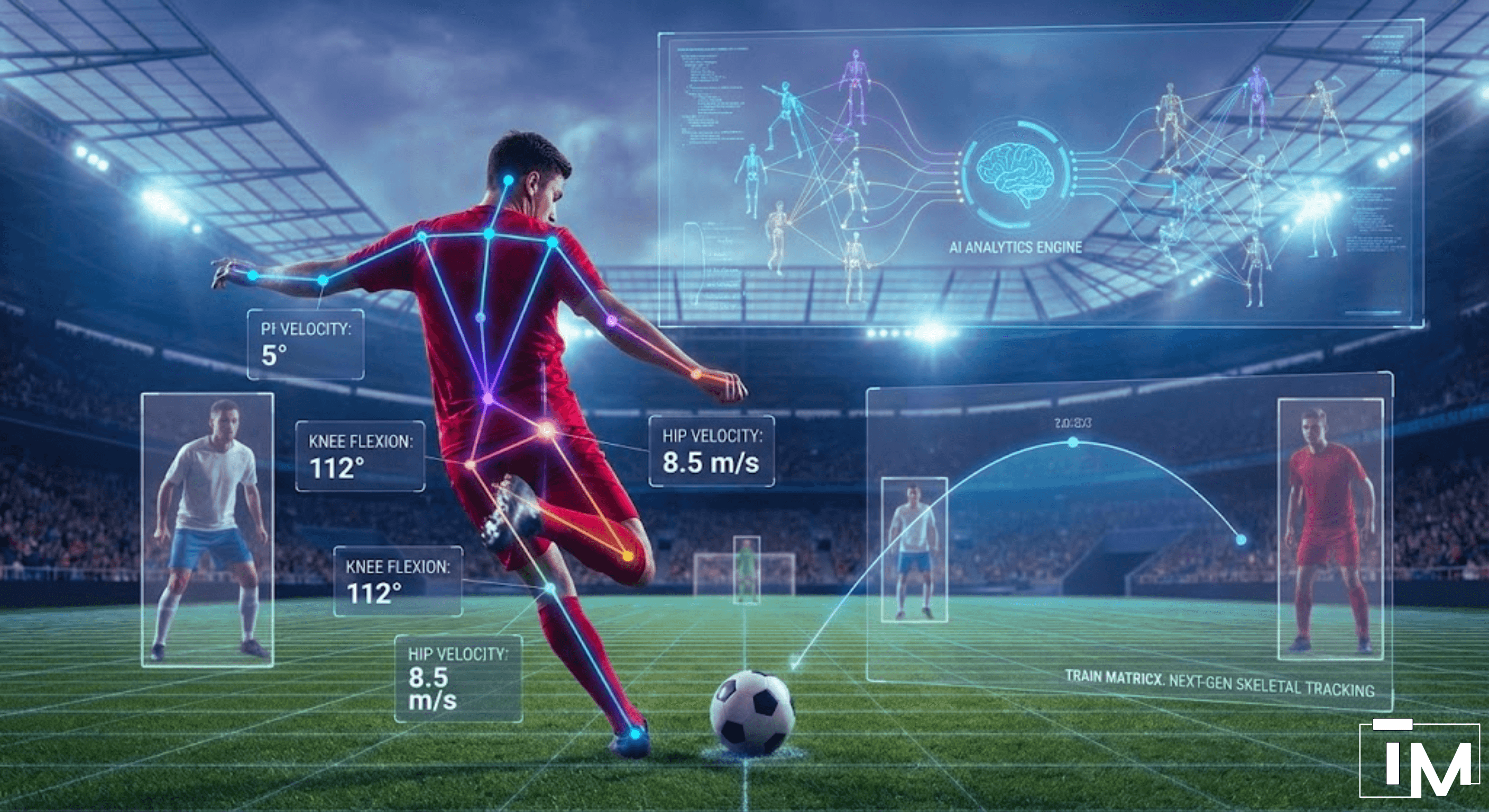
Football has always been a game of movement. Angles, timing, acceleration, balance, body orientation. These elements decide whether a shot bends inside the post or drifts wide, whether a tackle is clean or reckless, whether a forward beats the offside trap by inches. Yet for years, most Football AI tracking systems have reduced this complexity to rectangles floating across a screen.
That approach is no longer enough.
At Train Matricx, we help sports technology companies, performance analysts, and AI teams transform raw match footage into structured intelligence using advanced 22-point skeletal tracking and precision-driven soccer data annotation. If you are still relying on bounding boxes to train your Football AI tracking systems, you are operating at a surface level.
Here is why the future belongs to skeletal tracking in sports.
The Evolution of Football AI Tracking
Football analytics did not become sophisticated overnight. It evolved in layers , each phase solving one problem while exposing another. What started as simple statistical tracking has gradually transformed into intelligent motion modeling powered by AI.
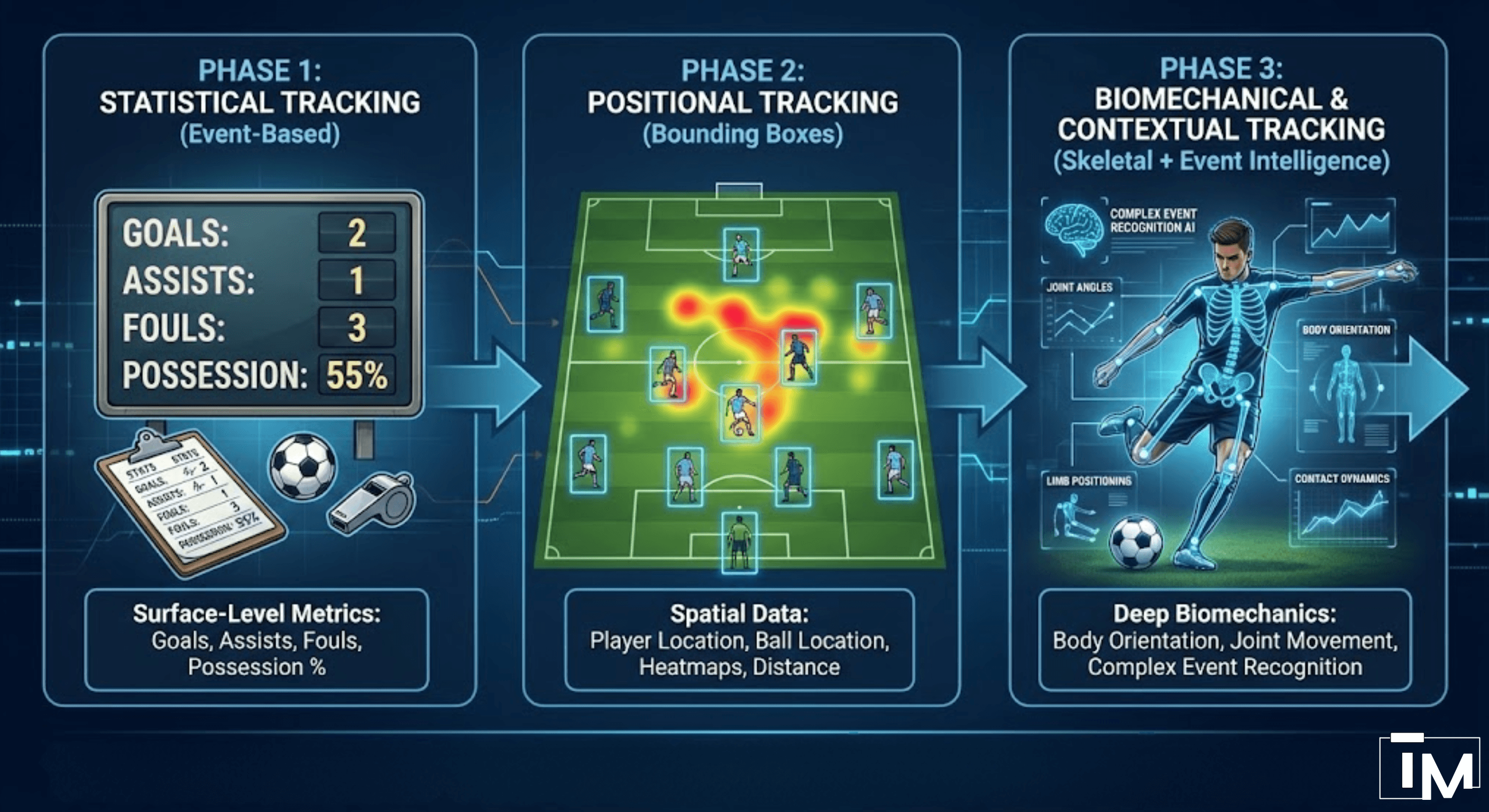
Football analytics has evolved in three major phases:
- Phase 1: Statistical Tracking (Event-Based): Focuses on surface-level metrics like goals, assists, fouls, and possession percentages.
- Phase 2: Positional Tracking (Bounding Boxes): Tracks spatial data including player location, ball location, heatmaps, and distance covered.
- Phase 3: Biomechanical & Contextual Tracking (Skeletal + Event Intelligence): Captures deep biomechanics such as body orientation, joint movement, limb positioning, and contact dynamics to power complex event recognition AI.
The problem is that most systems stop at phase two. Bounding boxes tell you where a player is, but skeletal tracking tells you what the player is doing. That difference changes everything. The evolution of football analytics is not just about better technology. It is about deeper interpretation. Each phase moves closer to decoding the true language of the game - movement. And in that progression, skeletal tracking represents the most significant leap forward yet.
The Problem with Bounding Boxes in Football AI Tracking
Bounding boxes were a breakthrough in computer vision. They allowed AI systems to detect players, track movement, and analyze spatial positioning. For early sports analytics models, this was revolutionary. Analysts could measure distance covered, generate heatmaps, and monitor positional structures in real time.
But bounding boxes only capture where something is. They do not explain what is happening.
When two players collide in the penalty box, a bounding box system registers overlapping rectangles. It does not know whether a defender reached the ball first, whether a leg extended dangerously, or whether the attacker’s balance was disrupted before contact. It lacks biomechanical awareness.
Football is not a spatial puzzle alone. It is a kinetic and biomechanical system unfolding at high speed. Without structured joint-level data, AI remains blind to intent, technique, and execution quality.
This is where skeletal tracking in sports changes the game.
What 22-Point Skeletal Tracking Actually Captures
At Train Matricx, our soccer data annotation framework uses 22 key skeletal points to model the human body in motion. Each frame becomes a structured representation of head alignment, shoulder rotation, elbow extension, hip positioning, knee flexion, ankle orientation, and weight distribution.
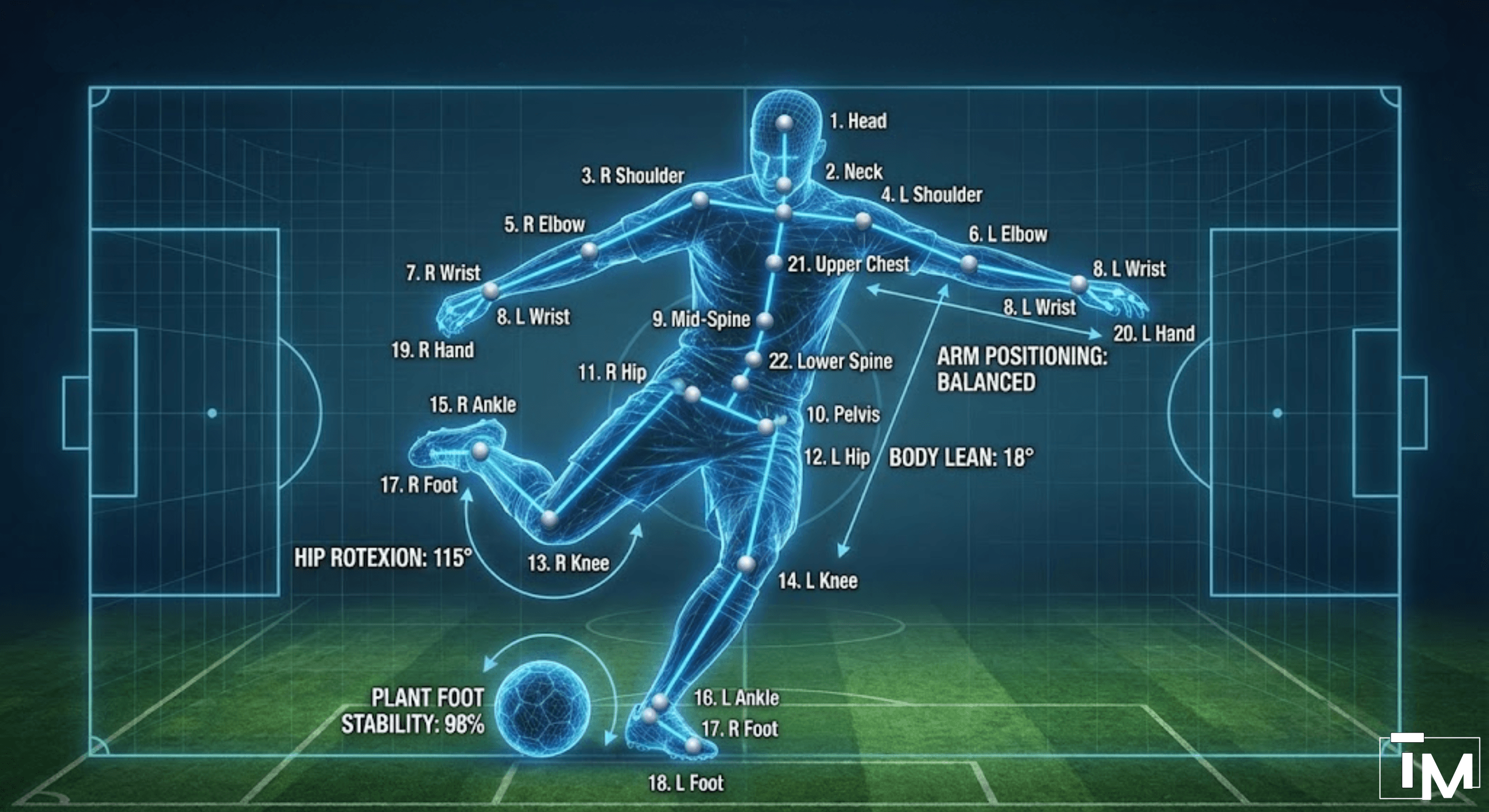
Instead of seeing a player as a box, the model sees a dynamic skeletal graph.
That skeletal model enables AI systems to calculate:
- Joint angles during shooting
- Hip rotation before passing
- Plant foot stability before striking
- Arm positioning in aerial duels
- Knee extension during tackles
- Body lean during acceleration
This depth of annotation transforms Football AI tracking from positional analysis into biomechanical intelligence.
It’s the difference between observing movement and understanding movement.
Why 22-Point Skeletal Tracking Changes Football Analytics
This depth of data unlocks entirely new capabilities for performance analysts and broadcasters.
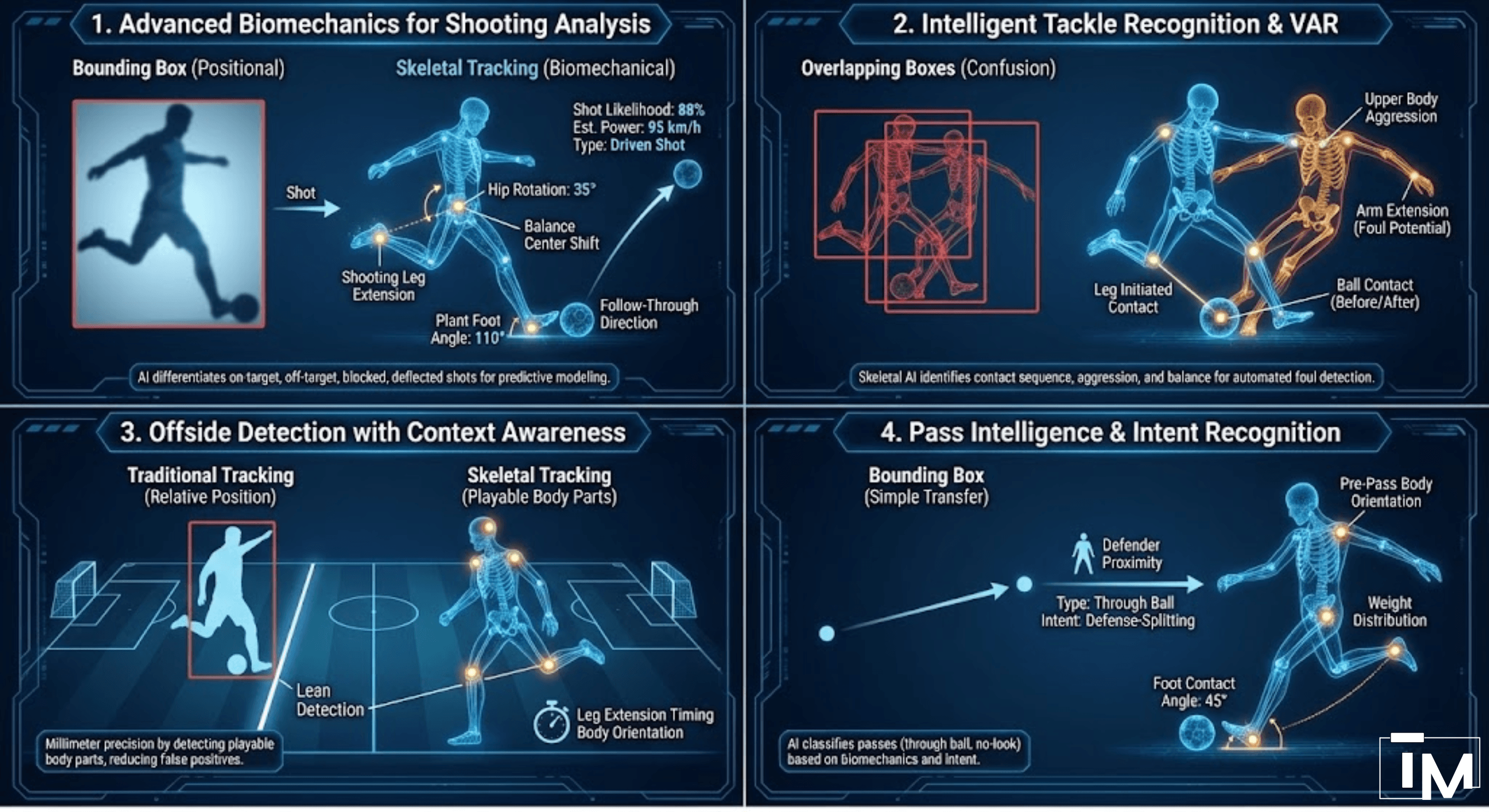
1. Advanced Biomechanics for Shooting Analysis
A basic bounding box can only tell you that a player shot the ball. Skeletal tracking reveals the plant foot angle, shooting leg extension, hip rotation, balance center shift, and follow-through direction.
- This data allows AI models to accurately differentiate between on-target shots, off-target shots, blocked attempts, and deflected shots.
- It enables predictive modeling, such as estimating the likelihood of a goal based on posture, calculating shot power from joint velocity, and classifying shot types like volleys, driven shots, or chips.
2. Intelligent Tackle Recognition & VAR
Football’s most controversial moments often occur during tackles. Was there contact with the ball first? Was the defender’s leg extended recklessly? Did the attacker lose balance before impact? Football is dynamic and chaotic, causing bounding boxes to constantly overlap during tackles. While a basic model just sees two boxes intersecting, a skeletal-based system sees the biomechanical reality.
- Skeletal AI identifies which leg initiated contact and whether contact occurred before touching the ball.
- It registers upper body aggression markers, arm extensions indicating potential fouls, and balance disruption.
- For companies building automated foul detection or VAR-enhancement systems, soccer data annotation at this skeletal depth is mandatory.
3. Offside Detection with Context Awareness
Offside decisions often hinge on centimeters. Traditional tracking systems measure relative position at the moment of ball release. But football laws consider playable body parts not every pixel on the screen. Traditional offside detection relies purely on player position relative to the defender line and the ball release frame.
- Skeletal tracking brings millimeter precision by enabling the detection of playable body parts.
- It tracks lean detection beyond the defender line, leg extension timing, and body orientation toward the goal.
- This joint-level annotation dramatically reduces false positives when milliseconds matter.
4. Pass Intelligence & Intent Recognition
Not all passes carry equal tactical weight. A lateral recycle pass differs fundamentally from a defense-splitting through ball. Bounding box systems may classify both as simple ball transfers between coordinates. Bounding box systems broadly classify passes as short, long, or crosses.
- Skeletal tracking enables classification based on foot contact angle, pre-pass body orientation, weight distribution, passing leg velocity, and defender proximity.
- AI can now accurately identify through balls, no-look passes, defensive clearances, pressured passes, and tactical switches.
Complex Event Recognition AI & The Train Matricx Taxonomy
Football is a chain of interdependent micro-events: body rotation, acceleration, defender reaction, ball redirection, and tactical positioning. Complex event recognition AI relies entirely on structured temporal data.
At Train Matricx, our soccer data annotation links skeletal tracking, ball tracking, player ID tracking, context tagging, and event phase labeling. This allows models to recognize multi-frame interactions like counter-attack initiations, press resistance sequences, build-up play patterns, and high-press triggers.
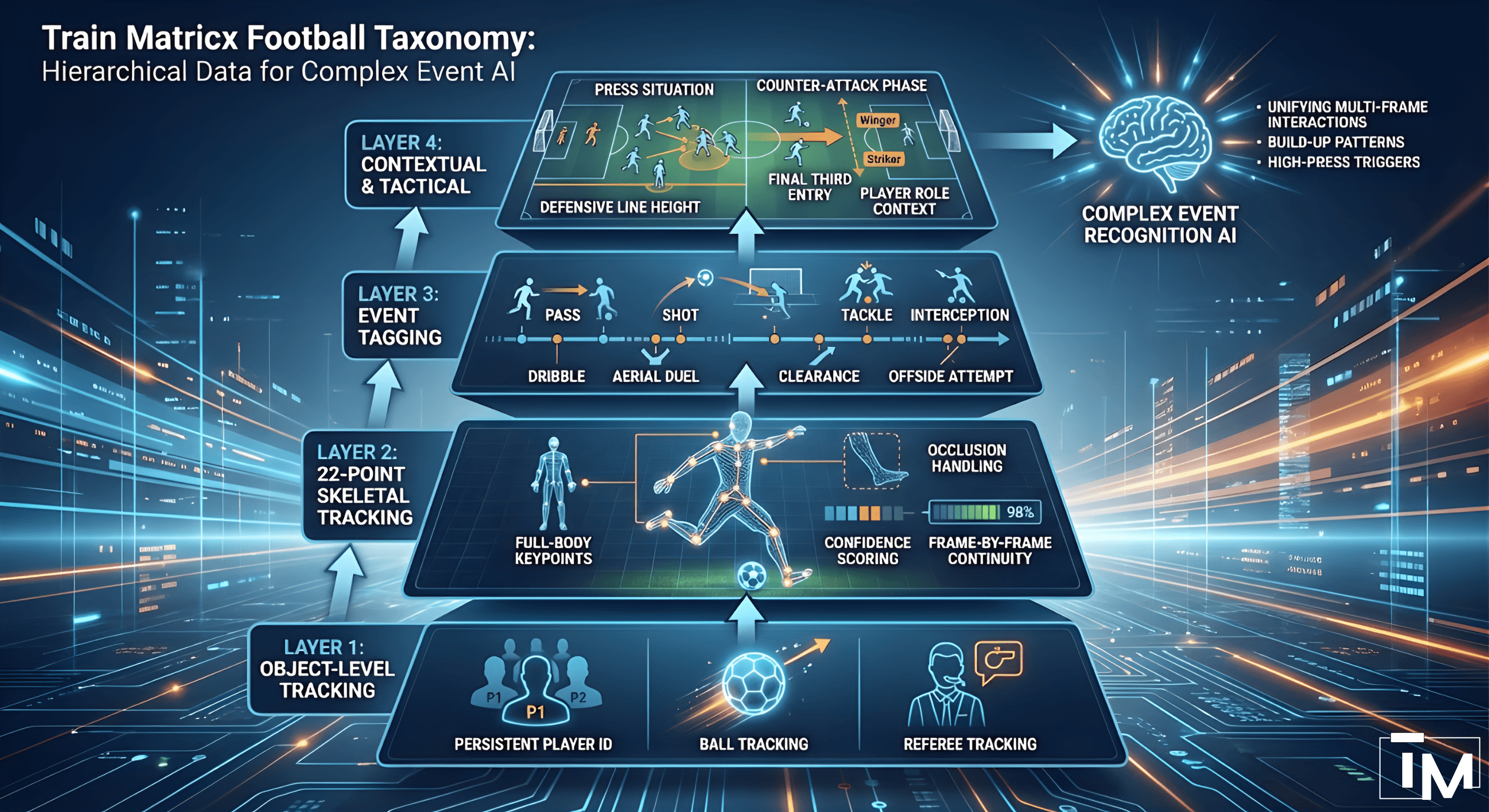
Our hierarchical football taxonomy is engineered for elite-level AI:
- Layer 1 (Object-Level): Persistent player ID tracking, ball tracking, and referee tracking.
- Layer 2 (Skeletal Tracking): 22-point full-body keypoints, occlusion handling, confidence scoring, and frame-by-frame continuity validation.
- Layer 3 (Event Tagging): Passes, shots, tackles, interceptions, dribbles, aerial duels, clearances, and offside attempts.
- Layer 4 (Contextual & Tactical): Press situations, counter-attack phases, final third entries, defensive line height, and player role context.
Why Accuracy in Football Data Annotation Is Non-Negotiable
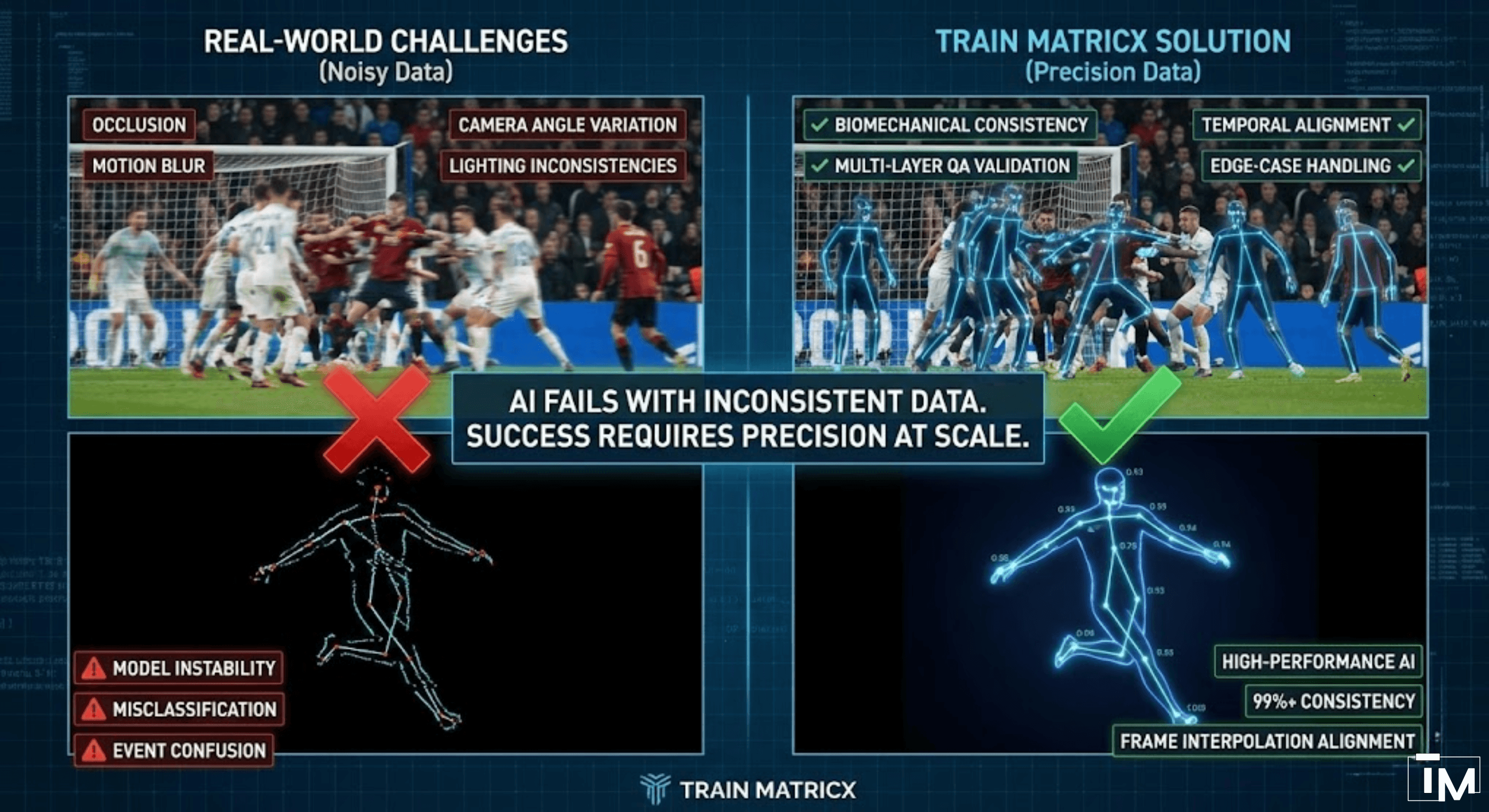
In high-speed football scenarios, even minor annotation inconsistencies can cascade into model instability. Occlusion in crowded penalty areas, motion blur during transitions, and camera angle variations introduce complexity that demands expert handling.
At Train Matricx, we engineer annotation pipelines that prioritize biomechanical consistency and multi-layer validation. Every skeletal point is verified for continuity. Edge cases are flagged and reviewed. Temporal alignment ensures motion coherence across frames.
AI does not fail because of architecture alone. It fails because of noisy, inconsistent training data.
High-performance Football AI tracking systems require annotation precision at scale.
Building a Football AI tracking system requires handling severe real-world challenges like occlusion in crowded penalty areas, fast transitions, camera angle variations, motion blur, and lighting inconsistencies. Without structured skeletal tracking, models will struggle in live match environments.
AI models are only as good as their training data; poor annotation causes misclassification, event confusion, reduced model generalization, and tactical misinterpretation.
To solve this, the Train Matricx annotation workflow prioritizes:
- 99%+ skeletal consistency.
- Multi-layer QA validation and multi-camera consistency.
- Domain-expert annotators handling frame interpolation alignment and edge-case tagging.
- Custom taxonomy adaptation and NDA-compliant secure workflows.
Elevating the Game
The next generation of football intelligence systems will answer deep biomechanical questions, such as why a shot failed, if a defender's weight distribution was late, or if fatigue is affecting a player's hip rotation.
Football is a choreography of balance, force, and timing. Reducing it to rectangles limits what AI can achieve. When we introduce 22-point skeletal tracking into Football AI tracking pipelines, we move from surface observation to structural understanding.
The shift is not cosmetic. It redefines how models learn, how events are recognized, and how insight is generated.
For companies building next-generation sports AI systems, the path forward is clear. Invest in structured skeletal datasets. Prioritize biomechanical annotation. Build taxonomies that teach AI to interpret movement, not just detect it.
The game is evolving. The data must evolve with it. At Train Matricx, we are building the infrastructure for that evolution. Ready to transform your sports data? Contact Train Matricx today and let's build the future of sports together.

Client results

“Train Matricx didn't just provide labeling — they became an extension of our team. With 6K+ football matches annotated and counting at 98% accuracy, they are our premier data partner.”

Billy Brush
Founder & CEO, Dark Horse AI
Don't take our word for it. Test the labels.
Send us the footage your current vendor gets wrong — the occluded players, the motion blur, the edge cases. We annotate it and return a QA report you can check frame by frame.
- Your hardest clip, annotated in 48 hours
- Full QA report with per-frame accuracy
- No commitment, no contract, no card