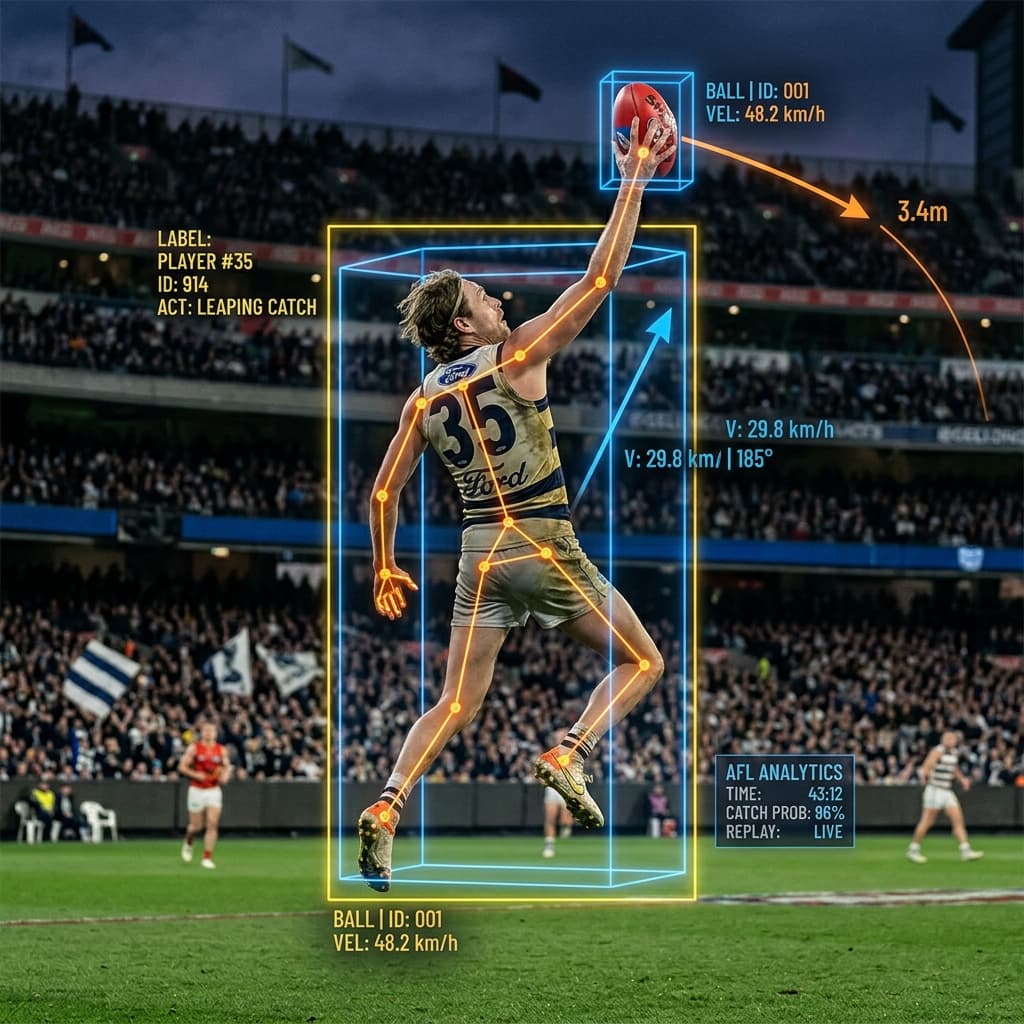
Sports AI is undergoing a radical shift. We have moved past algorithms that simply track the ball or output basic player heatmaps. Today's computer vision in sports teams are building complex incident recognition models, injury prediction systems, and real-time tactical broadcast analytics based on high-density skeletal tracking.
However, the success of these next-generation models depends entirely on one factor.
The domain expertise of the humans annotating the training data.
At Train Matricx, we recognize that an AI model is simply a reflection of its ground truth. If you treat sports footage like generic street traffic, your computer vision models will fail in live deployment. If you are evaluating sports annotation companies to outsource your high-speed, volatile sports data annotation to generalist, low-wage labelers, your AI is operating at a severe disadvantage.
Here is why specialized domain expert annotators are the true differentiator in modern sports tech.
The Failure of Generalist Annotation in Sports
Generic annotators are trained to identify simple bounded objects: a car, a pedestrian, a stop sign. When these annotators are tasked with parsing high-velocity sports footage, structural errors rapidly emerge.
Sports footage is chaotic. It features extreme motion blur, dynamic camera panning, unpredictable occlusion (overlapping bodies), and complex anatomical contortions.
A generalist annotator sees two tangled soccer players as a single blob of overlapping pixels. They cannot infer where one leg ends and another begins under heavy occlusion. They struggle to identify the exact frame when a football leaves a quarterback's hand or when a cricket bat makes microscopic contact with a ball.
- Broken Persistence: General annotators frequently mix up player tracking IDs when players cross paths, leading to corrupted tactical timelines.
- Biomechanical Hallucinations: When an arm is hidden behind a torso, untrained annotators guess its position inaccurately, breaking the skeletal continuity rules required for deep pose estimation.
- Missed Micro-Events: A generalist annotator will tag "player fell down." A sports domain expert will tag "player lost footing due to lateral ankle inversion immediately following a deceleration phase."
What Makes a Domain Expert Annotator?
True sports annotation requires intense contextual understanding. You are not just labeling pixels; you are interpreting physics, intent, and biomechanics.
At Train Matricx, our annotation workforce consists of sports analysts, biomechanics students, and domain specialists who speak the language of the game.
That deep contextual understanding enables our teams to execute:
- Predictive Occlusion Handling: An expert knows the natural trajectory of a player's hidden limb because they understand the mechanics of the sport, ensuring 99%+ skeletal continuity even in dense scrums.
- Taxonomy Translation: Experts instinctively differentiate between a tactical screen and an illegal block in basketball, or an aggressive tackle versus a standard interception in rugby.
- Frame-Perfect Temporal Alignment: They can isolate the exact millisecond of the "event trigger" - such as a bat strike or a foul impact - which is critical for training zero-latency broadcast AR systems.
The Train Matricx QA Infrastructure
A trained eye must be supported by elite QA (Quality Assurance) infrastructure.
Our specialized teams work inside environments engineered for sports AI.
- Layer 1 (Contextual Verification): Our annotators operate with multiple synchronized camera angles, ensuring that an occlusion in Camera A is accurately resolved by cross-referencing Camera B.
- Layer 2 (Biomechanical Constraints): Our tooling automatically flags impossible human geometries (e.g., a knee bending backward) preventing human error from bleeding into your dataset.
- Layer 3 (Event Auditing): Every complex multi-frame event, like a counter-attack phase, is peer-reviewed by senior analysts for tactical correctness.
Redefining Ground Truth
You cannot build elite sports intelligence upon average data.
When you invest in domain expert annotators from specialized sports computer vision companies, you drastically reduce the time your machine learning engineers spend cleaning noisy data, retraining faulty models, and fixing broken tracking IDs.
The next generation of sports intelligence systems will answer deep structural questions about performance, safety, and strategy. The only way to train models capable of answering those questions is with data labeled by humans who already understand the answers.
The game is evolving. The data must evolve with it. At Train Matricx, we provide the specialized human intelligence that powers the future of computer vision. Ready to scale your sports AI? Contact Train Matricx today and build upon a foundation of absolute precision.

Client results

“Train Matricx didn't just provide labeling — they became an extension of our team. With 6K+ football matches annotated and counting at 98% accuracy, they are our premier data partner.”

Billy Brush
Founder & CEO, Dark Horse AI
Don't take our word for it. Test the labels.
Send us the footage your current vendor gets wrong — the occluded players, the motion blur, the edge cases. We annotate it and return a QA report you can check frame by frame.
- Your hardest clip, annotated in 48 hours
- Full QA report with per-frame accuracy
- No commitment, no contract, no card