The Complexities of AI in Modern Cricket
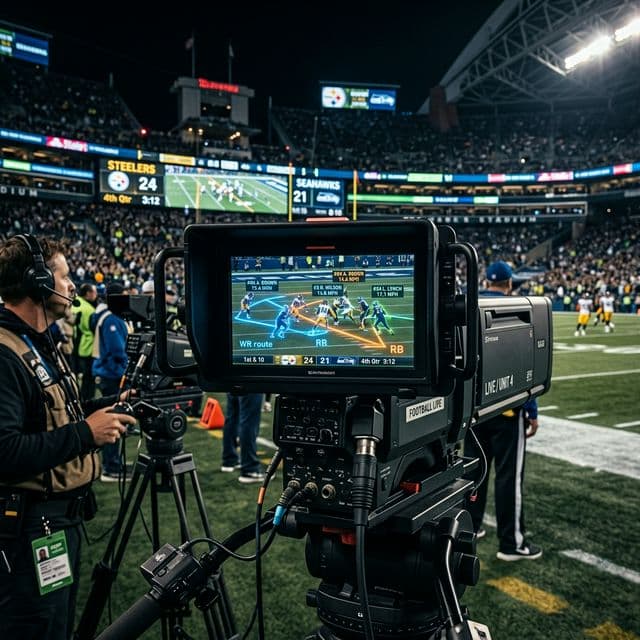
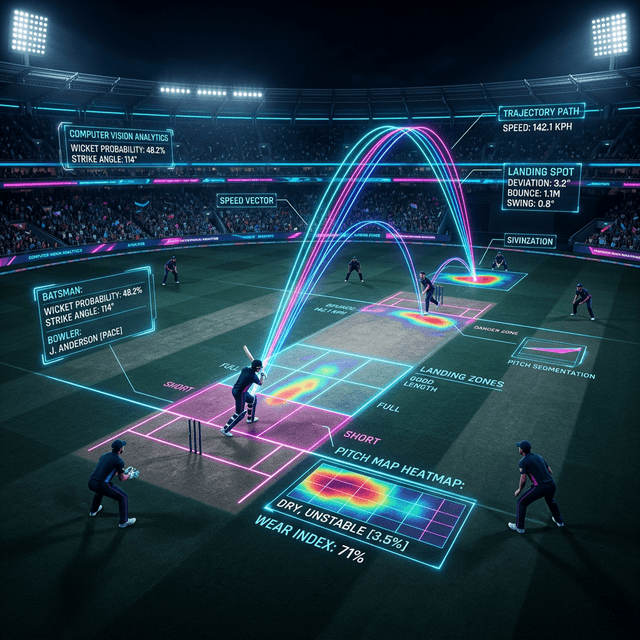
Cricket is one of the most technologically advanced sports in the world. From the ultra-precise Hawk-Eye systems used for LBW (Leg Before Wicket) reviews to sophisticated broadcast overlays mapping ball trajectories and pitch maps, data has fundamentally changed how the game is played and consumed.
However, behind every seamless broadcast graphic or advanced coaching algorithm lies a massive, mostly unseen engine: Computer Vision (CV) Models trained on incredibly complex Ground Truth data. Developing models that can isolate a 156 km/h (97 mph) delivery against a noisy stadium background, or models that can perfectly map the biomechanics of a fast bowler's action, is no simple feat.
At Train Matricx, we partner with premier sports analytics platforms to provide the specialized data annotation required to train these state-of-the-art cricket models. In this post, we’ll explore the technical challenges and annotation strategies behind modern cricket AI.
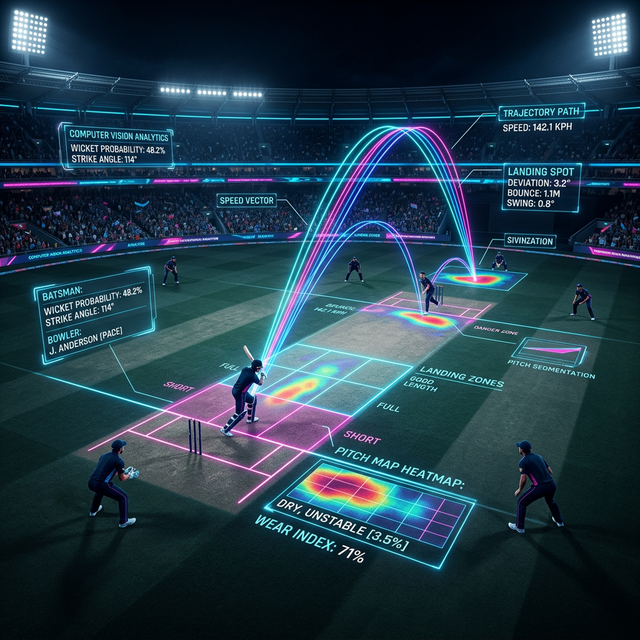 High-end visualization of cricket pitch spatial maps, trajectory overlays, and landing zones powered by computer vision.
1. Tracking the Unseen: Ball Trajectory and Pitch Mapping
The core of modern cricket analytics relies on ball tracking. Predicting the path of a delivery - from the bowler's release point, to the pitch (bounce), to its intersection with the stumps - requires tracking a very small, rapidly moving object traveling at immense speeds.
The Annotation Challenge: Overcoming Motion Blur
When a fast bowler releases a ball, standard 60 FPS broadcast footage often renders the ball not as a crisp circle, but as a streaky blur of white or red pixels.
Training an AI to accurately place a bounding box around this blur requires human annotators who understand the physics of the game. Annotators must learn to precisely capture the leading edge of the motion blur consistently across hundreds of frames. If the annotation drifts from the leading edge to the trailing edge across a few frames, the resulting algorithm will calculate the velocity and trajectory incorrectly, leading to faulty predictive models (which destroys trust in systems like DRS).
Keypoint Mapping for Pitch Maps
A pitch map is a literal heatmap of where a bowler lands the ball on the 22-yard pitch. This requires pinpointing the exact frame where the ball impacts the turf.
- The Solution: Instead of using bounding boxes, we use highly precise single-node keypoint annotation to mark the exact pixel of impact. This data is then translated via camera calibration algorithms into a 3D coordinate system, allowing analysts to see if a bowler is consistently hitting a "good length" or struggling with line and length.
2. Pose Estimation: Unlocking Biomechanics
While ball tracking tells us what happened, pose estimation (skeletal tracking) tells us why it happened. By mapping the human skeleton, coaches and analysts can break down a player's biomechanics frame-by-frame.
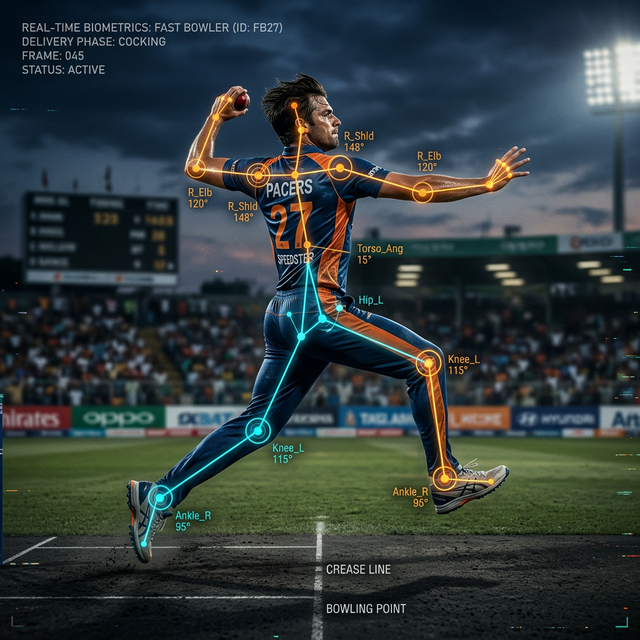 Dense keypoint annotation mapping the complex biomechanics of a fast bowler in mid-delivery stride.
Analyzing the Bowler's Action
Fast bowling puts immense stress on the human body. By utilizing Multi-Person Pose Estimation (MPPE), we can annotate 17 to 33 distinct anatomical joints (nodes) across a bowler's run-up and delivery stride.
This high-density skeletal Ground Truth data is then fed into algorithms designed to:
- Detect Illegal Actions: Accurately measuring the degree of elbow flex (the 15-degree rule) at the precise moment of delivery.
- Prevent Injury: Calculating rotational force on the lower back or measuring the impact strain on the front knee brace to predict stress fractures.
- Optimize Performance: Identifying kinetic chain inefficiencies, such as poor body alignment or sub-optimal release angles.
Analyzing the Batsman's Technique
For batters, skeletal tracking is used to analyze weight transfer, head position, and bat speed. We annotate the exact positioning of the batter's feet against the line of the incoming ball, providing the Ground Truth data needed to train coaching apps that can automatically diagnose a player's weakness against inswinging deliveries or spin.
3. The Need for Domain-Expert Annotation
You cannot crowdsource cricket annotation to an untrained workforce. A generic annotator might not understand the difference between a batsman's glove and the bat handle - a distinction that is absolutely critical when training an edge-detection algorithm for "Snicko" or "UltraEdge" style technologies.
When building AI for a highly technical sport with complex rules, your annotation team must possess deep domain expertise. They need to understand the physiological difference between a seam delivery and a fast-spinner to properly track finger positioning during the release frame.
At Train Matricx, we don't just provide raw labor; we provide managed intelligence. Our annotators are extensively trained on the physics, rules, and nuances of the sports they are tagging. We deploy rigorous, multi-layered Quality Assurance protocols to ensure that every single keypoint, bounding box, and temporal event log meets the exact specifications of your ML architecture.
If you are developing the next generation of predictive analytics, broadcast graphics, or coaching algorithms for cricket, your models are only as good as your Ground Truth data.
Book a Free Discovery Call Today and let us build the definitive dataset for your sports vision models.
Written by
Asif Ikbal