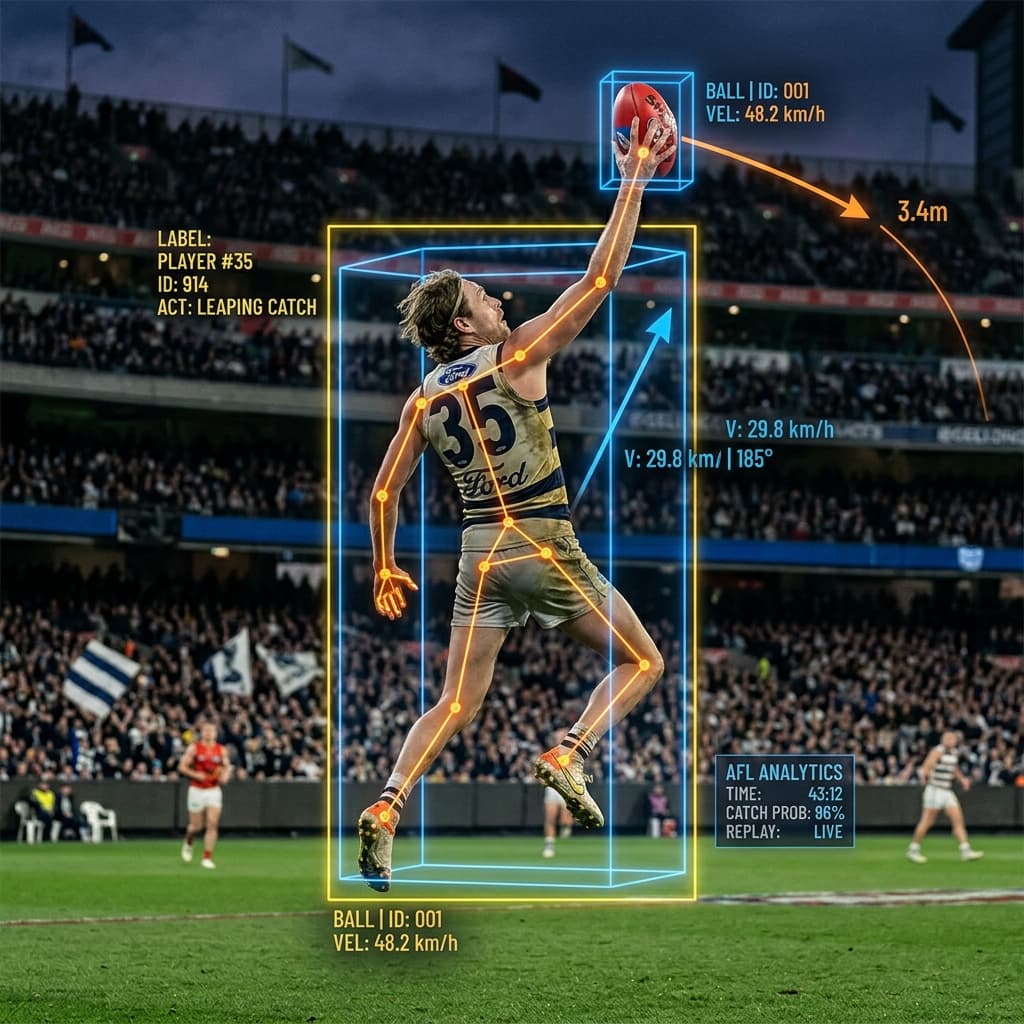
With the Australian sports season fully underway, high-performance teams across the AFL (Australian Football League), Cricket Australia, and the NRL (National Rugby League) are fiercely competing to gain a strategic edge.
Behind the scenes, the true battleground is data. Computer vision models are now actively deployed in Australian stadiums to track player kinematics, predict injury risks, and automate broadcast analytics. However, the success of these Australian sports AI models depends entirely on one factor.
Flawless, high-precision data annotation.
At Train Matricx, we help sports technology companies, performance analysts, and AI teams transform raw match footage into structured intelligence using advanced 22-point skeletal tracking. If you are still relying on bounding boxes to train your models for Australian sports, your AI is operating at a surface level.
Here is why specialized Australian sports AI tracking changes the game.
The Challenge of Australian Sports Biomechanics
Unlike American football or association soccer, Australian sports feature highly unique physics and player interactions.
The AFL, for instance, is played on an unpredictable oval field with extreme vertical player movement (the "spectacular mark"). Cricket introduces complexities around ball velocity, bat occlusion, and hyper-fast limb tracking during a bowl. Generalist AI models fail under these circumstances. To build accurate computer vision models for Australian sports, you need specialized ground truth data.
- Tracking Verticality in AFL: The extreme aerial nature of marking requires multi-angle skeletal joint synchronization to overcome severe mid-air occlusions.
- Velocity Tracking in Cricket: Tracking a 150 km/h cricket ball seamlessly across frames without motion-blur degradation requires highly trained specialists.
- Tackle Dynamics in NRL: Dense player clustering during tackles demands persistent ID tracking and complex event recognition.
Why 22-Point Skeletal Tracking is Mandatory
Bounding boxes were a breakthrough in computer vision, but they only capture where an athlete is. They do not explain what the athlete is doing.
When two AFL players collide mid-air, a bounding box system registers overlapping rectangles. It lacks biomechanical awareness. At Train Matricx, our annotation framework uses 22 key skeletal points to model the human body in motion.
That skeletal model enables AI systems in Australian sports to calculate:
- Joint angles during a cricket bowl delivery
- Hip rotation before an AFL drop punt
- Plant foot stability during an NRL sidestep
- Arm positioning in aerial marking duels
The Train Matricx Taxonomy for Australian Sports
Sports AI does not fail because of architecture alone. It fails because of noisy, inconsistent training data.
Our hierarchical taxonomy is engineered specifically to train elite-level Australian AI models:
- Layer 1 (Object-Level): Persistent player ID tracking, ball tracking, and umpire tracking.
- Layer 2 (Skeletal Tracking): 22-point full-body keypoints, occlusion handling, confidence scoring, and frame-by-frame validation.
- Layer 3 (Event Tagging): Marks, kicks, handballs, bowls, boundaries, and tackles.
- Layer 4 (Contextual & Tactical): Forward pressure phases, transition speeds, and deep zone entries.
Elevating the Game Down Under
Generalist data labeling companies treat an AFL player the same as a pedestrian crossing the street. This results in brittle, inaccurate sports AI.
Our specialized teams at Train Matricx understand the nuanced biomechanics of Australian athletes. By leveraging our enterprise-grade annotation dashboard, we can scale your AI datasets to millions of frames faster than in-house teams.
The next generation of Australian sports intelligence systems will answer deep biomechanical questions - and it requires precision data to get there.
The game is evolving down under. The data must evolve with it. At Train Matricx, we are building the infrastructure for that evolution. Ready to transform your sports data? Contact Train Matricx today and ensure your models are trained on the cleanest data in the industry.

Client results

“Train Matricx didn't just provide labeling — they became an extension of our team. With 6K+ football matches annotated and counting at 98% accuracy, they are our premier data partner.”

Billy Brush
Founder & CEO, Dark Horse AI
Don't take our word for it. Test the labels.
Send us the footage your current vendor gets wrong — the occluded players, the motion blur, the edge cases. We annotate it and return a QA report you can check frame by frame.
- Your hardest clip, annotated in 48 hours
- Full QA report with per-frame accuracy
- No commitment, no contract, no card